 Netwrck
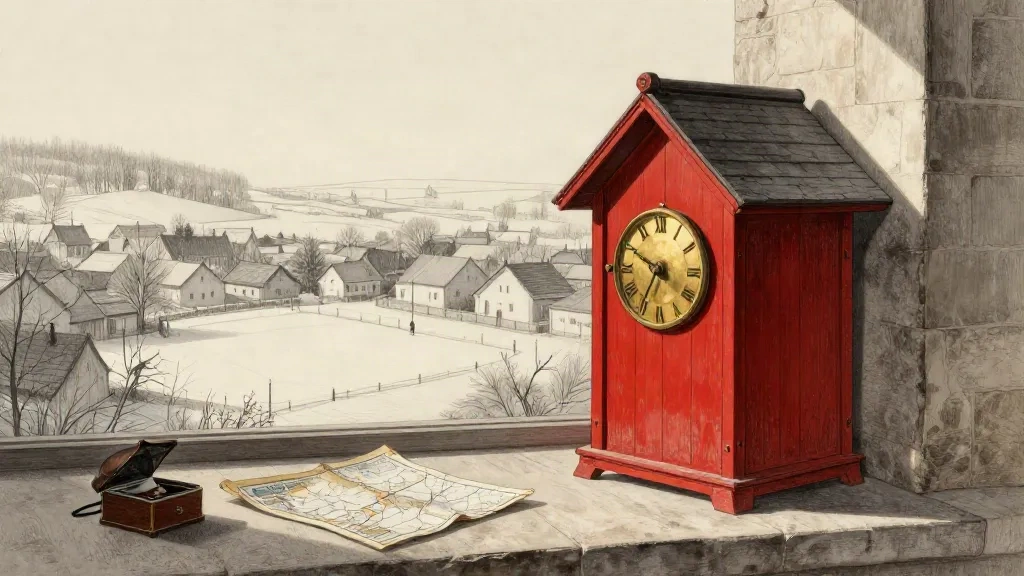
Speculative Fiction.
The Monastery Without an Hour
The clockmakers’ monastery stood on a limestone shelf above the valley, where noon arrived early to the high meadows and dusk sometimes never came.
There, clocks were repaired by agreement rather than gears. A bell marked the hour agreed by the farmers. Water clocks measured intervals between meals. Bells of rope, sand, smoke, and human breath divided the night. In the monastery’s lowest room, thirteen brass clocks had agreed to strike midnight, though midnight had not occurred for nineteen years.
Ilya Venn arrived with a folded map in his coat and a music box wrapped in wool. He had been an actor for forty-two years. The profession had taught him entrances, exits, and the small lies that sustained both. Now his hands shook when he reached for a doorknob.
He could re-enter any room he had ever left. Not return from it, not travel backward through time. If he opened a door he remembered leaving, he stepped into that same room as it had been at the instant of departure. The ability had made him wealthy, then notorious. It had also made him old too quickly, for every remembered room remained alive within him.
His grandfather had once left a room in the monastery’s registry. On the map, that room was marked beside an inked square: RETURN THE BORROWED HOUR.
“Promise me,” Grandfather had said, years before his final illness.
Ilya had promised.
The House That Listened
Behind the dormitory stood a narrow house with red shutters. Its door fit three people abreast, though the building’s single visible wall was no wider than a wardrobe.
The prioress met Ilya in the charcoal courtyard. “It has added nineteen rooms,” she said. “One for every person who entered telling an untruth.”
Ilya unfolded the map. The square denoted not a room but a public place: Venn’s Square, in the village erased during his grandfather’s lifetime.
“He promised to restore an hour the village lent to the monastery,” Ilya said. “The hour has never been returned.”
The prioress looked at the music box, but did not ask about it. She knew what it was. In his final years, Grandfather had wound it once each evening. The melody had eight notes, followed by a ninth click the mechanism could not quite produce.
That evening, Ilya opened the house.
Inside stood the dining hall where he had said he knew Grandfather was dead before the funeral. The map was still in his hand, yet he had crossed out the village name during the war and concealed the change for six years.
A new wall rose ahead of him, brick-red, sweating pale winter light. A doorway opened in it.
Beyond was Venn’s Square.
Stalls stood beneath a white sky. Snow rested on empty market awnings. His grandfather leaned against the fountain, younger than Ilya’s memories of him, holding an hourglass turned downward.
“We came to remove the fountain from the map,” Grandfather said. “But there was still a crowd.”
Ilya looked down. A crowd occupied every doorway, their faces obscured by the folded map I was holding. They had no shadows. Between them, a brass clock struck once.
“Tell the truth,” Grandfather said, “and the room will take you instead of me.”
What the Room Would Not Bear
Ilya almost entered the square.
He had rehearsed the confession all the way from the city. He had decided to mention the actors he had ruined, the company he had stolen, the woman who had waited beneath the same station clock while he left on another train. But the room needed only one lie, and his apology surrounded the original one too closely.
Grandfather extended the hourglass. “You can carry the hour out. Or you can carry me. Not both.”
The house shuddered. A kitchen appeared above the square, then a nursery, then a railway carriage packed with winter passengers. Each wall opened onto a moment in which someone had chosen to pretend.
Inside the carriage, Ilya saw himself at Grandfather’s deathbed. He had promised to return. Then the doctor offered him a sedative, and Ilya had stepped into the corridor to avoid hearing the final silence.
That was the room he had left. Now the carriage swallowed the square.
Grandfather’s face disappeared behind the turning sand.
Then Ilya opened the music box.
Eight notes rang beneath the false winter. On the ninth, he pressed the missing mechanism inward with his thumbnail.
The click broke the measure.
Every clock in the square stopped.
“An hour is not a number of seconds,” Grandfather said. “It is what people rely upon one another to do.”
Ilya understood.
He entered the carriage.
The Door He Left Open
Inside, Grandfather lay still beneath a winter sheet. The doctor waited. Beyond the window, the village burned, though fire had not consumed it.
Ilya did not take the sedative. He went back to the bedside.
“Stay until morning,” Grandfather whispered.
“I’m here,” Ilya said.
The room folded inward. The carriage vanished. The false square returned, quiet beneath its pale sky. Grandfather’s hand closed around his wrist, warm at last.
He did not carry his grandfather out. He carried the hour.
For sixty minutes, nothing in the village changed. Then the bells answered one another down the valley. The market awnings lifted. Fountain water began to run upward into the winter light. Far below, windows opened across the restored square.
Grandford stood beneath them, growing old as clocks moved beneath the walls. He nodded once, understanding that the promise had required neither resurrection nor forgiveness.
“The map,” Ilya said.
It lay open in his hands. The village name had returned.
He folded it carefully and left the square by the door he had entered.
When he reached the courtyard, the music box had stopped. He wound it again. The eighth note sounded, and the mechanism clicked into the ninth place.
Beyond the monastery wall, a clock struck an hour none of them had counted before.





