 Netwrck
Romance.
The Country on Her Hand
Mara first noticed the country when she burned her palm over a faulty seal.
She was apprenticed to Elian, the monastery’s cartographer, in a country whose rivers changed direction between noon and dusk. Its people measured days by meals, weather, and the bells buried beneath hilltops. The clockmakers kept the bells silent. Their brass clocks disagreed so constantly that a promise made at dawn might be due at midnight.
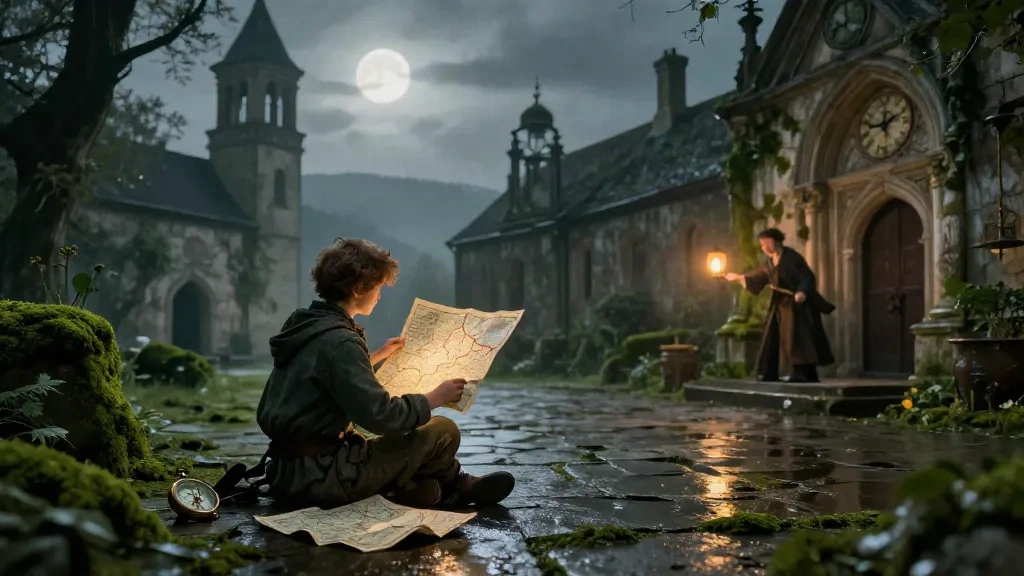
Mara worked in the oldest scriptorium, copying roads that no longer existed. Her left hand lay open on the vellum. A thin green line crossed her wrist, widening beneath the burn into a river. Small hills rose near her thumb. At the center, hidden beneath a translucent blister of skin, a marigold town glowed like a fallen ember.
“That is not a wound,” said Sister Venn.
Mara stared at the tiny roads. “It is a map.”
Venn brought the brass compass Elian had given her, its needle trembling between north and west. “Your master believed every map was a promise the land had forgotten. He drew the land that should exist.”
Mara touched the marigold town. A bell sounded inside her bones.
The Note the Bells Refused
Her mother’s song had always ended on a note Mara could not hear. She remembered the melody from childhood: the sweetness of the first line, the hesitation before its close, the silence afterward. In the village, her mother had said the last note belonged to whoever loved the singer enough to find it.
Mara had believed that was a riddle. Then her mother died, the village disappeared beneath a winter flood, and the melody returned whenever Mara touched the country on her hand.
In the monastery, the clockmakers kept one bell that rang without a hammer. It sounded at unpredictable hours, always beginning with her mother’s melody and stopping before the final note.
“A bell cannot choose its ending,” said Brother Tace.
He waited beside the bell chamber each morning, a lean boy with ink-stained cuffs and a scar through one eyebrow. He had arrived three winters before Mara, claiming to be searching for his sister’s voice. He knew the hidden stair beneath the water clock.
That was why Mara began watching him.
The Rival’s Map
Tace carried no map of the kingdom, only a folded square of blue cloth. Mara saw it once when he fell asleep in the archive. The cloth unfolded into a chart of the monastery, marked with red circles around every clock. One circle surrounded the silent bell.
She took the folded map.
“You are looking for the wrong lost thing,” Tace said, catching her at the archive door. His hand closed around her wrist, below the country on her skin.
“You want the note to restore your sister.”
His face emptied. “I want to know what she became.”
He had heard his sister’s voice inside the bell, trapped between the final note and the next hour. He believed the missing sound was a door. Mara needed it as an ending. They stood on opposite sides of the same locked mechanism.
For three days they traveled together. Tace carried the compass. Mara carried the map. They descended beneath the wet-stone cloister, through a door shaped like a crescent moon, into a chamber where hundreds of gears turned without touching.
The country on her hand warmed against the walls. A road appeared beneath her skin and ended at a tower made of glass.
The Last Measure
The tower was the oldest clock in the country.
Inside, a single pendulum hung above a pool. Its face reflected no room, only a village beneath a green sky. On the far side stood a woman in a red shawl, singing.
Mara knew the song. Tace heard his sister call his name.
“One note can open two doors,” Mara said.
“Or leave both trapped.”
She understood then. The country on her hand was not a map to a hidden place. It was the land waiting to be measured. The final note was not missing because the song was broken. It had been withheld so the land could remain unclaimed.
Mara placed the folded map on the pool. Her own map burned beneath her skin. Tace set the compass beside it.
“If we make it whole,” she said, “we decide what it means.”
They turned the compass together. The pendulum swung. Mara sang, and at the place where the melody ended, she released the note into the glass tower.
It was not loud. It was the small sound of a door opening in a distant room.
On the pool, the village brightened. Her mother stood beneath the green sky, smiling. Tace’s sister stepped from the tower, no longer a voice, only a girl with a clock-key in her palm.
Then Mara felt the country settle beneath her skin. One road remained. It curved toward the marigold town and stopped at a small brass door.
Tace touched it. The compass pointed to her.
“What is it?” he asked.
Mara opened the door.
Inside, a folded map waited on a desk. Written across it in her mother’s hand were two words: Come home.
Mara looked at Tace. He had spent years hunting a voice. She had spent years hunting an ending. The country had given them both a beginning, which was less comforting and more useful.
Together they stepped through the brass door, carrying no answer and no lost thing, only the next road between them.





