 Netwrck
Mystery.
The Last Road Out
When Mara Venn entered the forest, the trees stood in rain silver, every leaf facing west. The map showed an old charcoal road. The forest showed only fern, bog, and trees whose bark recorded a century of drought in pale, cracked lines.
Her assignment was simple: protect twelve square miles evacuated from time. Someone had once knocked a wedge of morning from the world here. Sunrise continued elsewhere, but inside these trees, forgotten moments accumulated beneath the moss: wedding mornings, last farewells, summers that had never reached autumn.
Mara carried a rucksack, a rain-dark coat, and the brass key found on the body of Elian Voss. Elian had vanished three days earlier while completing the survey. Her map ended at the monastery of clockmakers. Beside it, in Elian’s square hand, were six words: Do not stop after the bell.
The small moon travelled in Mara’s coat pocket, wrapped in soft cloth. It gave off no light. It felt cool, though the rain had penetrated everything else.
At noon, the monastery gate appeared between two birches.
The Curfew of Exact Things
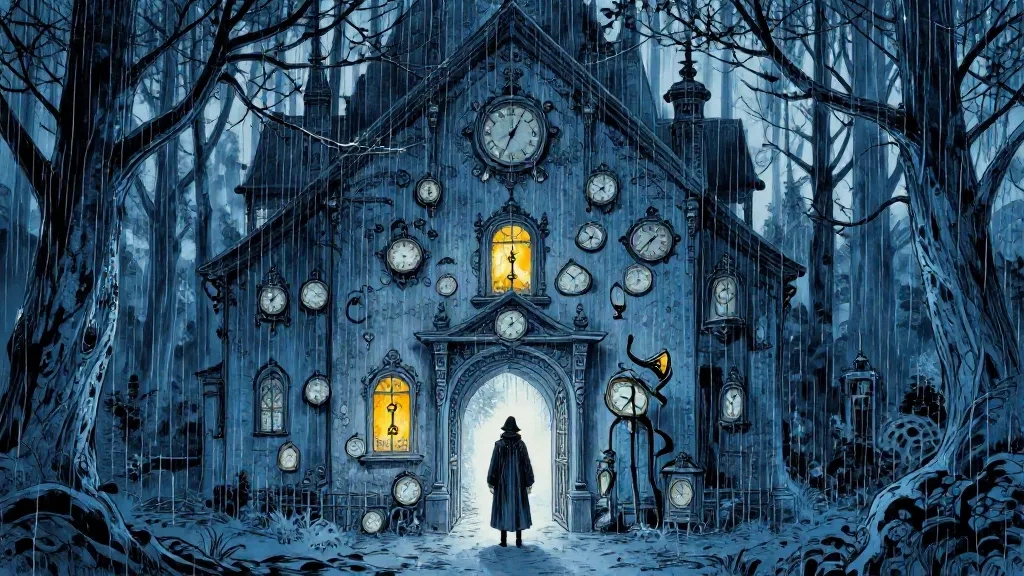
The gate was black wood banded with tarnished silver. Beyond it, steep roofs shone under an ink-blue sky. Hundreds of clocks occupied the windows, each showing a different hour. One amber window burned among them.
A bell sounded without moving.
Then something crossed the wall.
It was tall, narrow, and furred with white bristles. Six feet stood on the ground, but twelve more hung from its shoulders in poses of exact balance. Each bore a clock face. A face like an iron coin looked at Mara.
“The road closes,” it said. Its voice came from every window at once.
She showed Elian’s map. “I’m expected.”
“Expectation has no standing after the eighth bell.”
The thing stepped aside by precisely the width of her body.
“Curfew,” it corrected. “No entrance after the eighth bell. No departure before the first. This is not hostility. Hostility is imprecise.”
Inside, the clockmakers watched through open doors. None stopped working. Hammer met brass; gears clicked in wooden cases; thin hands leapt toward unseen stars. Elian’s supplies lay on a workbench beneath the amber window: a dismantled compass, a weather diary, and a route marked in red.
Elian had reached the monastery. Mara knew now that her disappearance was not death.
The Work of the Lost Hour
The road out began in a locked clock.
The abbess, Iolanthe, was a small woman sewn into navy wool. She touched Elian’s brass key to a case marked with the same blue crescent Mara carried in her pocket.
“Your traveller misunderstood,” Iolanthe said. “The key is not for a door. It winds the road.”
Mara unwrapped the moon. It bore a hole through its centre, worn smooth by a cord. Around its edge ran minute teeth too small to see.
For three years, Mara had searched for the path her sister, Nessa, had taken into the evacuated forest. Nessa carried a survey wheel and always returned with maps finer than any ruler could cut. Her final letter contained one address and a warning: When the forest borrows an hour, do not let it spend twice.
Mara had spent those years travelling without knowing where. Elian had found the answer: Nessa’s route lay not beyond the monastery, but inside the clock that did not advance.
At the seventh bell, Iolanthe set the dismantled compass on the table.
“The road takes one traveller and leaves one mistake,” she said. “Your sister left the gate unlatched. Something has been leaving it open ever since.”
Mara fitted the moon into the key. Its teeth caught with a sound like a distant swallow.
She set both against the stopped clock.
An Ending That Would Hold
The eighth bell began.
At once, clocks throughout the monastery leapt forward. The curfew creature crossed the threshold, its many feet striking the same instant.
“The road is not closed,” it said. “It is exact. You may pass only if you carry back what was taken.”
Mara turned the key.
Beyond the wall, the forest opened into darkness. Nessa waited beside a locked iron gate, ten years older and no older at all. Rain silver slid from her coat. The survey wheel in her hand was motionless.
Behind her, hundreds of lost hours moved through the trees. In one, the monastery burned. In another, Mara had never come. In a third, the entire road vanished.
“Finish the journey,” Nessa said.
Mara understood. The forest had preserved every exit Nessa had abandoned. The work was not to bring her sister home. It was to close the route without losing the one life the road had already carried.
She stepped through, took Nessa’s hand, and turned the survey wheel once. Every road folded inward. The burning monastery, the absent Mara, the missing darkness—all vanished into the brass key’s teeth.
At the locked gate, Nessa smiled. “Now we can leave.”
Mara turned the key. The gate opened onto wet grass beyond the forest. Somewhere behind them, the eighth bell ended and the ninth began.
No bell sounded at midnight. For the first time in twelve years, the monastery had nothing left to lose.





