 Netwrck
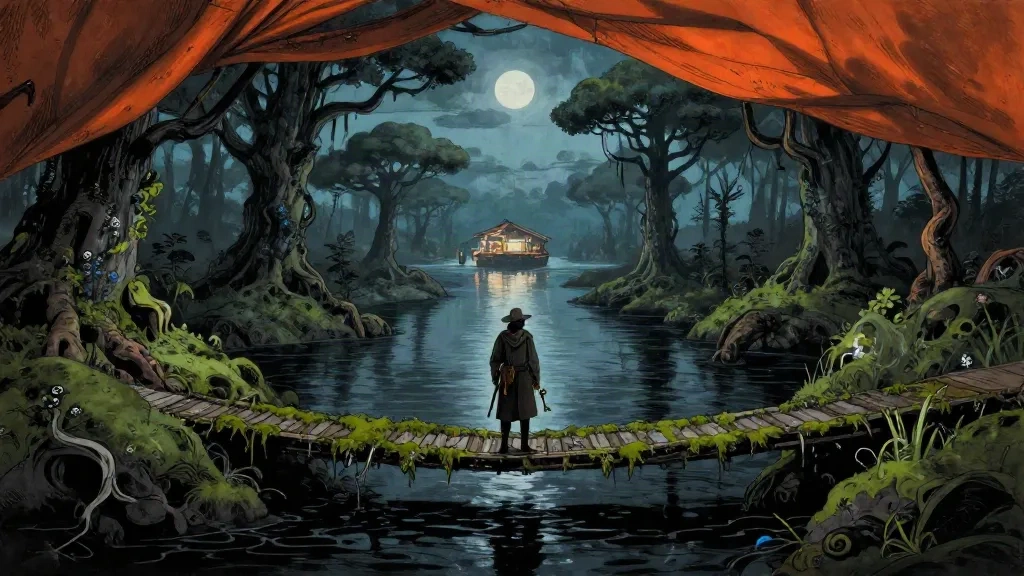
Surrealism.
The Market of Unclaimed Things
Mara found the market at the hour when rain hangs before falling. It floated above a drowned valley, held aloft by hundreds of tethered umbrellas and the slow breath of a white animal no larger than a sleeping cat. Stalls leaned together under a canopy of burnt-orange cloth. Spoons remembered the mouths that had tasted them. Glass beads held afternoons from houses now underwater. On one table, a pair of shoes walked in a patient circle around a puddle.
A brass key rested at the center of Mara’s palm, warm as bread. It had belonged to Ilyan, the ranger who vanished six years ago while escorting a caravan across the evacuated forest. His journal ended with a route: through the green gate, beneath the leaning pine, past the well where thunder slept, then onward to the tree that kept the forest’s oldest hour.
Mara’s assignment was simple. Protect the forest until the timeline sealed.
The forest itself had been removed from time. Its trees stood in a single green dusk, their leaves turning without falling. Every road within it led back to its beginning. Animals remained fixed mid-step, their tracks already buried beneath roots. In the evacuated villages, chairs waited beside empty tables, and doors stood open for people who could no longer arrive.
At the market, memory dealers traded what no one else wanted. Mara was told the key could open the way Ilyan had found, but the market’s oldest stallholder refused to name its price. She brought the key anyway.
The Curfew of the Blue-Haired Creature
The creature arrived without sound. It stood beside the ferry ropes, taller than the lantern poles, with a narrow blue body and many silver joints. It looked at Mara, then at the key, and raised one finger.
Curfew begins when the small moon rises below the market.
The creature was not hostile. It was precise.
At the appointed minute, every lantern in the market would extinguish. Any memory traded after that would be assigned to the nearest living witness. If Mara tried to cross the water before curfew, the creature would record her destination and return her to the stall where she had purchased it.
Mara watched the little moon appear beneath the eastern cloud, pale and low. She had one hour to reach the forest. The ferryman refused payment in coins. He wanted the memory of having once forgiven his brother.
Mara had carried that memory for years, not because it was hers, but because forgiving was the only inheritance she had managed to keep from a dead woman. She surrendered it.
The ferry crossed the black water. Behind them, the market folded its lights one by one, and the blue-haired creature began counting in a voice like glass placed beneath a stone.
The Forest That Had Been Late
The green gate opened at Mara’s approach. Inside, the air smelled of wet bark and lichen. Blue storm-light moved between the trunks without a storm. Every tree wore a small moon in its branches, though the moon beneath the clouds was the only one that counted.
She passed the leaning pine. The tree whispered Ilyan’s name in a voice made of wind. She passed the well, where a sleeping thunder lifted one eyelid when she looked in. Beneath it lay a road of pale stones, each one marked with a date from tomorrow.
The curfew warning sounded across the forest. The blue-haired creature had followed, crossing the impossible boundary on six long legs. It pointed toward a path Mara could not see.
Ilyan’s route required her to leave the road.
She stepped into the lichen. The ground yielded without sinking. Her boots filled with the sensation of walking through someone else’s childhood. Behind her, the forest began erasing the market, the ferry, and the creature’s long shadow.
“You are late,” said a voice from the roots.
Mara raised the brass key. “He started this journey.”
“You are carrying its ending.”
The Door in the Oldest Hour
The tree that kept the forest’s oldest hour was not a tree. It was a narrow door grown from a single trunk, its frame covered in lichen and its lock shining with blue storm-light. The little moon had risen beneath it.
Mara inserted the key. The creature began counting faster. One. Two. Three.
She turned the key.
Inside the door was no room. There was only a forest at dawn, full of birds calling from branches that had not yet been made. A figure stood at the edge of the trees, carrying a lantern and a second brass key.
Mara recognized the walk before the face.
Ilyan had not vanished. He had crossed the oldest hour and left the key behind so someone else could finish bringing the forest home.
He looked at Mara and bowed.
“You found the road.”
“I found your note.”
He stepped aside. Beyond him, the evacuated village filled with returning voices. Chairs moved. Doors received their travelers. The forest’s leaves fell, rose, and settled again.
The blue-haired creature reached the door and stopped precisely at its threshold. It raised one finger, then pointed toward the dawn.
Mara understood. The curfew was not a punishment. It was the shape of the world keeping itself from breaking.
She stepped through with Ilyan’s key still warm in her hand. Behind her, the market vanished into blue light, carrying every unclaimed memory toward a home that had finally learned to receive it.
At dawn, Mara planted the small moon in the ground beside the green gate. It remained there, neither rising nor setting. Whenever the forest grew quiet, its pale light showed the path home.





