 Netwrck
Romance.
The Curfew
Every night, the forest disappeared from itself.
At ninth bell, the monks closed the monastery’s inner gate and wrapped their throats in scarves against the silence. Trees withdrew their roots from the wet stone. The brook climbed backward over its moss-green stones. Owls remembered the shape of wind but forgot how to use it. Even the small moon nested in Sister Oren’s window rolled halfway across the sky, paused, and began returning.
And the birds called names.
Iven came to the comet monastery three years ago, when the council named him ranger of a forest evacuated from time. The Evacuation Order had cast its people into the century nearest to each one. A woodcutter returned as a child. A fisherman aged eighty minutes for every hour he slept. Most vanished entirely, spared by a season that could no longer touch them.
Sister Oren remained.
She was the one who had opened the forest gate during the withdrawal and failed to close it before the last bell. When she vanished, her boots stood beside the path, neatly paired. Her expedition map ended halfway through the Marrow Vale. Beside its unfinished final passage lay my name.
Then the curfew began.
Its author waited above the reliquary each night: a pale creature with six jointed limbs, a beak exact as a compass, and eyes containing no pupils. The monks called it the Compositor. It never attacked. It corrected.
At exactly the Curfew, it stitched three loose moments together: the breaking of a cup, a moth against a lamp, Sister Oren saying my name. Then it would nod, satisfied.
“She asked for nothing,” I told it on the seventh night.
The Compositor tilted its head.
“You did not ask her nothing,” it said. Its voice was the sound of scissors closing beyond the page. “Leave tomorrow where you found it.”
The Map’s Missing Country
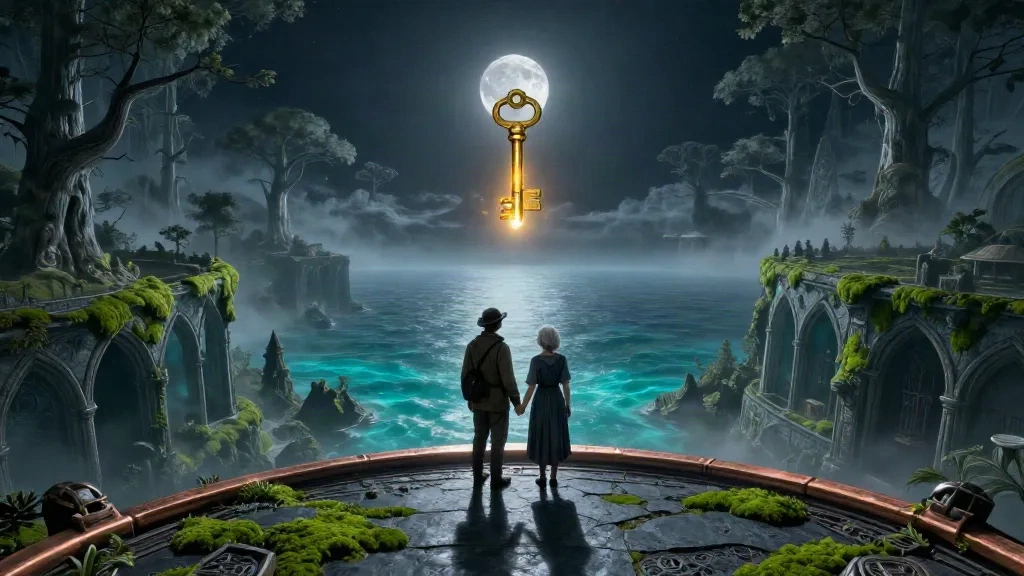
I carried a brass key from her room. It was warm, narrower than a monk’s key, and etched on its bow with the number 719. The map’s last marked chamber stood in a country the parchment called Elsewhere Present.
At the Curcrow, I took the key outside.
The moon in the window vanished. Trees streamed backward through the valley, their leaves filling with moonlight. Somewhere among them, a woman’s voice sang the old tide song.
“Still precise,” I whispered.
The Compositor descended without hurry. “Leaving a door unlatched is not error. It is invitation.”
Beyond the monastery wall, the evacuated forest glittered with impossible rain. Each drop held a season: copper autumn, blue spring, snow thawing before it fell. The path climbed through wet stone toward a chapel suspended in the comet’s dark.
Sister Oren waited at its threshold.
She had aged only one day. Her gray hair blew upward, though no wind crossed the platform.
“You took the wrong road,” she said.
“The map is yours.”
“No part of it is mine.” Her eyes shone wetly. “I found the Currow after the evacuation. Everyone was safe, but every tomorrow they had sacrificed was trapped here. The Compositor waits for them to choose which future to release.”
She touched the brass key in my palm.
“I came back for you because the last journey cannot be completed by one person. Mine could not.”
The Last Crossing
The key turned a lock shaped like a sleeping bird. Beyond it waited an ocean suspended beneath a small moon, its black water luminous within. Each wave held a possible tomorrow: villages, harvests, reunions, births, wars not yet begun.
Sister Oren took one end of a braided cord. I took the other.
“I thought you wanted to finish my route,” I said.
“I wanted to discover whether I would abandon it for you.”
The Compositor landed on the chapel bell. Its claws made no sound. All possible movements of the stars became still.
“The Curfew exists,” it said, “because freedom without precision becomes destruction.”
“Then be precise now,” I told it.
We divided the futures. She released the small ones: first snow, forgiving hands, rain on a seed. I let the enormous ones return to their proper years. The moon brightened until the ocean became a thread of marigold fire.
The forest’s curfew dissolved. Trees resumed their roots, the brook accepted gravity, and names flew upward from the valley like a congregation of returning birds.
When the spell ended, Sister Oren remained. So did I. We had not found forever, only a choice that could be renewed each morning.
She slipped the brass key into my hand, then closed my fingers over it.
“What road is yours now?” she asked.
“Here,” I said. “But not alone.”
Across the wet stone, a marigold flowered from the seal of a lock no longer guarding a prison.





