 Netwrck
Mystery.
The Last Reliable Place
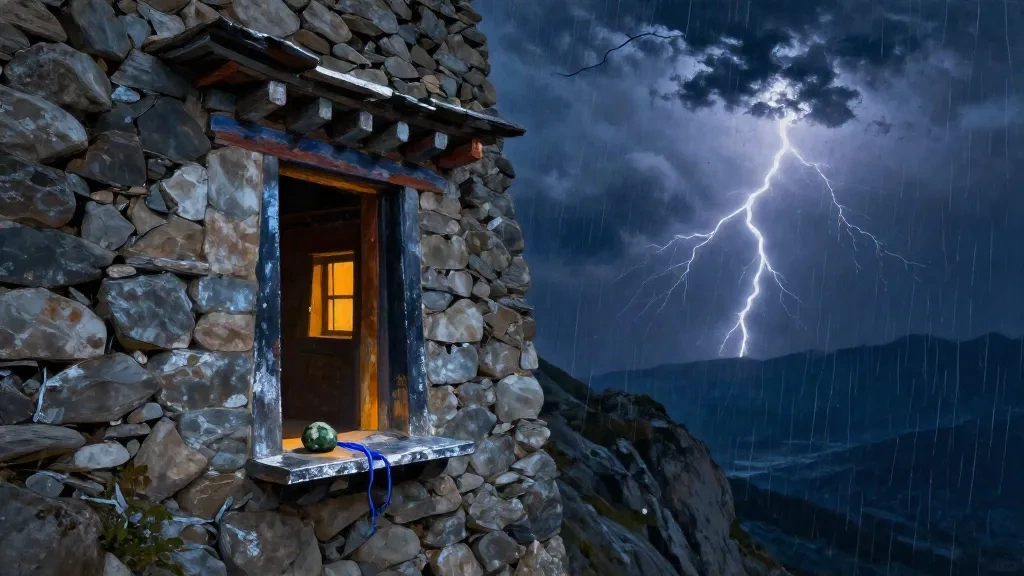
Mara Venn had not left orbit for nineteen years, not even when the ground stations stopped calling her by name. Above the night side, the monastery of Saint Orra appeared as a cluster of silver roofs and one warm amber window, a lantern in a country where calendars had been outlawed and clocks were burned as dangerous relics.
From her capsule she could see the roads only as pale scratches between black forests. The country had declared time unreliable after the Long Winter, when dawn arrived in the wrong order and harvests were counted twice. The monks of Saint Orra kept no clock. They kept doors.
Each monastery door opened onto a different place, depending on who stood before it. A novice might step from a corridor into a flooded kitchen. An abbot might enter a room containing the last train he had missed. The arrangement was dangerous, local, and never explained twice.
Mara remained above because Earth had become a rumor. The voice was not a rumor.
It arrived through the static beneath the monastery radio, hidden under weather reports and monastic bells. Once a night it said, Mara, do not come down. The voice had belonged to Pavel Ilyan, the mission controller who had signed her launch orders and been erased from the public record when the orbital program was declared a clerical error.
She had spent six years trying to recover the rest of his sentence.
Green Stone, Blue Thread
The signal strengthened whenever she aligned the capsule with the amber window. On the seventeenth observation, she saw a green stone in the monastery courtyard, split through the middle and polished on both halves. A blue thread was knotted around the larger piece.
Those objects had belonged to Pavel. The green stone was a fragment of the asteroid sample he had carried; the blue thread came from the old flight suits, where every astronaut had marked a hidden seam with thread colored for emergency recovery.
They were not in orbit. They were below.
Mara undocked before dawn. The descent capsule struck a forest roof and rolled downhill, shedding sparks. By the time she reached Saint Orra, the storm had begun.
Rain silvered the mountain paths and drove horizontal through the cloisters. Doors slammed in sequence, each followed by a different weather. From one arch came thunder, from another the smell of pine resin, from a third the dry heat of summer.
The novice who met her wore a blue thread at his wrist. He pointed to a door hanging from the western wall. Its hinges pointed downward.
“The storm has rearranged the doors,” he said. “Do not enter unless you know what you are carrying.”
Mara held up the green stone. “A voice.”
The Room Behind the Weather
The door opened into Pavel’s control room. Not a memory. A real room beneath the monastery, its walls made of black stone and its instruments still running without power. Rain crossed the floor in narrow silver streams.
Chairs had been arranged in concentric circles around a brass microphone. A blue thread ran from the microphone into the wall, taut and unbroken. At its end, a small green stone rested beside a black recording cylinder.
Mara wound the handle.
Static filled the room, then a child’s voice: Tell them the sky is not empty. Another voice answered, older, familiar, Pavel’s. We hear you.
Behind the cylinder stood a second door. Its label read RETURN TO EARTH. The storm shook it violently.
Mara understood the danger then. The monastery was not hiding Pavel’s voice. It was containing the return path. If she opened the door, the room would send her back to the instant she had left orbit—and the voice would be erased again, reduced to a speck of background noise in history.
She cut the blue thread.
The cylinder stopped. The door burst open. Through it came the smell of wet earth, the monastery courtyard, and the amber window blazing above the roofs.
Pavel’s voice came once more, no longer from the machine.
“You came down,” he said.
Mara looked at the green stone in her palm. “No,” she said. “I finally came in.”





