 Netwrck
Folk Horror.
The Door With No House
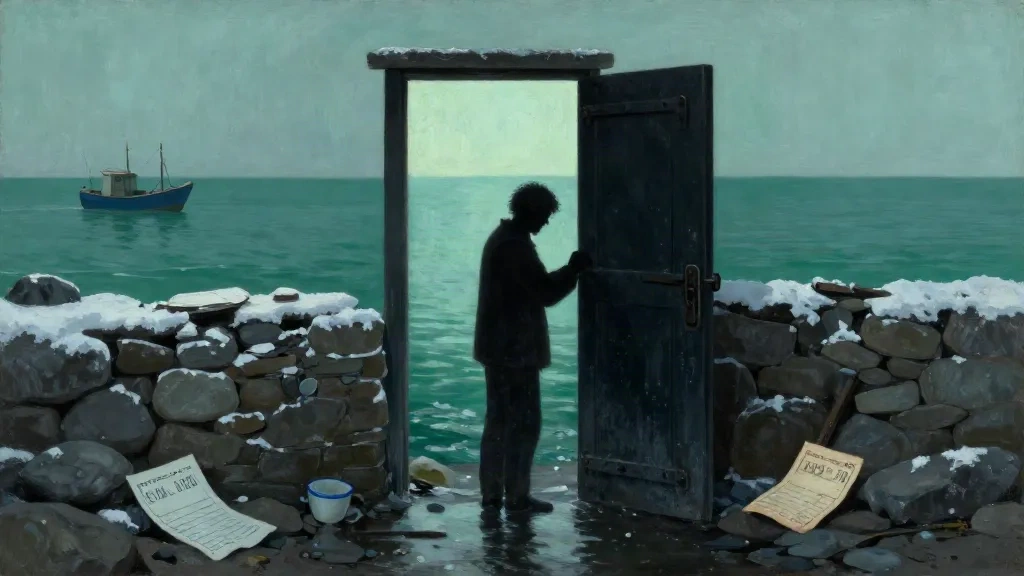
Mara Venn forged hinges for the harbor master, the priest, and the women whose cottages leaned into the winter wind. But the doors she repaired most often belonged to nothing. They stood upright in the wrack at low tide, black wood swollen with salt, their frames opening on blank air. The village called them the year-doors.
Each morning, Mara found another one beneath the sea wall. Some were narrow as a coffin. Others were broad enough for a cart, though no cart could pass through the space they occupied. She worked iron into their hinges, hammering until frost turned her cuffs white. The doors remained shut.
Her daughter, Lise, had left eleven years before for the city. Mara had walked her as far as the station and watched the train take her away. Every tide since, a paper train ticket returned in the sand: OUTBOUND, ONE PASSENGER. The date was always tomorrow.
There was also a cup.
It was white china with a blue rim, though no household in the village owned such a thing. The sea placed it inside the empty doorway of whichever year-door Mara had repaired last. The cup was always empty. Lise used to say that an empty cup meant somebody was coming home.
What the Tide Sold Back
One winter morning, the harbor master approached while Mara was tempering a hinge. He pointed toward the water, where a black arch had risen from the shallows.
“Leave that one,” he said.
“It needs iron.”
“Some things should stay shut.”
He offered her enough silver to buy a new roof and enough silence to keep the old one. The missing year-doors were sold by the Harbor Company. Each door was cut from a house before the last inhabitant died, carried beyond the breakwater, and sunk where the water could return it. The Company stored the years inside them, waiting for a buyer.
Mara knew the story because her husband had sold doors. Before his lungs failed, he had told her the sea was only a warehouse. The dead bought passage onward; the living paid in forgetting.
At the next ebb, Mara opened the black arch.
Beyond it stood a kitchen lit by an impossible cyan dawn. Steam rose from a kettle. A child laughed in another room. Lise’s cup sat on the table, blue-rimmed and full.
The ticket lay beside it.
OUTBOUND, ONE PASSENGER.
Below the date, someone had written Lise’s name in fresh ink. Mara reached for the ticket. The kitchen vanished.
The Price of an Ending
The Harbor Company nailed the arch shut before sunset. They said the tide had confused her. They said the year-doors belonged to no one.
That night, Mara carried a hammer down to the beach and broke the seal.
The door opened onto a narrow street beneath frost-bright stars. Lise waited at its far end, older than Mara remembered, wearing a red coat she had never seen. Behind her, the street filled with people walking toward the sea.
“Did you come to bring me home?” Lise asked.
Mara looked at the ticket in her hand. The empty cup had appeared in her coat pocket, cold against her ribs.
“I came to ask what you chose.”
“I chose to leave.”
“And?”
“And I was not finished.”
The tide began climbing the street. The people behind Lise turned toward the water, but she remained. Her hand rested on the ticket, not claiming it.
Mara understood then. The Company did not keep the mystery closed to protect the dead. It kept the future closed so no one would choose a life they had not yet earned. Every door contained an unfinished path. To open one was to surrender the comfort of certainty and accept the possibility of refusal.
She could not force Lise through the door. She could not buy passage. She could only hold the hinges while the water rose and the impossible dawn began to bend.
The Hinge That Held
At sunrise, Mara drove her shoulder against the door. Her body became its hinge. The frame opened wider, and the street broke apart like thin ice.
Lise stepped through.
The ticket caught in Mara’s hand. The empty cup broke against the stones, spilling no water. Around them, the absent doors slammed shut along the shore, one after another, their hinges singing.
The Company was gone by noon. Its records were full of doors, but none had ever been opened. The village called the event a miracle until the next tide returned the cup intact.
Mara left it beside her forge. Lise drank from it that evening while they waited for the dawn to finish becoming morning.





