 Netwrck
Weird Fiction.
The Door With No Wall
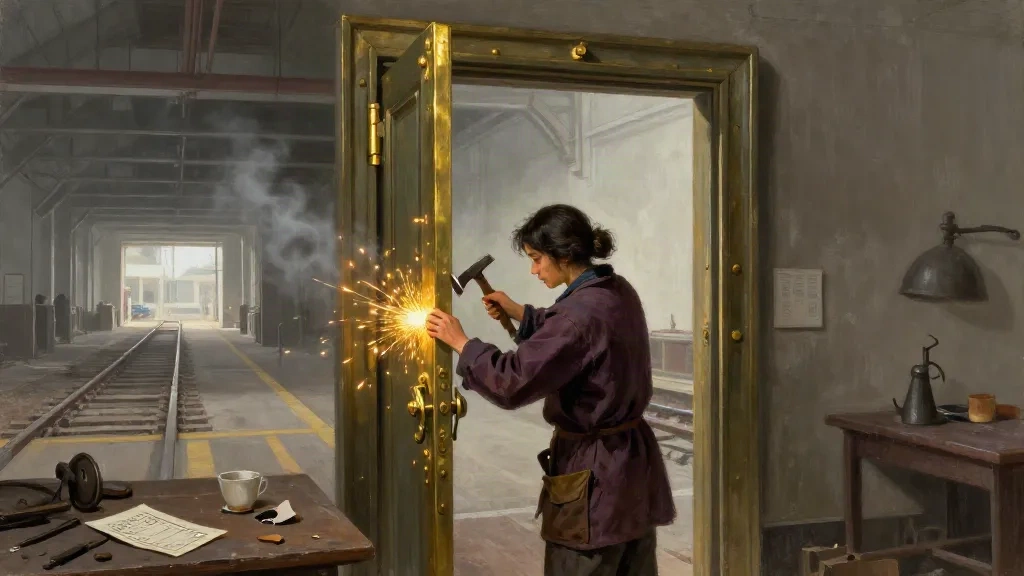
At the back of the museum, behind a velvet rope and a sign reading ARCHITECTURAL REMNANTS, stood a doorframe containing no door. Iona had repaired its hinges every spring since her father died, though there was nothing on the other side but smoke-grey air.
The hinges were enormous, forged from black iron and saffron brass. Each bore a different mark: a wave, a flame, a closed eye, a crown, a small train climbing a mountain.
“You are making it worse,” said Director Vey, the museum’s curator, watching from the archway. His fingers were stained violet with the sealing ink used on retired exhibits.
“It hangs crooked.”
“It is meant to.”
Among the frames in the Hall of Departures was one Iona touched whenever doubt became a weight. Its hinges opened onto the courage to leave a city, a marriage, a name. Another led to the courage to remain when every sensible creature fled. Others opened onto apologies, betrayals, declarations made before dawn.
But the empty frame opened onto tomorrow.
Iona had seen it only once. Beyond the threshold lay a field of unfinished houses, a railway platform beneath saffron moon, and a woman who looked like her daughter, though Iona had no daughter. The woman held out a brass key and said, Choose the ending you can live inside.
Then Vey had slammed the door and sealed it.
The Price of an Unfinished Door
The museum’s gift shop sold tickets to temporary doors. Visitors paid to experience one hour of courage: the courage to forgive a public enemy, to jump from a moving carriage, to speak before a crowd, to swim against a river’s direction. Vey called the practice civic education. The city called it progress.
But the temporary doors weakened the permanent ones. Each visitor who entered a known courage emerged less willing to risk the unknown. Vey collected the difference in a ledger, recording who had chosen safety and who had paid in coin, reputation, memory, or blood.
Iona knew the numbers because she repaired the hinges after every admission night.
“You are the maintenance smith,” Vey said. “You are not the keeper of the future.”
“You made me a keeper of things no one else will mend.”
In her tin box lay a train ticket and an empty teacup. Both had appeared in different exhibits. The ticket was stamped for a destination that did not exist. The cup was cold despite the museum’s furnaces. When Iona placed them beside the empty hinges, the brass began to glow.
Vey seized the ticket. His face thinned with anger.
“That door is closed for a reason.”
“Then someone will have to explain the reason to the people behind it.”
What the Morning Owes
At midnight, Iona climbed the museum’s central tower and used her smallest hammer. She loosened the saffron pin, then the black iron pin, then the hidden nail beneath the threshold. Each removal woke a sound from the frame: wheels on gravel, a kettle beginning to boil, thousands of hinges turning at once.
The door did not swing open. It leaned toward her, waiting.
Vey came after her with the sealing ink. He had made himself smaller, but his hands remained powerful. “If you release it,” he said, “the future becomes possible. People will do things they have not earned the right to regret.”
“Possibility is not a verdict.”
“Every choice costs somebody.”
“Then let the cost be visible.”
She drove the final nail through the empty teacup. The cup broke cleanly. A saffron flame rose from it, filling the tower with the smell of bitter leaves and cold iron.
Vey threw himself against the door. The hinges caught him. He hung there, suspended between the frame and the smoke-grey air, while the train ticket trembled in Iona’s hand.
An Ending With a Door in It
Beyond the threshold, the unfinished houses had gained windows. The woman with the brass key was waiting beside the platform.
“You have come to choose,” she said.
Iona looked at the ticket. Its departure had no station, only a white space where a destination should be. She tore it in half and placed the pieces in the dead teacup’s shadow.
“Not yet,” she said. “A future should have to keep earning its ending.”
She turned to the waiting woman and offered her the hammer.
The first blow rang through the museum. Every closed exhibit door shuddered. In the plaza outside, people stopped beneath their umbrellas, suddenly remembering that courage was not a room they could enter once, but a hinge they might have to repair in the rain.
By dawn, the empty frame stood open. Smoke-grey air drifted through the museum, carrying saffron petals and the distant sound of a train leaving a station that had not yet been built.
Iona left Vey hanging there. The hinges were sound, after all, and the future was on the other side.





