 Netwrck
Weird Fiction.
The Last Screening
The cinema had no roof in the weather, only a low ceiling of smoke-grey clouds pressed against the rafters. Saffron posters peeled from the walls, their actors smiling beneath titles that had never existed. The air smelled of hot dust, old velvet, and tea left burning on a projector.
Every evening, the building showed a future that had almost happened. A city floating above a drowned harvest. A queen surrendering a year of winter. A boy returning from a war that never began. The audience was small, because most people preferred futures they could complain about.
Outside, Marek repaired hinges.
They belonged to doors no building contained. Each morning he found them along the tram tracks or in the foundations of demolished houses: iron fittings vast as wagon wheels, blackened at the edges, still warm from some absent room. The doors stood upright without walls around them, opening onto blank grey light. Marek had been taught that a loose hinge was a promise the world had forgotten how to keep.
He carried a train ticket in his coat, though the line had closed before his birth. Its destination was printed in faded saffron ink: Where the Ending Is Still Undecided. The date below had been scraped away. Every evening, the ticket grew warmer in his pocket.
The Cinema’s Proprietor
The cinema belonged to a woman called Vey, who sold tickets from a brass booth and never removed her gloves. She kept the empty teacup on the counter. It had no saucer, no spoon, and no stain, though she poured hot water into it whenever someone asked about the future.
“The mystery must remain closed,” she told Marek. “People pay to see the edge. They do not pay to walk over it.”
Her profits came from certainty. Vey could show a future and then sell a second ticket to change it. The first customer would leave relieved to have escaped disaster. The second would pay to escape the escape. In time, the cinema had made itself wealthy by preventing any future from becoming settled.
Marek had come because the doors were failing. The absent hinges had begun to seize, and each locked door made another possibility less possible. He placed his tools beside the projector and listened to the future films rattling behind the screen.
“There is a door that opens onto a world where my forge never opened,” he said.
Vey set the empty teacup nearer to him. “Then you should not repair it.”
What the Ticket Refused
He found the door behind the last row of seats. It had no frame, only a seam of saffron light in the smoke-grey wall. Its hinges were gigantic and already half-rusted. Marek worked through the night, striking each pin loose and drawing it free. With every blow, the cinema trembled.
On the screen, a film he had not seen began to play. It showed a future in which Marek became a mayor, a physician, a silent king, and finally a forgotten man buried beneath an apple orchard. Each life had an ending. Each ending arrived too early. The camera repeatedly cut to the empty teacup, waiting for water that never came.
Vey appeared in the projection. She spoke without sound. The words gathered in the dust:
Close the door and I will make you safe.
Marek understood then that the local power was not a person but a habit. The cinema had learned that people would surrender their futures if offered a small, convincing disaster. Vey had kept the mystery closed so she could keep the profit.
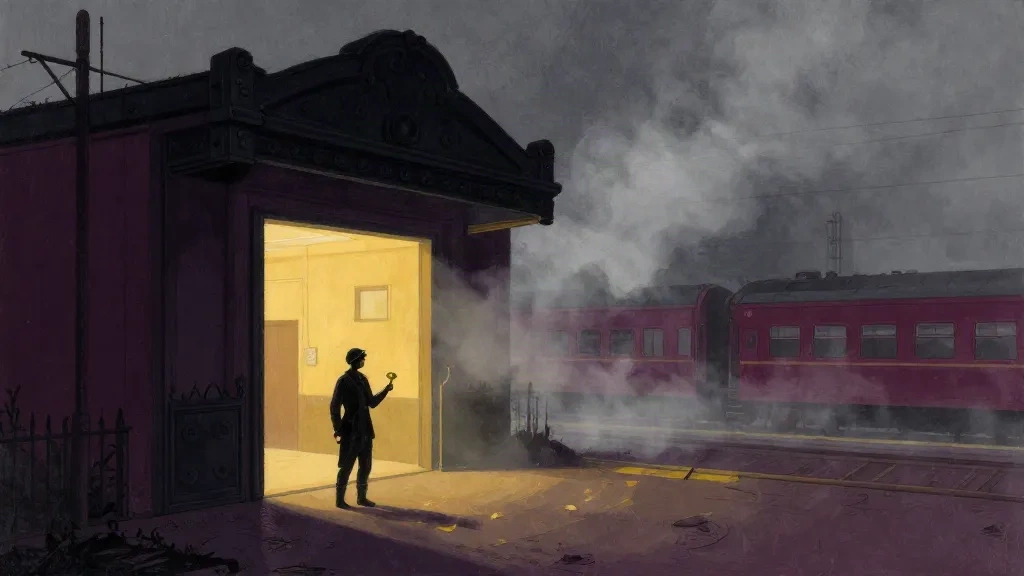
He fitted the last hinge. The door opened inward, revealing a platform beneath a saffron sky. A train waited without engine or carriages, its windows lit plum-dark. On the platform stood a woman holding a train ticket exactly like his.
“You have not yet earned the ending,” she said.
The Ending Still Undecided
Marek could board, or he could return to the forge. He looked back through the doorway. Vey had seized the projector, tearing film through the light. The auditorium filled with smoke-grey air, and every absent door began to swing at once.
He placed the empty teacup on the new train’s windowsill. It remained empty. The woman nodded.
The train started without a sound. Behind it, the cinema burned with saffron flame, and the doors along the platform opened onto thousands of unfinished mornings. Marek did not choose one of them. He chose the space between them, where a future could still change its mind.
For the rest of his life, he repaired hinges wherever they appeared: in winter, in hospitals, beneath the roots of trees that had not yet been planted. He kept the train ticket in his pocket and the teacup empty on his bench.
Whenever someone asked what came next, he repaired the hinge. The answer, he had learned, was not a destination.





