 Netwrck
Folk Horror.
The Door Beneath the Hinge
Every morning, Orin Vale found the same door waiting beneath the eastern wall.
It was not in the wall. The wall merely agreed to pretend.
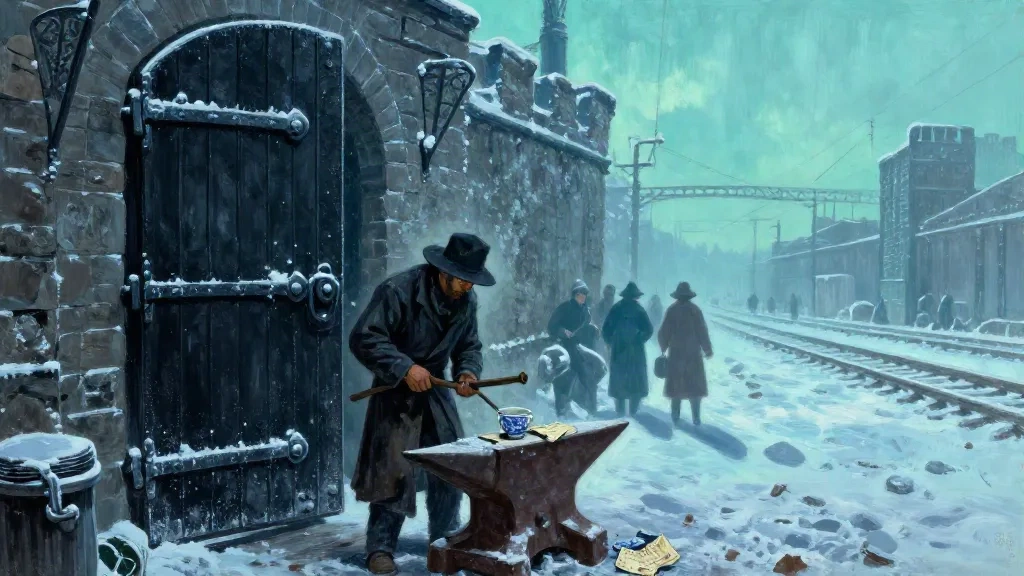
The door stood ten paces high, black as a winter river, its hinges sunk into frost that had never melted. No building surrounded it. No street had been laid to its threshold. Yet every dawn carried the same faint coal-smell from its seams, and every evening, when Bellwether’s citizens went indoors, the door remained.
Orin was the city’s blacksmith. He repaired ordinary hinges: tavern gates, schoolroom lids, the crooked cabinets in the magistrate’s house. He worked with iron filings, horsehair, and a narrow hammer inherited from his mother. For the enormous door, he used a new file each time.
Its hinges did not close. They tightened.
Orin’s concrete desire was simple. He wanted to know what lay beyond the door, and he wanted the right to choose whether it entered the city.
That desire had begun when his daughter vanished.
No funeral had been permitted. No announcement had been made. The city’s shadows had folded over her absence, and the living had accepted the blank as a natural thing, like frost on a rail.
He kept the hammer. He kept waiting. He did not keep hope, because hope in Bellwether was dangerous: it made a person cast a shadow before their future had been decided.
The Mayor’s Empty Cup
Mayor Seraphine Kade kept a teacup on her desk.
It was white porcelain, blue at the rim, and never contained tea. When petitioners came with complaints, she poured water into it. When they asked about the eastern door, she poured water into it again. The cup made no sound, though the liquid trembled.
“The door belongs to the city,” she said. “The city has not agreed to open.”
She was a broad woman with a narrow smile. Her shadow wore a crown, though she had never been crowned. It stood behind her chair and counted the minutes on its fingers.
Orin brought her a train ticket found in the hinge well. The ticket was stiff with frost, its departure time printed in a language he could read only when the sun was down. The destination had been scratched away.
“You can repair the hinges,” Mayor Kade said, turning the cup beneath her fingers. “Do not repair the reason.”
Orin looked at the empty cup. “Someone profits from the door staying closed.”
“The city profits from certainty.”
“That is not an answer.”
Her shadow leaned closer. On its crown, the count had changed from minutes to names.
That night Orin followed the municipal lanterns to the north archive. Beneath a desk marked CONTINGENCIES, he found a ledger whose entries were all departures. Every person who had questioned the eastern door had been assigned a destination: coal mines, salt flats, distant provinces, places with no return road.
The latest entry bore his daughter’s name. Beside it, someone had entered: DOOR UNOPENED. FUTURE UNPAID.
On the desk lay a second train ticket.
Its destination was Bellwether.
The City Cast Its Shadow
At midnight, the citizens of Bellwether gathered beneath the door without being summoned.
They stood in their own shadows, thin as black water. The shadows rose from their feet and began to vote. Each pointed toward a different street, a different name, a different version of the morning.
Those who voted for certainty received work. Those who voted for wonder received a beautiful dream. Those who voted for an unknown future were sent home with their pockets full of small cold coins.
Orin watched his daughter’s shadow step out from beneath the crowd.
It had her shoulders. It had the missing corner of her smile.
“Is she beyond the door?” he asked.
“She is waiting for you to decide,” said the shadow.
“Tell her to come home.”
“Home has an ending.”
The city’s shadows turned toward him. Mayor Kade’s shadow removed the crown and placed it on its own head. The iron in the enormous hinges began to sing.
Orin understood then that the door was not a passage. It was a bargain made by the city whenever it feared the future. Its opening would return the vanished, but only by admitting every unfinished possibility: disaster, joy, strangers, children not yet born, and choices no ledger could price.
Someone had kept the bargain closed for profit. The railway company bought the silence, the magistrate bought the blame, and the shadows collected the names.
Orin set his shoulder to the iron.
A Future Not Yet Earned
The hinges resisted. Frost spread up his arms.
He did not ask the city for a prophecy. He asked for a place in the timetable.
With the last blow, the giant hinges gave.
The door opened onto a railway platform under an impossible dawn. Frost lay on the rails, but the sky was soft cyan, colorless and tender. Beyond the platform waited a thousand doors, each one opening onto a morning that had not yet chosen what it would contain.
His daughter stood there, older by one breath than when she had vanished.
Orin held out the train ticket.
“You can return,” he said. “Or you can take a different train. I will not choose for you.”
She looked at the ticket. Then at the empty cup waiting in his pocket, which he had carried from the mayor’s desk without knowing why. A blue rim caught the cyan light.
“Can I come back?” she asked.
“Only if you leave the door open.”
Behind them, Bellwether’s shadows rushed toward the opening, shouting in the voices of citizens. The dawn widened, indifferent and immense.
Orin stepped onto the platform.
He did not know whether he had saved his daughter, abandoned his city, or purchased a future with his own name. The door remained open behind him, and the hinges held.
That was enough. An ending could wait.
An unfinished morning had room for another.





