 Netwrck
Weird Fiction.
The Door That Was Not Performed
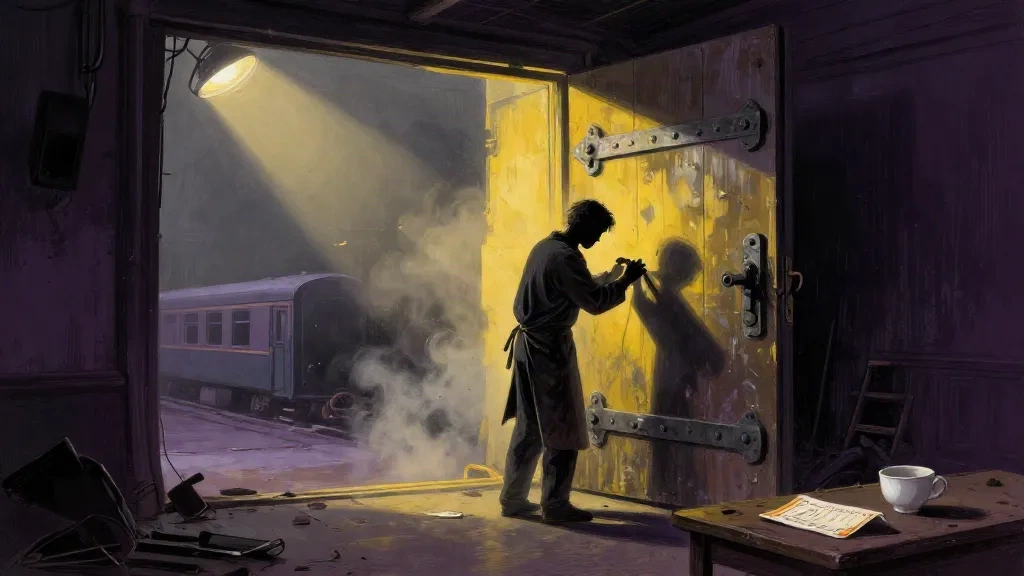
Every morning, Orin Vey found the theatre waiting behind the foundry: a narrow brick building wedged between a shuttered bathhouse and the saffron glare of the morning market. Its sign had no letters. Above the stage, heavy doors stood in a row, each bound with iron hinges larger than his shoulders.
He repaired them with blackened steel, split pins, and narrow strips of hammered brass. The doors belonged to no wall. When he tested one, it opened onto darkness, and from that darkness came a performance: a woman forgiving her brother, a city sinking into a blue winter, a child becoming famous and unhappy. Each was tomorrow's discarded ending, rehearsed badly and abandoned before the audience could object.
Orin watched from the wings. He wanted a future that had not yet earned its ending.
Every afternoon, after the final scene, a woman named Sava arrived to collect the spoiled scripts. She carried a train ticket in her left glove and an empty teacup in her right. The cup had no handle. A pale ring of tea remained at the bottom, though no one ever poured it.
“You mend the hinges,” she said. “You understand that some doors should stay shut.”
“A door is not a verdict.”
“A hinge is.”
The Municipality of Unfinished Things
Behind the theatre, beneath a staircase smelling of wet plum and smoke, sat the Municipality of Unfinished Things. It sold endings by the pound. Wealthy citizens brought in futures they considered embarrassing: a marriage without children, a kingdom without war, a person who lived long enough to become ordinary. Clerks weighed each possibility on brass scales, then fed them into furnaces.
Orin had worked there once, repairing its gate. The gate opened only for those who already knew how their story ended. The Municipality was quiet, rich, and entirely convinced that mystery was a tax.
Sava worked there now. She brought the same ticket every day, punched for a destination three stations beyond the horizon. The date on it had been rubbed away. Whenever Orin asked about it, she placed the empty teacup over the ticket as if covering a wound.
“The theatre feeds us,” she said. “The Municipality sells what we discard. Between them, they have made tomorrow predictable.”
That night, an ending escaped its hinges.
It entered the auditorium as a gust of smoke-grey air, carrying the smell of rain on hot iron. The stage filled with a railway platform seen from above. A train waited without arriving. On its seat lay a ticket identical to Sava's.
Orin stepped onto the stage. The script in his hand had no final page. Each time he read the lines, they rearranged themselves into warnings.
Do not open the west door. It opens toward a choice.
Outside, the Municipality's locks began to turn.
The Price of an Open Door
The west door was the largest. Its hinges had been cut from a shipwrecked cathedral, and its surface was deep plum, cracked with saffron dust. Orin set his tools beside it while Sava tried to stop him.
“If you open it, you choose a future,” she said. “You do not get to see whether it is good.”
“That is the point.”
He drove the first pin free. The door shuddered. Somewhere beneath the theatre, theMunicipality's clerks began ringing their brass scales. They could not permit an unpriced possibility. Men in plum coats climbed the stairs with extinguishers, buckets, and forms requiring three signatures.
Orin struck the second pin. The empty teacup on Sava's table cracked clean down the middle. Steam rose from it, carrying voices from thousands of possible mornings.
“I never went to the station,” Sava said.
“No.”
“My father bought the ticket for me.”
“Does that make the ending his?”
She looked at the door, then at him. Her hand closed around the cup, but she did not lift it.
On the stage, the waiting train sounded its horn. The sound did not announce departure. It announced permission.
An Ending in the Hands
Orin removed the final pin. The west door swung inward, revealing no room, no sky, only a narrow railway platform suspended in smoke-grey air. Saffron light lay across the tracks. Beyond them, every discarded ending stood as a figure, waiting to board.
The Municipality men demanded he close the door. Their extinguishers hissed against the saffron light. Their buckets leaked smoke. Sava stepped onto the platform, still holding the empty teacup, and placed the train ticket into the conductor's gloved hand.
“I choose not to go,” she said.
The conductor waited.
She looked back at Orin.
“Not because you chose for me. Because I am not finished.”
Then she tore the ticket in half.
The train began to move without her. The figures on the platform turned toward it. One by one, they boarded, carrying their forgivable, monstrous, ordinary endings with them.
Orin remained on the platform. The west door had opened, but it did not demand he pass through. It simply held.
At dawn, he returned to the theatre and hung a new hinge on the empty frame beside the stage. It was small, plain, and made from steel he had forged himself.
Sava arrived before the first performance. She no longer carried a teacup. In its place was a second hammer.
“What are we repairing now?” she asked.
Orin looked at the closed doors, each one hiding a future that had not yet decided what it was.
“The chance to come back,” he said.
They began work.





