 Netwrck
Weird Fiction.
The Door Without a House
Ilyra found the first hinge beneath the saffron market, where smoke-grey air pooled between stalls like spilled tea. It was made of black iron and warm to the touch, even in winter. Around its pin, someone had scratched two words: still here.
There was no wall, no house, no doorframe. Only the hinge, standing upright in the wet stones. The market women avoided it. They had learned that when the river changed course at midnight, objects left on the wrong bank could arrive somewhere impossible. This hinge had been waiting three years.
Ilyra was a blacksmith because her father had been one, and because the town needed a person who could make repair without asking what had been broken. She lifted the hinge onto her anvil and worked until sunset. Its mechanism was finer than anything she had forged: seventeen interlocking plates, a spring that breathed, and a narrow crescent cut into its centre.
Midnight Turns the Water
At midnight, the river turned.
It did not surge or overturn. The current simply slid beneath the bridge and continued in the opposite direction, carrying rafts, red leaves, and the reflection of the moon toward the wrong horizon. The saffron lanterns trembled. The smoke-grey air thickened into curtains.
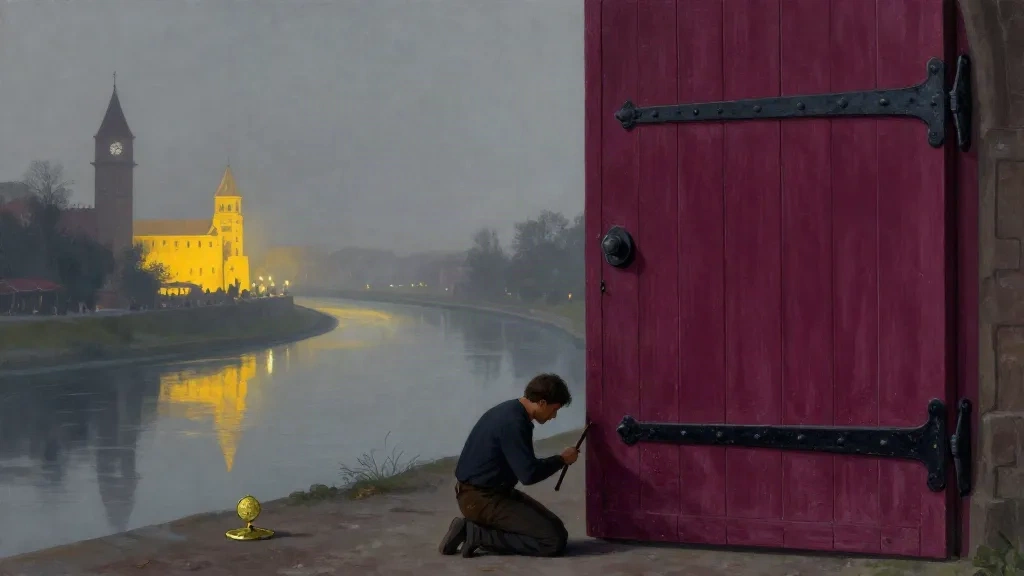
Across the water stood a great door.
It had no building around it, no hinges visible, and no handle. Its panels were painted deep plum, cracked into the pattern of a country. At its foot lay a train ticket dated tomorrow, and beside it sat an empty teacup, still warm.
The ticket was addressed to Ilyra. The destination read: THE FUTURE YOU HAVE NOT EARNED.
She pocketed both objects before she could stop herself. The power behind the river, Magistrate Orun, emerged from the fog wearing a brass seal at his throat. He did not ask what she had taken. He told her the door was a mistake.
“A future is not a country,” he said. “It is a debt. The less you know about it, the longer it can wait.”
The Price of an Unfinished Thing
Orun permitted her to keep the hinge, but only because the town paid him to keep the mystery closed. He collected a toll from every clockmaker, ferryman, and child who tried to follow the reversed river. He sold certainty: tomorrow would arrive when he declared it, and the door would remain a thing for fools and blacksmiths.
Ilyra had repaired many absent doors: hinges floating in wheat fields, latches attached to clouds, handles that opened onto rooms erased from maps. She never asked their purpose. Repair was enough. A door belonged to someone not yet born, and that someone had the right to enter.
Now she understood the missing piece. The hinge was not broken. It was waiting for a decision.
Orun offered her the future she had been raised to expect: a quiet forge, a house above the ferry stairs, a life in which nothing dangerous was ever repaired. He poured tea into the empty cup, then poured it away. The cup remained empty.
“Choose safety,” he said. “The future can remain unfinished.”
Ilyra struck the hinge. It rang through the town like a bell. The brass seal at Orun’s throat cracked. The deep-plum door leaned forward, and behind it appeared fields under a saffron sun, crowded with cities that had not been built.
What the Door Held Open
She fitted the hinge to the door. The spring breathed once, then opened.
Beyond it, people were waiting to choose their lives. Some carried the same ticket. Some held empty teacups. None of them wanted a future chosen for them.
Orun seized the ticket from Ilyra’s hand and tore it in half. The ink spilled into the air, and the smoke-grey fog began to thicken. Across the river, the town clocks rang backward.
Ilyra raised the hammer.
She struck the door’s lock, not the hinge. The lock had been the final thing keeping tomorrow outside.
It broke. The reversed river surged forward, and every absent door in the valley opened at once: behind the market, beneath the church, inside the walls of sleeping houses. Their hinges turned with a sound like distant thunder.
Orun vanished among them. His brass seal remained on the ground, stamped with a closed eye.
By dawn, the river had returned to its ordinary course. The great door was gone. In Ilyra’s palm lay one half of the train ticket, its date still unreadable.
She put it beside the empty teacup on her anvil and began making a new hinge.
Not for a door that someone had lost.
For the first door that someone might still choose.





