 Netwrck
Historical Fantasy.
The Door Without a Wall
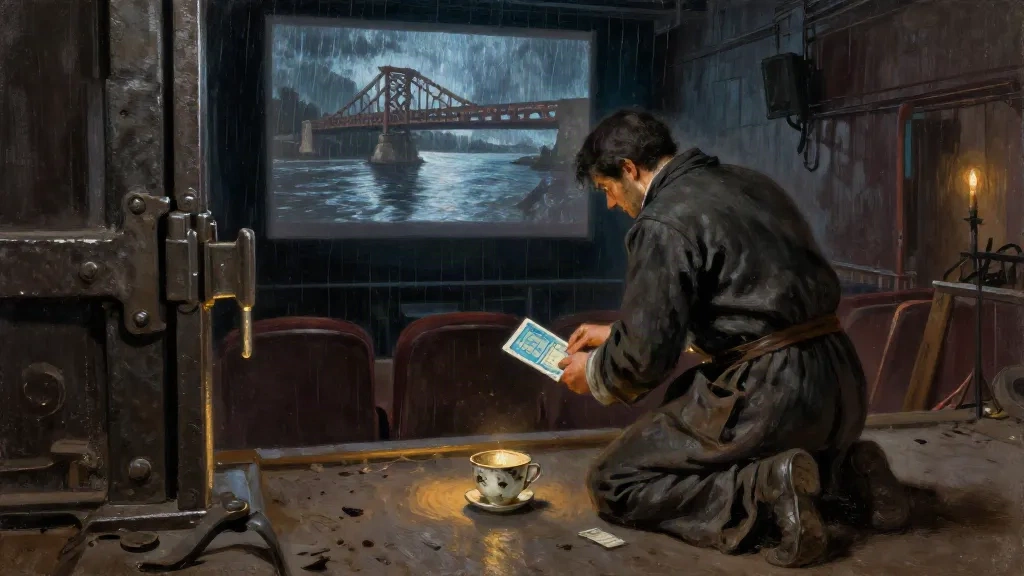
Rain had entered the old cinema through the roof and settled in the corners, where it made small pools around ticket stubs and peeled posters. Iven found the work beneath the balcony, in a room marked by a brass plaque: PROJECTION OF UNREALIZED HOURS.
There, the screen showed places that had almost been. A bridge over a black river, crowded with children who never drowned. A city waking beneath a red sun, its towers still unburned. A woman in a grey coat opening a letter marked with the date of tomorrow.
Between the films, enormous doors appeared in the projection room. They had no walls, only hinges fixed to a black iron frame, each hinge as broad as a man’s torso. Iven repaired them with steel, copper, and patience. The doors opened onto glimpses, then vanished when the reel ended.
He carried two objects from the ruined lobby. A train ticket, its destination printed in letters that changed when he looked away. And an empty teacup, chipped at the rim, warm though no flame touched it.
“Choose one,” said the projectionist, “and the ending will hold.”
The Merchant of Closed Questions
The projectionist’s name was Mr. Vale, though Iven suspected it was another borrowed identity. Vale wore a tobacco-brown coat and moved beneath the light of a single candle, never allowing its reflection to touch the screen.
Vale sold certainty by the minute. He collected the audience’s small anxieties—a daughter leaving home, a ship delayed by fog, a city deciding between war and mercy—and sealed them inside the films. While the mystery remained closed, his company, the Meridian Assurance, sold tomorrow’s risks to the present. The people paid to learn which futures were dangerous. They did not ask who was making the danger.
“You repair hinges,” Vale said, “but not the choice behind them.”
Iven tightened the loose pin on a brass hinge. The train ticket in his pocket grew warm.
He had come to the cinema with one desire: to choose a future that had not yet earned its ending. Every door he mended had been closed by the machine. Vale profited from the lock, and the town’s fortunes were secured against possibilities that might never arrive.
What the Empty Cup Kept
At midnight, the screen displayed Iven’s own workshop. The projection showed him leaving for the northern line, ticket in hand, while an older blacksmith remained behind to mend the hinges forever. The empty teacup trembled in his grip.
Vale had based the film on a memory Iven had forgotten: his father had offered him a ticket decades earlier, promising work in a city where every morning arrived with clean weather. His father had died before the train left. Iven had stayed, repairing the hinges left by the dead.
He struck the cup against the edge of the frame. Candlelight burst across the room, catching the steel blue of the hinges and the tobacco brown of Vale’s coat.
“A future is not a promise,” Iven said. “It is work.”
He loosened the central hinge. The machine shuddered. On the screen, the bridge rose over the black river. The children crossed it. In Vale’s private booth, a brass indicator climbed from loss to possible gain.
Vale reached for the candle. Iven kicked the teacup aside, scattering its reflected flame across the floor.
“If I open every door,” Iven said, “someone will have to answer for the choices.”
Vale smiled. “That is the future you fear.”
The Ending in Progress
The projectionist pulled the final lever. Every door in the room swung toward a different hour. A field before battle. A hospital full of recovered voices. A market where bread was divided without price. A train departing with its passengers safe and its destination unnamed.
Vale rushed to the ledger and tore out the page marked MYSTERY. The figures vanished. The lights returned. The machinery stopped, and the screen became a blank sheet of blue.
Iven held the train ticket to the candlelight. The destination had changed: WHEREVER THE NEXT MORNING IS.
He left the empty teacup on the theatre steps. Behind him, the unfinished doors remained. Their hinges shone in the dark, polished for callers who had not yet arrived.
Not every future deserves belief. Every one deserves a hand upon the latch.





