 Netwrck
Historical Fantasy.
The Door Without a House
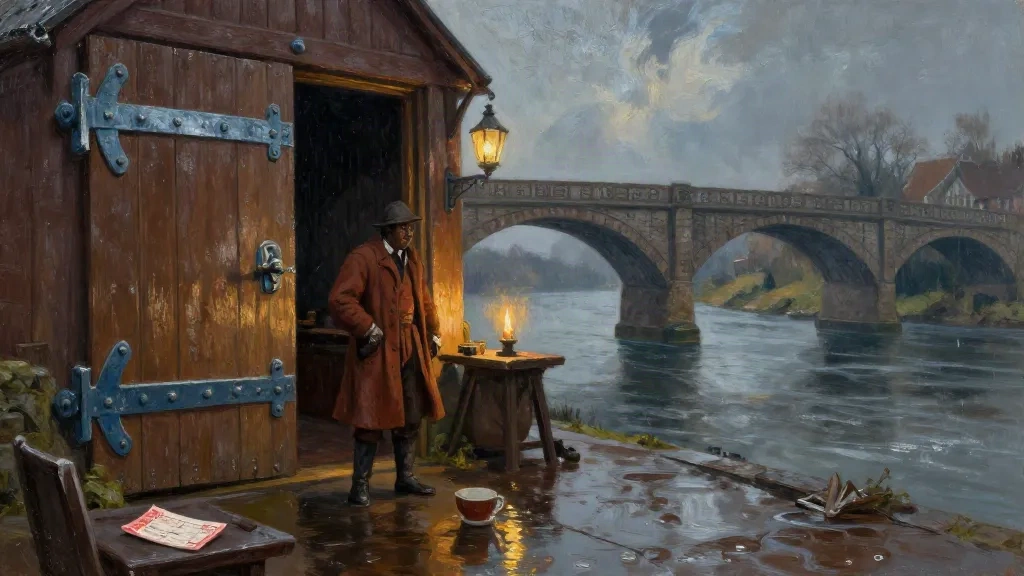
By the time Mara Venn reached the western quay, the rain had turned the river the color of old steel. Bellwether stood on both banks, joined by bridges whose arches were carved with promises: We shall return. No debt crosses dry-footed. What is witnessed here is never lost.
She stopped beneath the foundry eaves and listened to the hammer inside. Every morning, the town’s doors were repaired by her hand. Not ordinary doors. The hinges of enormous absent doors appeared throughout Bellwether, standing in locked courtyards, beneath bridgeheads, inside abandoned customs houses, sometimes in the middle of fields. They were oak and iron, tall enough for giants, fitted with hinges forged in a fire no smith had seen. When one began to rot, the promise it guarded began to change.
Mara had repaired eleven such doors. She never opened them. That was not modesty. The municipal records made the consequence plain: one door opened in 1789, and the western bank disappeared from every map before sunset.
On the workbench lay an envelope dampened by rain. Inside was a train ticket printed in red ink, dated the sixth of Frostmere, 1842. The destination was Bellwether, but the departure station was a place Mara knew from her mother’s tales: Tomorrow Junction.
Beside it sat an empty teacup. No tea. No stain. The cup bore the seal of the River Office, and a note in Commissioner Halden’s hand read: Some futures are safer unwitnessed.
The Office of Closed Histories
Halden received her inside the old tollhouse, where the river appeared in every polished window. He was broad, tobacco-brown, and always smelled of boiled leaves and lamp oil.
“You found the ticket,” he said.
“It was beneath the teacup.”
“The teacup was beneath the future.” He gestured toward the river. In the blue dusk, a train whistle answered from nowhere.
Bellwether’s bridgekeepers collected promises for a living. Halden collected the moments when a promise could be changed: before a marriage, before a pardon, before a child left for the capital. His office paid families to remove inconvenient words from public record. A promise unrecorded could not be broken, Halden explained, because the river never heard it.
That was the mystery Mara had accepted since childhood. It was also the lie on which his prosperity rested. She had seen the river ledger in the locked room behind his desk. Names crossed out. Bridges repaired with iron taken from memorial gates. The town remembered only what Halden permitted it to remember.
“Tomorrow Junction is a rumor,” Mara said.
“Tomorrow Junction is a destination.”
He poured water into the teacup. It remained empty, though the cup was full to its rim. A candle flame bent toward the window.
“The bridge south of us was built for a train that never arrived. The next train arrives tomorrow. If you open the door, the future arrives with it.”
Mara thought of her daughter’s schoolroom, the new gas lamps promised by council, the widow’s house still marked as her husband’s property. She wanted a future where no one could erase her.
“What do you gain?” she asked.
Halden smiled. “A future with no surprises.”
Hinges Made of Choice
At midnight, Mara carried the train ticket to the largest absent door. It rose behind the old station, black boards silvered by rain, with hinges thick as mooring chains. Candlelight from the station lantern trembled across its surface.
She had brought her tools, but not a plan. The door had been waiting for her. In its grain she saw Bellwether as it was: muddy streets, drowned fields, the first bridge built by conquerors. It was not a door to another place. It was a door to every version of the town that had refused to become itself.
Behind her, Halden’s men came with lanterns and a writ stamped by the River Office. “By order,” one called, “the future is postponed.”
Mara set the empty teacup against the threshold. The candle flame inside it flared, despite the rain. The river answered with a deep metallic groan.
She understood then: the cup did not contain tea or emptiness. It contained the moment before a decision. The ticket was not an invitation. It was a wager.
To open the door, she had to forge a hinge that could bear a future she had not chosen. Such a hinge would need a promise freely given, not a debt extracted from the living.
She struck the iron once. The sound rolled across the water. Twice. Every bridge in Bellwether trembled.
Then she called the citizens from their windows and houses. She named the promises they had been forbidden to record: the widow who had rebuilt her home, the apprentices who would open a trade school, the boy who had promised to leave but intended to return.
They spoke into the rain. The river listened.
The Ending Is Not Earned
At dawn, Mara opened the door.
No kingdom appeared. No army. Only a second Bellwether, standing in clear morning light beyond the threshold. Its bridges were repaired. Its shops were open. The same people stood there, older by one year, carrying tools she had not yet made.
One of them stepped forward. It was Mara herself, with grey at her temples.
“Is it true?” the older woman asked. “Did we choose well?”
Mara looked at Halden’s empty teacup, the red ticket trembling in the wind, and the river reflecting candlelight even beneath the brightening sky.
“We chose,” she said. “That is the only ending we earned.”
She did not step through. A future, she understood, was not a prize to possess. It was a hinge to keep oiled. Every bridge held because someone had chosen to repair it, and someone else had chosen to cross.
The older Mara smiled. The second Bellwether withdrew, not vanishing but settling into Bellwether’s streets like a bell’s last note.
When Halden reached the threshold, the door slammed shut. His office vanished with the empty cup, the erased ledger, and the writ in his hand. He remained on the riverbank, unemployed and astonished.
Mara turned the train ticket over. A new line had appeared in red ink: RETURN WHEN YOU HAVE LEARNED TO LEAVE.
She pocketed it. The river carried the reflection of the town’s lamps toward the sea, and Bellwether began, cautiously, to remember the future.





