 Netwrck
Historical Fantasy.
The Cinema Below the Coal Cellar
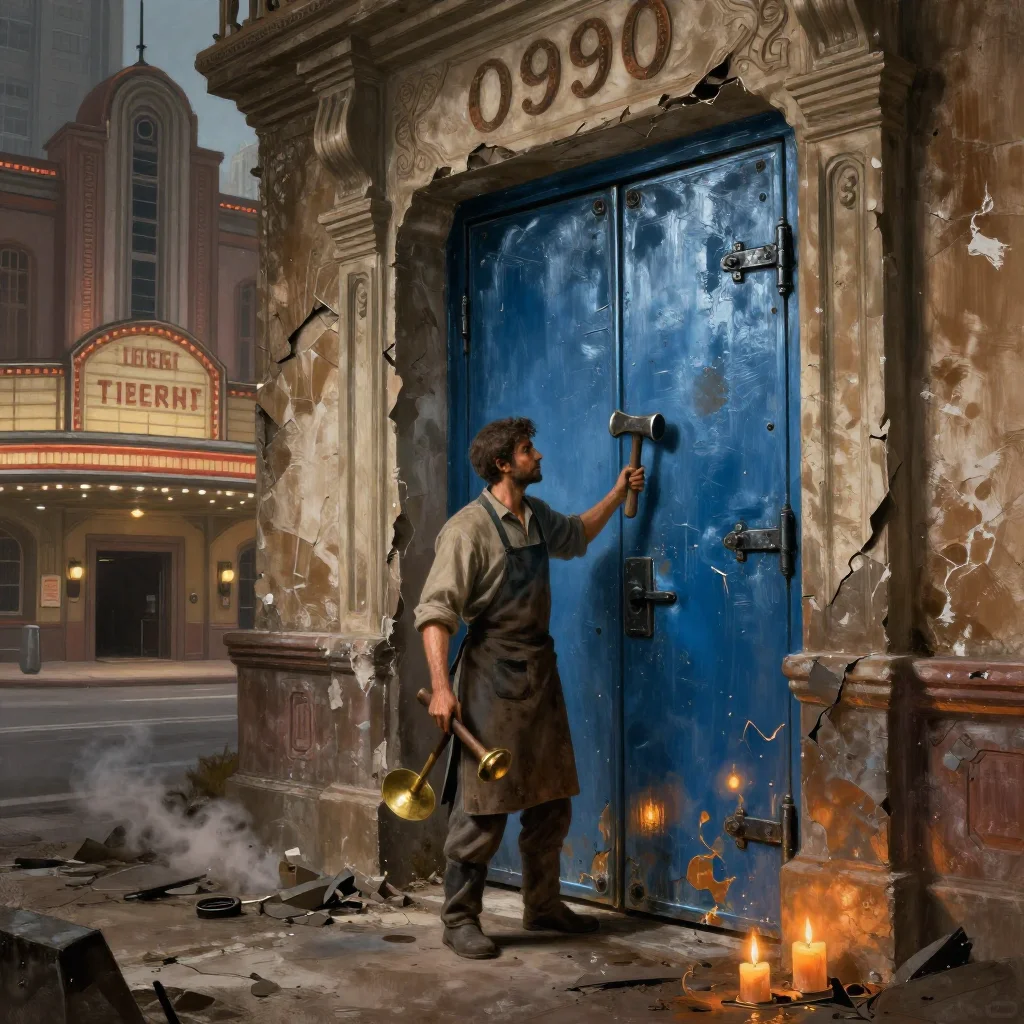
By the winter of 1897, the Rialto Cinema had been abandoned for nineteen years. Rain stitched down its ticket window, peeled the letters from the entrance, and gathered dust over the marble staircase. Yet beneath the cellar, where the old coal bins opened onto brick, a pale blue light shone every evening at dusk.
That was where Ansel Vane kept his forge.
He was a broad-shouldered blacksmith with a soot-dark beard and hands like iron tools. The village called him a curious man, because he repaired more than scythes and wagon braces. He repaired hinges. Great ones, for great doors, though no such doors stood above ground.
Each night, when the blue glow strengthened, Ansel descended with his hammer, files, and small tin of lamp oil. In the cellar wall, a seam of silver appeared. He would set his shoulder to it and pry it open. Beyond lay a corridor of doors, each taller than a man and polished as steel-blue water.
Behind one, he once saw a city marching beneath red banners. Behind another, a harvest failing while children sang in a language he did not know. The doors were always locked. Their hinges, however, were loosening.
The Ticket and the Teacup
On a table in the projection room, beneath a sheet embroidered with silver thread, lay a train ticket and an empty teacup.
The ticket was dated 18 June 1911. Its destination read Bellwether Junction, a town that did not yet exist on any map Ansel knew. The teacup was white china, chipped at the rim, still warm. Its surface held the reflection of a candle flame, though the room had no candle.
He had found them during his first repair. The ticket seemed harmless then. The teacup seemed less so. Whenever he touched its handle, the films on the cinema screen changed, and he heard a woman say his name.
“Ansel,” she whispered, “do not choose for us.”
He asked who was speaking. The voice answered, “You will.”
The Men Who Profited from Doubt
The power behind the mystery was not the cinema’s owner. The owner had vanished years before. It was Mr. Bell, the town’s railway agent, a soft man with a soft voice and a ledger full of narrow handwriting.
Bell collected the loose tickets from beneath the cinema seats. He paid Ansel for repairs he never reported, and he told the village that the doors were only machinery. Yet Bell watched them closely. Every hinge Ansel mended, Bell recorded. Every future image, Bell copied.
“People will not buy uncertainty,” Bell told him one afternoon. “They will buy certainty. One destination. One ending. A railway fare and a clean cup set on the table.”
Ansel understood then. The films were not being shown for the village’s pleasure. Bell sold the difference between possible futures, trading certainty to those who could pay. The empty teacup was a promise withheld. The ticket was a claim.
When Ansel refused to mend the largest hinge, three men arrived with crowbars. They pried the door open, and on the screen appeared Bellwether Junction, shining under an unfamiliar sun. A crowd cheered. A woman in a red scarf waved at Ansel. She was the voice.
Bell smiled. “See? A future worth choosing.”
The Door Without an Ending
Ansel returned after midnight with his hammer. He had repaired the hinge, but he would not strike the pin home.
“The future has not earned its ending,” he said.
Bell lunged for him. Ansel drove the hammer into the door, not to open it but to hold it. The steel-blue light spilled across the cellar, swallowing the ledger in Bell’s hand. Pages lifted and scattered. Dates, names, and prices tangled in the air.
The woman in the red scarf appeared in the unfinished image. Behind her, Bellwether Junction was still being built. Its streets wandered between hills. Some windows were dark, some bright. A child held an empty teacup at a station platform.
“Then build it with us,” she said.
At dawn, Ansel used the warm teacup to quench his final repair. Steam rose between the hinges. The vast door remained open, not because a future had been chosen, but because its people still had time to choose.
From then on, the Rialto showed unfinished films: towns changing their names, wars stopping before the first shot, harvests saved by an argument made in time. Nobody could say which ending would last. Bell’s certainty vanished in the blue light.
Ansel kept the ticket in his pocket, though its destination had never been taken. He left the teacup beside the screen. Every night it filled with warm tea, and every morning it was empty again.





