 Netwrck
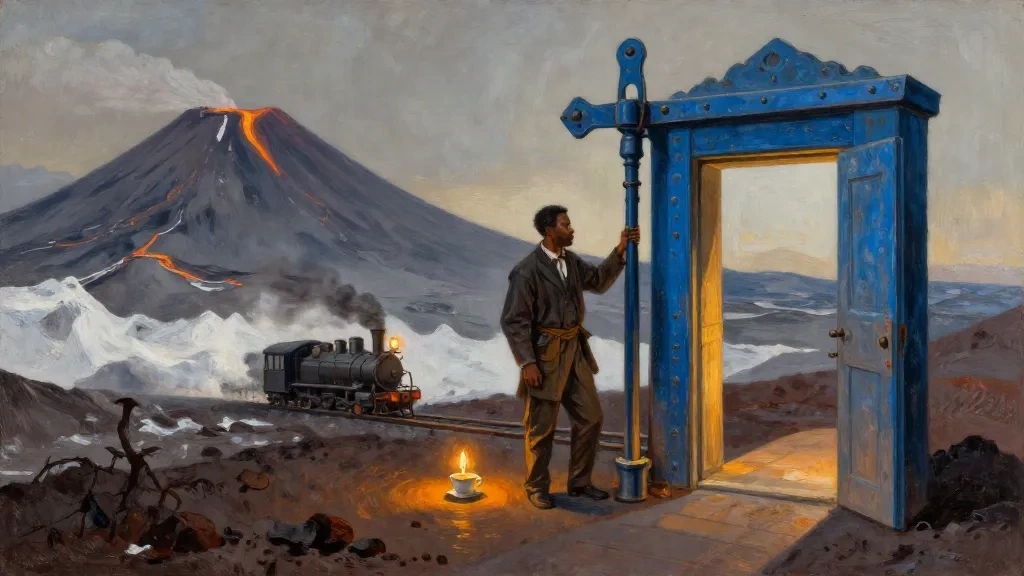
The Doors Without Walls
In the winter of 1887 the fire beneath Mount Ossian turned blue and dreamed of burning. Iona Vale carried a roll of hinge tools up the observatory stair while snow hissed against the volcanic glass, each flake going to vapour a hand's width from the pane. Above her, a bell in a cage of black iron struck the hour by means she had never bothered to learn. Below, pipes the thickness of her arm trembled with the patient breathing of a mountain, and every fourth breath carried up through the floor a smell like iron filings and snow.
The observatory was famous for its doors. Travellers descending from the eastern provinces swore they had passed arched entrances hung with frost, each opening onto a room they remembered with perfect and inconvenient detail: a marriage, a funeral, a winter without coal. Scholars in the capital called it an old civic myth, the sort of thing invented to make a mountain interesting. The Mountain Office called it restricted infrastructure and fined the scholars.
Iona did not care for explanations. A hinge was a promise between two surfaces. It admitted nothing and permitted everything, and if it was true and seated and free of rust it would hold for a hundred years without once being asked to hold. She had been mending them since she was nineteen. She had mended the hinge on the Ash Street door in 1879, the year of the bad coal, and she had not forgotten the widow who walked through and came out unable to say her daughter's name.
She had told herself for eight years that this was the widow's own choosing. It was a comfortable sentence. It fit in the pocket beside her father's watch, which was where she kept the things she would not argue with.
Steel Remembers Being Used
That morning she found the largest hinge yet, lying naked on her anvil where no hinge had lain the night before. It was twelve feet long, cast from blue-black steel, the colour of a bruise on a hand. She turned it once and read the mark on the knuckle: her father's shop mark, the V over the fire, struck in reverse for the casting. Her father had been dead eleven years. He had never made anything larger than a gate.
No door in the mountain fitted it. She tried it against the furnace arch, against the frame of the great reflector, against the low door of the instrument cellar. It was too long for all of them by a foot and more, and it was heavy in a way that felt less like mass and more like argument. When she lifted it, something fell out of the hollow barrel and struck the anvil like a bell.
A train ticket, brown with age it was not. One passage, Ossian Central to Bellweather. The departure was stamped for tomorrow at 4:17 in the afternoon. Bellweather lay two hundred miles east, though the railway had ended there in 1859, and the ground between had been sold, subdivided, and resold by men who had never once seen a train.
She turned the ticket over. On the back, in a small precise hand that she knew as she knew her own handwriting in the sense of a bruise, was a line: Do not let them bill you for it.
Tomas had signed his name with a stroke that ran under the whole word, as though he meant to get out from under it quickly.
The Man Who Kept the Mountain Blind
Master Oren Vey, keeper of the observatory, came up the stair without hurry, though no man of his age took stairs without hurry. Tobacco-brown coat, brass spectacles, hands polished by decades of handling other people's evidence.
“You found the eastern hinge,” he said.
“I found steel.”
“Steel remembers being used.” He set his hat on the bench and did not sit. “There is a room at the bottom of the lower furnace where the hinges are stored. There is a ledger there. You have not been down and I would rather you did not go.”
He offered her a salary in folded crowns and a key to the lower furnace, which she already had, and which had been given to her by a man who died of lung fever in 1881 and had not been told what it opened. Every month, Vey explained, the mountain tested its people against the choices they feared. A shutter would close around a missed opportunity. A clock would run backward through a wasted life. The Office recorded the results and then erased them from public notice, so that a town could not learn that its shoemaker had once been a soldier, or that its blacksmith might have had a daughter in Darrow.
“Who profits?” Iona asked.
“Everyone who arrives after a future has closed.” Vey's spectacles took the candlelight and gave nothing back. “Fear is patient. Doubt pays rent.”
“Rent to whom?”
That was the wrong question, and she knew it before she had finished asking it, because Vey's face closed like a furnace door. The Office did not take rent. It stored it. Everything the mountain showed and nobody walked through did not stop existing; it went down into the rock with the rest, and the Office kept the ledger, and the ledger kept the years, and somewhere in the keeping they were worth something to a man who could be made to believe he had never thrown them away.
“Your brother looked,” Vey said, softer. “I did not lie to you eleven years ago when I told you the doors were harmless. I have never lied to you since. I have simply declined to correct an old kindness.”
The Fifth Bell
At the fifth bell she carried the great hinge up to the observatory roof, because the roof was the only place in the building where you could see both the station below and the sky above, and she wanted them in the same look.
The station had been a station for ninety years. In summer it served two mail trains a week. Tonight a train waited in a wind tunnel of steam, its carriages without windows, the conductor in a uniform with standing collars and a braid that no northern kingdom had ever issued. He was perhaps fifty, perhaps twenty. He asked, courteous as a customs man, what she intended to do with the journey.
Iona set the ticket on the rail. “I came here to choose a future that has not yet earned its ending.”
“Ah.” He placed an empty teacup on the platform, saucer and all, as though this were a place where people sat down. “Most people arrive with an ending already folded in their pocket. The door refuses them. The door has no interest in them at all, whatever the Office prints on its notices.”
Then Vey's men came up the stair: six of them, with extinguishers and a canvas hood for the ledger, and Prefect Halden behind them carrying a decree that made the hinges evidence of dangerous sorcery and the mountain a place where such evidence was to be gathered, folded, and stored. Vey himself came last, and he shouted down from the parapet that the doors were never meant to open. Every future the mountain showed was a temptation, he called. Every passenger who looked through one came back willing to accept the first ending offered to them, and a man who accepts the first ending is a man who has stopped being a citizen and started being a tenant.
It was a good argument. She held it up the way you hold up a tool you have decided not to use yet.
“Then name the tenant,” she said.
Vey did not answer. The men below unrolled their canvas. Somewhere under the floor the pipes breathed their fourth breath, and the whole mountain shifted a quarter inch, the way a sleeping man shifts when he is being told a story he has heard before.
What the Ledger Owed
She went down to the lower furnace at the sixth bell with the great hinge on her shoulder and Halden's men three floors above, arguing about the wording of a report. The key turned. The door was warm.
Behind it, the hinges were stacked to the ceiling, hundreds of them, blue-black, every one cast with a maker's mark she knew: Vale over fire, and the Darrow smiths, and a foundry at Corve that had burned in 1844. She had mended forty of these. She had mended them for the Office, for eleven years, for a wage in folded crowns, and she had known in her body, the way a person knows a sound is wrong, that mending was not the same as opening and that she had made a life out of the difference.
The ledger lay open on the furnace lid, and the mountain had been writing in it since the fire turned blue. Column one: the hinge. Column two: the door. Column three: what the door showed. Column four: what the passenger took.
Entry for 4 March 1878, Ash Street: Widow Hanne, one door. Showed: daughter dead of cold, 1879. Took: the knowledge of it.
Iona had hung that hinge. She had watched the woman go through and come back with her basket still on her arm and her face like a scoured pot, and she had been given a crown and a half for the afternoon, and she had spent it on coal.
Under that, in the same neat upright hand, Vey, R., one door. Showed: wife living, 1849. Took: the having.
He had looked into a future where his wife had never married him, and the price of the looking was that he no longer remembered being loved at all. She looked at the entry, and at his name, and understood that the man on the parapet was not lying to protect the Office. He was lying to protect the only person in the mountain he had not yet ruined.
And at the bottom of the last page, on a line written in a different ink, in that stroke that ran out from under itself:
Tomas Vale, one door, 1878. Showed: everything. Took: the year of it.
The Ending Not Yet Written
She came back up to the roof with the ledger under her arm and the great hinge across her shoulder and the whole of her life rearranged behind her sternum into a shape she had not been carrying before.
“It is not a test,” she said. “Tests end. There is a ledger and the entries go down and down. The mountain shows, the Office collects, and the rest is rent, and you are not the landlord, Master Vey. You are the tenant who is afraid of the lease.”
“The doors take,” Vey said, and his voice cracked in the middle of the word like a cold bar. “That is the whole of it. They take.”
“They take from whoever is not holding the ledger.”
She struck the great hinge against the rail. The sound went through the station, down the tunnels, into the mountain's sleeping throat, and the extinct volcano answered with one blue flame that stood up off the platform without heat or smoke. In the carriages without windows something that had been a conductor and a train and a kingdom that did not yet exist went to ash in the space of a breath, and the ash fell upward, which is what ash does when the wind is coming from a direction that has not been invented.
Halden's men raised their extinguishers and lowered them again, because there is no arguing with a blue flame and no authority in a room where the furniture is on fire. The prefect began to write. The ledger under her arm began, very slightly, to be warm.
The ticket trembled beneath her thumb, stamped now with every possible departure. East to a city built out of compassion and drowning in it. North to a country where no law could command love and the countryside was quiet for that reason. South to a village that remembered every death in the valley, with one exception, and the exception was her mother.
She tore the ticket into pieces. She fed them to the flame. The fire took the rail and the platform and the last of Vey's authority in the mountain, and the ledger in her arms went hot enough to blister through the leather, and she dropped it, and it burned, and every closed year in it went up at once.
That was the cost. She had known it would be a cost and she had done it anyway, and she would carry that fact for the rest of her life, along with four hundred and eleven unchosen lives going up through the mountain's throat. Some of them would land in people. Most people, she thought, would be better off with them than without.
Some of them, she thought, would not.
At dawn she set the great hinge into a new frame on the roof: two uprights of untreated timber, a lintel scarred by axe and weather, and nothing whatever behind them. The blue flame had gone out by then. The mountain breathed its ordinary breath. Vey was gone down the west stair, taking his ledger-shaped coat and his terrible arithmetic with him, and Halden's men were asleep on the platform among the ash, having fallen asleep the way men do when the reason they came has been taken away.
The Doorway Through the Snow
When the railway men came up in the morning, they found no prophecy, no forbidden room, no grand explanation and nothing to write in the special column. Only a doorway through the snow, standing by itself in the weather like a thing that had always been there.
That afternoon a train arrived at Ossian Central with real carriages and real windows, and a guard who wanted to know who had left the frame standing on the north roof, and Iona told him it was not a door, it was a frame, and he said that was the same thing with less paper.
On the platform she left the empty teacup. Nobody had taken it. It was a cheap thing, thin as an eggshell, and it had no shadow, and twice in that day she saw someone looking at it and turning away as though it had caught them doing something.
In the spring a letter came from a village two days east. Widow Hanne, whose daughter had died of cold in 1879 and whom Iona had known since 1879 for a woman who had lost something she could not name, wrote to say that the name had come back to her in her sleep and that she had woken and sat on the edge of the bed for an hour. She did not know who to thank. She said the handwriting on the envelope was the same as on the hinge invoice for the Ash Street door, and she asked, in the way of people asking, whether a person who had been made to forget ought to be told.
Iona wrote back no, and then wrote yes, and then she put both in the stove and sat with the empty cup until the light failed.
When they buried Tomas, they buried the coat. She was at the graveside and the men were saying that it had been nine years and the mountain had not given him back, and she did not tell them what the ledger had said, because the ledger was ash and because the truth of it was that she had signed for a crown and a half and spent it on coal, the same as anyone.
Afterwards the child came, the one who always came, with his hands in his sleeves and his question. Iona had the hammer in one hand. The other hand she had given to the cup, which was clean, and empty, and had not once shown her a face.
“What is it for?” the child asked.
She looked east, down the valley, where the morning was still being made and had not yet been told what it would be for.
“That,” she said, “is for us.”





