 Netwrck
Weird Fiction.
Hinges for vanished buildings
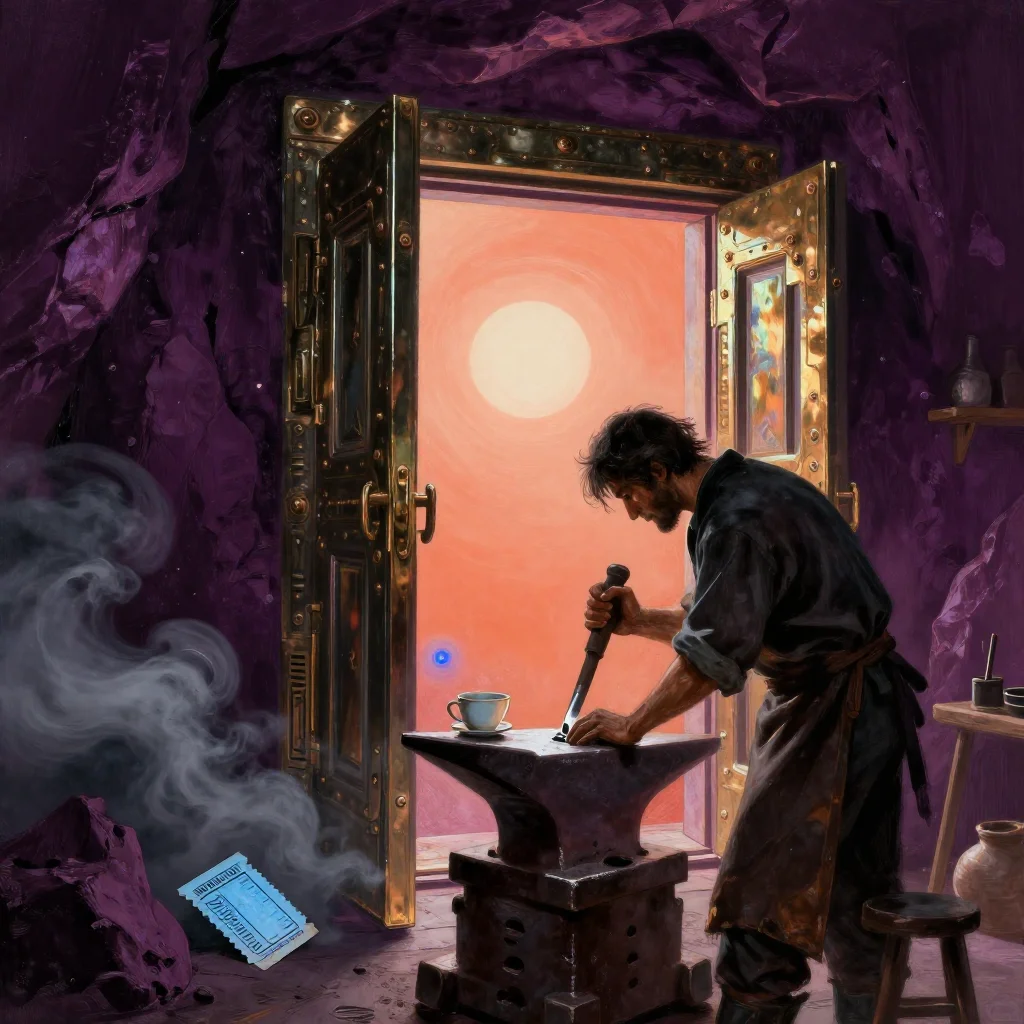
Ardan woke before the saffron bells and descended through the comet’s plum-dark throat, carrying oils, hides, and a hammer shaped like a broken crown. The monastery drifted toward a blue-white sun, its corridors lined with doors that opened onto nothing.
Not darkness. Not sky. Nothing retained the memory of a wall.
Each hinge was enormous. Bronze bars thicker than his thigh joined invisible jambs and vanished under polished floors. Beyond them waited absences so complete that birds flying past altered course. Ardan repaired the hinges because the abbey paid him to repair the hinges. The absent doors had once belonged to the world below: bathhouses, courthouses, kitchens where monks had eaten onions before the comet took them.
Smoke-grey air moved through the workshop. Saffron lamps burned without wicks, tinting the brass.
His master, Brother Ilex, inspected every hinge by tapping it once. Some answered with the boom of a furnace. Some with surf. One, lately, with a carriage descending a steep street.
“They are settling,” Ilex said.
Ardan tightened the final pin. “Buildings do not settle.”
“Then why does the New Year sound like a train entering a station?”
The fare already collected
In the archive Ardan found a registry of doors. Each line named a vanished structure, the year it disappeared, and the name of the monk responsible for sealing it. Beside his own name was the current year. No building.
Beneath that entry lay a paper train ticket.
It was blue with age and smelled of rain on hot stone. Its destination read THE YEAR AFTER. Its departure date was tomorrow.
Brother Ilex took the ticket without looking startled. “Keep it,” Ardan said.
“It was waiting for you.”
“Where?”
“That cannot be said while the door remains shut.”
The power controlling the monastery was the Prior, Vey, who collected from every village below for the privilege of uncertain weather. No taxes, no debts, no conscription survived the comet’s passage. Yet villages grew poorer each year, and Vey’s coffers rang like full bells.
Ardan followed the smell of tea to the Prior’s solar. An empty teacup stood on the table, still warm, its inner wall marked by a brown crescent.
“They are afraid of a future,” Vey said. “If we open a door to next year, they will abandon this one. That is how hope ruins a people.”
“Then why keep collecting?”
“Fear is a faithful tenant.”
Vey smiled. Ardan understood, then, that the doors were not lost. Their hinges held the years together. Every closed threshold left the present answerable only to the past, and Vey charged for that authority.
What the empty cup held
Ardan poured tea for Ilex in the refectory.
The monk stared at the cup as if it contained a weapon.
“When I was a novice,” he said, “we believed every cup contained the future of whoever drank from it. If it emptied, the future was certain. If it stayed full, the drinker remained undecided.”
“That belief was profitably misplaced.”
“Yes. Vey removed the saucer.”
That night, the Vesper Toll rang though the bell rope hung still. From below came the whistle of brakes, wheels striking joints, hundreds of passengers arriving in a silent carriage.
Ardan reached the eastern workshop with the ticket. The largest hinge stood against the wall, polished by generations of hands. It belonged to a door the registry called the Chamber of Consequence.
He struck the pin with his crown-shaped hammer. Bronze sang. The workshop tilted. Through the keyhole came saffron light and the murmur of tomorrow.
Brother Ilex arrived carrying the empty teacup. “A destination,” he said, answering the question Ardan had never asked, “is not a fate.”
They loosened the hinge. Door by door, the monastery confessed its machinery: gears buried in the chapel, censers filled with tomorrow’s ash, spring water carrying cries from a summer no one had lived yet.
Vey climbed toward them, led by the monastery’s bells. With every step, the absent doors tightened.
A future without an ending
The locks fought the hammer. Ardan’s hands split. Ilex held the gap while the comet entered its long shadow.
“Close it,” Vey commanded. “Tomorrow will ask for what today cannot bear.”
Ardan pulled the final pin.
The Chamber of Consequence opened.
No grand city waited. There was only a small workbench, a cup filled to its rim, and a sheet of paper bearing the unfinished sentence: Ardan chose—
He did not read the ending.
Instead he set the empty teacup beside the sentence and took up his hammer. Behind him, the new year poured through the monastery: cold rain, chimney smoke, unknown birds calling in saffron air. The doors opened onto places not yet completed.
Vey vanished into the first crowd.
Brother Ilex smiled. “Will you join him?”
Ardan struck the nearest hinge.
“No,” he said. “I have hinges to mend.”
Years later, travelers claimed a bright forge moved through a monastery riding a comet. They brought it hinges from distant doors, empty cups, and tickets to years that had wisely left their endings unwritten. At the new threshold, the blacksmith welcomed them in.
To return, travelers had to choose what they might become.
He never asked them to surrender it.





