 Netwrck
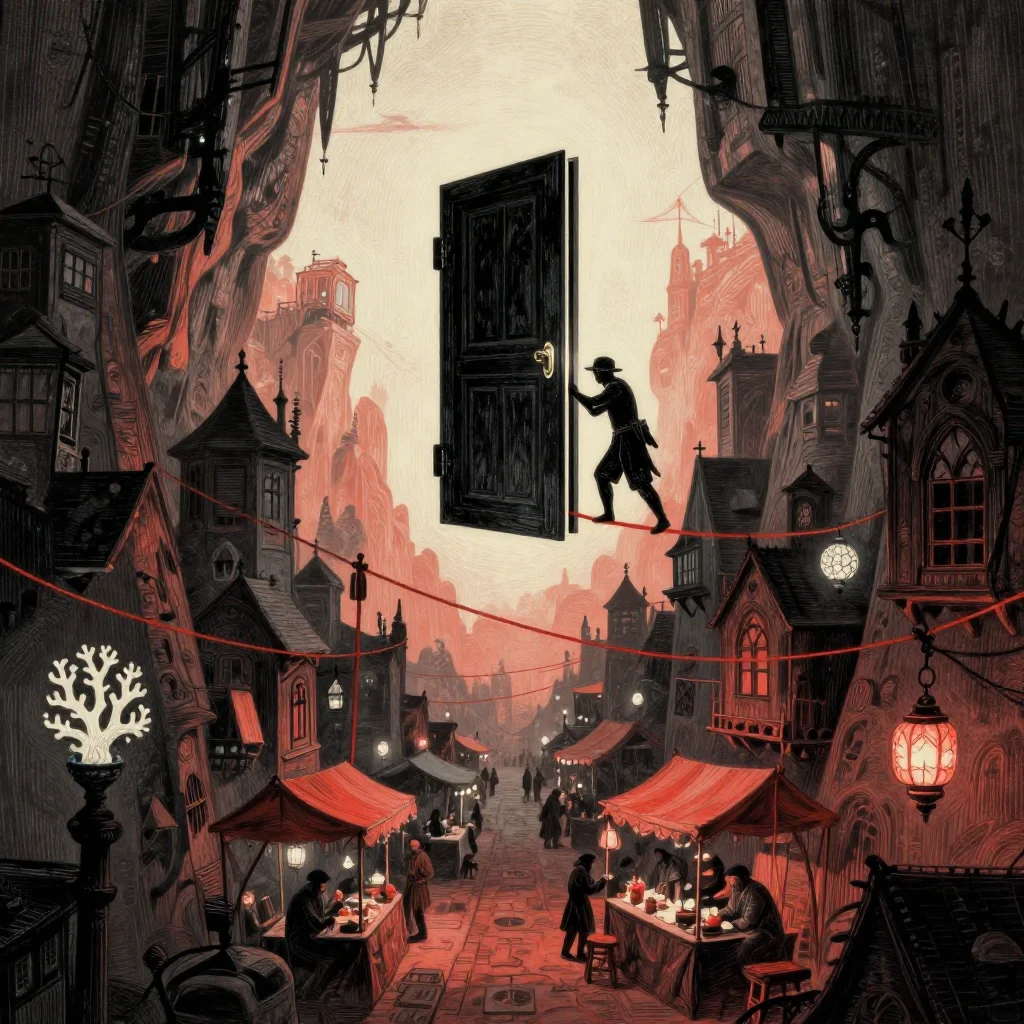
Gothic Fantasy.
The Market Under the Floor
The night market hung beneath Bellwether’s first floor, suspended over a chasm whose bottom had never been measured. Lanterns burned white coral. Ink ran down the market’s black awnings. Between stalls of bottled thunder and salt shaped like sleeping birds, a single red thread crossed every surface: tied around pear stems, pinned above doorframes, trailing from the vendor of small, sour faces.
Oran Vey repaired hinges for doors that did not exist.
They arrived in crates stamped EMPTY and departed in the same crates, though the hinges were always heavier. He would grind their pins until they swung without a sound, oil their joints with lampblack, and ask no owner where the door had been. The market had one rule: the doors must remain absent.
On the night the ticket appeared, he found it folded beneath his workbench. White paper, black departure stamp, and a departure time written in his own hand.
Four seventeen. Northbound.
Beside it sat an empty teacup, its white coral glaze crossed by a thread of red. Oran had not seen either object before. Around him, the market seemed to hold its breath.
The Office of Closed Histories
The magistrate found him beneath the awnings before dawn.
Magistrate Pell wore white gloves stained at the seams with ink. Red thread bound his cuff to his sleeve, though he claimed not to know why.
“You repaired Hinge Nine,” Pell said.
“I repair all of them.”
“Not after tonight. Hinge Nine belonged to a door removed from the city’s records.”
Oran looked at the magistrate. “A door needs hinges.”
“This one does not.”
Pell’s warning carried no heat. That frightened Oran more. In the upper city, men feared the Office of Closed Histories because it opened files and discovered offenses. In the lower market, they feared it because it closed them. A person erased from the record received no rent, no bread, no burial. Their house became vacant, their name became noise, and the city profited from the space between what had happened and what could be claimed.
“The hinges are revenue,” Pell continued. “Every absent door keeps another possible future outside the walls.”
“Possible for whom?”
“For those who can afford to choose them.”
Oran touched the ticket in his pocket. The paper had begun to warm.
Pell offered him a month’s wages to forget Hinge Nine. The amount was exact enough to be insulting. Oran refused. Pell left a red thread on the workbench and said the Office would return when the city grew tired of his questions.
What the Door Remembered
He followed the red thread through the market.
It passed beneath tables, through drainpipes, and into a stairwell where the walls narrowed with each step. At the bottom stood a door made of black wood. No hinges. No lock. Only a small, empty teacup resting against its base.
Oran had mended a door for his wife before she died. He had never asked where she went after. Now he understood the reason: Bellwether had taken the answer while leaving him the hardware.
He knelt and fitted Hinge Nine into the wood. With every turn, the market above filled with voices. A child laughing in a room that no longer existed. A woman counting coins beneath a vanished window. His wife saying, Do not build the ending for me.
The red thread tightened around the teacup.
Then a slot opened in the door. Cold air entered, carrying the smell of rain and iron.
Beyond it stood a platform, far above the market, beneath an open sky. A train waited with its lamps burning white. Its departure board showed one destination: Tomorrow.
Oran understood the trap. The city sold him a future because it had not yet earned an ending. A train carried people away only after their names had been paid for, their choices recorded, their possible lives filed beneath someone else’s seal. To board, he would have to surrender the last door that remembered his wife.
He drew the train ticket from his pocket. The ink had changed. It now read RETURN.
A Door Left Open
The city began to shake.
Above them, bells rang in the empty streets. The market stalls tore free and rose like leaves on black water. From the platform came the whistle of the train, patient and precise.
Oran could have stepped through. He could have chosen a life where his wife still waited, where Bellwether had never taken anything, where the future arrived already decided. But such a future would belong to the Office. It would be beautiful because it had been sealed beyond questioning.
He tore the ticket in half.
The train lights flickered. The red thread snapped from the teacup and raced up the door.
Then Oran did the work he had been paid for. He drove the hinge deep into the wood and opened the door the rest of the way.
The train screamed once and departed without him. Across the platform, every red thread loosened at the same instant. Above the market, shutters flew open. Doors returned to houses no one could name. Ink spilled from public ledgers and spread across the floor like a dark tide.
By morning, the Office of Closed Histories had vanished, leaving only a white teacup on the stairwell floor. Oran placed the train ticket beneath it, one half marked northbound, one half marked return.
He did not choose a future. He chose the hinge that would let one remain possible.





