 Netwrck
Folk Horror.
The cinema behind the wall
By first frost, the old Orpheum had sunk deeper into the hill behind Saint Brannock's disused station. Only its ticket window remained above the snow, a narrow black mouth with no glass. Every winter, someone found a fresh train ticket inside it, punched for a destination that had never been built.
That winter, the ticket was mine.
I am a blacksmith. My forge stands beneath the water tower, where iron rings when the cold changes. I repair hinges, especially enormous ones, and not only because they bring a fair price. A hinge is a promise between two things: the door and the wall that refuses to let it go. Mine are made from axle iron and old carriage springs, hammered flat enough to fit into places ordinary builders would not trouble to notice.
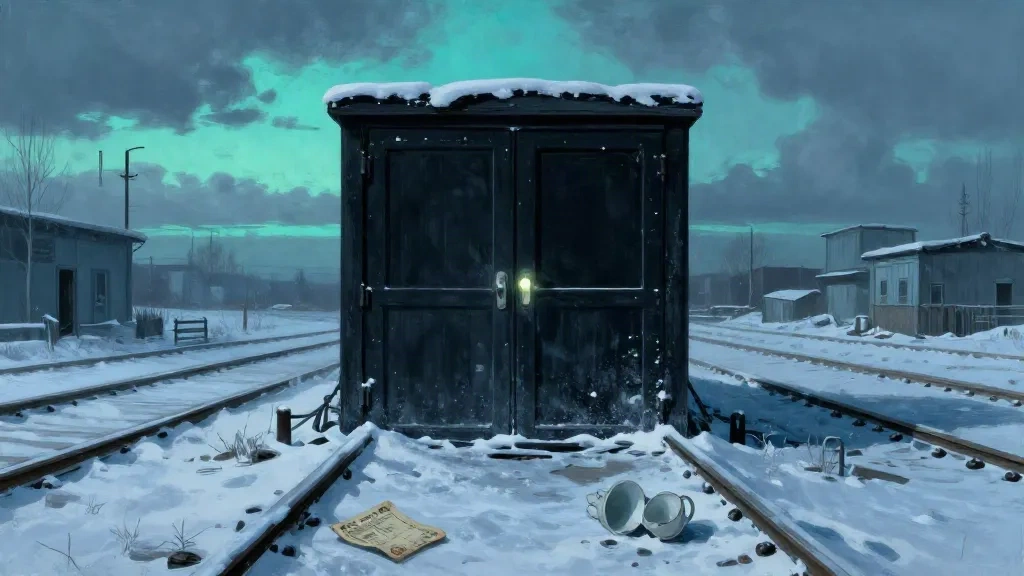
On the night the ticket appeared, I followed the rail line without a lantern. The Orpheum's entrance waited behind a wall of packed snow, yet its doors were visible through it: twelve feet high, black as a thunderhead, each one carrying a central hinge wider than my shoulders. Cold radiated from them in pale sheets. When I touched the nearest hinge, frost formed between its teeth.
The door swung inward without opening.
Inside was not darkness but a theatre filled with blue haze. Rows of seats faced a blank screen. Above the screen, a clock stopped at 4:17.
The future that lost its train
A woman in a railway cloak sat in the last row, holding an empty teacup between her palms. She had no face, only the smooth shine of a polished spoon.
“You came to choose,” she said.
The cup filled with tea. Steam rose from it in the shape of a station sign: BRANNOCK, NORTH, UNFINISHED.
On the screen, a film began. A town woke beneath a red sun. Children carried water through streets where every window burned. A blacksmith stood at my forge, younger than me, hammering a crown. The townspeople called her the Morning Warden, and they cheered when she sealed the sky shut.
That future had almost happened. The woman told me its ending had been earned by a choice already made: the river diverted, the north quarter abandoned, the last wild dogs shot so the roads would stay quiet. In the film, everyone praised the Warden. No one remembered the names of the missing.
Other screens flickered. In one, the town drowned under black water. In another, the station opened and a train carried every child away. In the last, I married a man with iron cuffs, grew blind, and died beside my own forge.
“You may take any of these,” the woman said. “Only choose one that has not yet earned its ending.”
That was the bargain hidden in the request. The cinema offered me a future and made me responsible for completing it. I wanted no inherited ending. I wanted the train to arrive before the schedule was written. I wanted Saint Brannock to remain a town of ordinary grief, not a monument to somebody else's necessary sacrifice.
The company of locked doors
I left with the ticket. The next morning, every road out of Saint Brannock ended at the Orpheum.
Men in black coats marked the route with red paint. They called themselves the Endkeepers. Their foreman, a thin man with wet eyes, said the futures belonged to the company that owned the cinema. The company had bought the land before the town existed. It paid for the films, the fire, the train tickets. In return, it received the difference between what happened and what might have happened.
When I burned my ticket, the snow around him melted into a shallow trench. When I forged a hinge that opened toward the town instead of away from it, the theatre doors began appearing in houses along the railway.
They were enormous, absent doors with no walls around them. People lost hours trying to pass through. Some returned speaking languages that had died centuries before. Some returned with empty hands and a conviction that they had murdered someone they still mourned.
The Endkeepers nailed the hinges shut. The foreman offered me my own ending: a warm room, a full cup, and a final sunrise with no memory of the road. I refused.
So they took my forge.
They came after the iron with chains, and I met them beside the water tower. My hammer split the first chain. The second struck my wrist. By dusk I was on my knees, and the foreman was saying that a future without a blacksmith was merely a future without property.
The hinge at 4:17
I crawled to the station with the empty teacup in my coat. It had never really belonged to the woman. It had been left at the forge years ago by my mother, who died before she could explain why she had watched the clock every evening at 4:17.
At the platform, I set the cup on the rail and laid my last iron hinge across it.
The station clock moved.
Not forward. Backward.
The Endkeepers came down the slope with lamps, shouting that the cinema was not meant to be opened. The old cinema did not open. It inhaled.
Walls of snow tore apart. Light rose from the buried theatre, impossible and soft, the cyan of a dawn arriving before the sun. Every absent door in town slammed once. On the blank screen, the film flickered without a projector.
I saw the northbound train rounding the bend, carrying passengers who had not yet been born, and beside it a second train traveling the other way. The station clock trembled between 4:16 and 4:17.
I drove the hinge into the rail.
The teacup shattered. A drop of tea struck the iron and became a line of frost. For one breath, the future opened like a hand with no palm, empty enough to hold whatever we made next.
The Endkeepers ran. The blue dawn entered Saint Brannock, but it did not erase the night. It set both inside the glass, side by side, while the absent hinges groaned awake.
I took the ticket from the snow. The destination had changed. It read: HERE, UNFINISHED.
Then the train arrived.





