 Netwrck
Historical Fantasy.
The Door Without a House
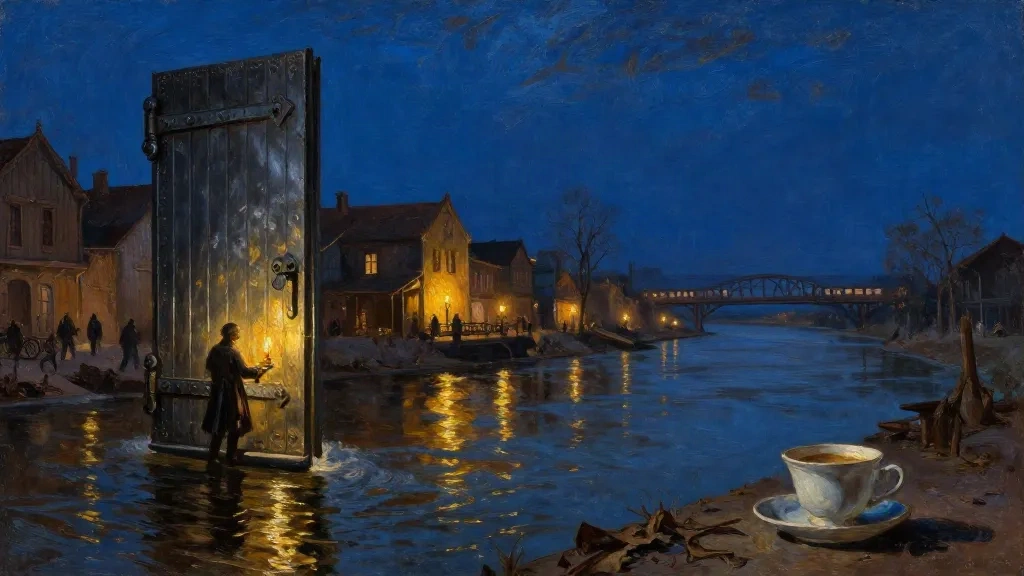
At dusk, the river ran east beneath Bellwether, dividing the town into weather and consequence. At midnight, it turned and ran west, carrying the reflected candles of the opposite bank toward the old quarter. By morning, every road had been rearranged, though only the people of the forge remembered the change.
Elias Venn repaired hinges. Not the small brass kind for household doors, but iron hinges shaped for enormous thresholds, each one stamped with the name of a house that no longer stood. He had inherited the work with his father's hammer and the warning: Some doors are not waiting to open. They are waiting for a witness.
His employer, Collector Marrow, paid in silver and tobacco. Elias never asked where the doors came from. He understood that questions were another kind of hinge: once lifted, they could not be made to close.
The Ticket and the Cup
On the night the river turned, a train ticket slid beneath Elias's door.
It was damp, printed in violet ink, and bore the departure time tomorrow, 04:17. The destination had been scratched away. Beside it sat an empty teacup, its rim marked with the black tea of Bellwether's vanished station. Elias had never seen the station, but he knew its whistle from the dreams of sleeping children.
He carried both objects to the forge. Outside, the river climbed its bank without spilling, as though a giant hand had tilted the world.
“That is not yours,” Marrow said from the shadows.
He was smaller than Elias remembered, though his coat still shone with the polish of a man accustomed to owning difficult things. Behind him stood a ledger bound in blue leather.
“The ticket belongs to the railway,” Marrow continued. “The cup belongs to whoever waits there. Neither belongs to the man who finds them.”
“And the doors?”
Marrow smiled without showing his teeth. “The doors are merchandise.”
He opened the ledger. On every page, a future was listed as a property: the year a marriage ended, the season a war began, the hour a child became an adult. In the margin beside each entry, Marrow had written a price.
He made money by keeping the mystery closed. Once a person knew which door led to which possible life, the river could not take the choice away.
Hinges Against the Current
Elias struck the first hinge at midnight.
The impact rang through Bellwether like a bell beneath water. Across the river, roofs lifted from vanished houses. Their doors appeared in the air, enormous and blue with moonlight, each one suspended above a different future.
One belonged to a woman who would never leave Bellwether. One opened onto a battlefield where the town had won. One revealed an empty train platform and a cup filled with hot tea.
Elias repaired them as quickly as he could, setting each hinge true. But Marrow followed him, pinning the doors shut with silver nails. With every nail, the river reversed another street.
“You are delaying the future,” Marrow said.
“I am giving it hinges.”
The final door stood before Elias's forge. Its hinges were rusted shut. Punched into the iron was a word: UNFINISHED.
He had spent his life making thresholds serviceable for owners whose names had vanished. Now he understood the cost of his obedience. A repaired hinge was a promise that something already decided could open the way.
Elias drove the silver nails from his own ledger. Marrow laughed and offered him a future of his own: wealth, a house, a life in which his daughter—if he had one—would never know the river's midnight trick.
It was a kind offer. It was also a closed door.
The Ending Not Yet Earned
The river turned. The train sounded beneath the water. In the empty cup, reflected candlelight gathered into a small gold horizon.
Elias opened the unfinished door.
Beyond it stood Bellwether as it might be in fifty years: the bridge repaired, the market full, the station alive. He could not see who would live there, or whether they would be happy. The future waited beyond the threshold without claiming his obedience.
Behind him, Marrow's ledger fell open. Every priced ending lifted from the page and became a spark in the steel-blue air.
Elias stepped through.
He did not know what he had chosen. For the first time, that uncertainty was not a debt. It was his.
At dawn, the river ran east. The forge door was gone. In its place stood a single enormous hinge, warm from the forging, and beside it a teacup no longer empty.
Its tea smelled of tobacco and rain. Elias drank it while the town woke to another road.





