 Netwrck
Folk Horror.
What the River Left Behind
At midnight, the river changed its mind.
Mara heard the reversal before she saw it: a deep iron groan traveling beneath the ice, followed by hundreds of small bells along the eastern bank. By dawn, the current had withdrawn from the town and gathered in the western channel, leaving shops, wells, and fish weirs stranded in grey mud.
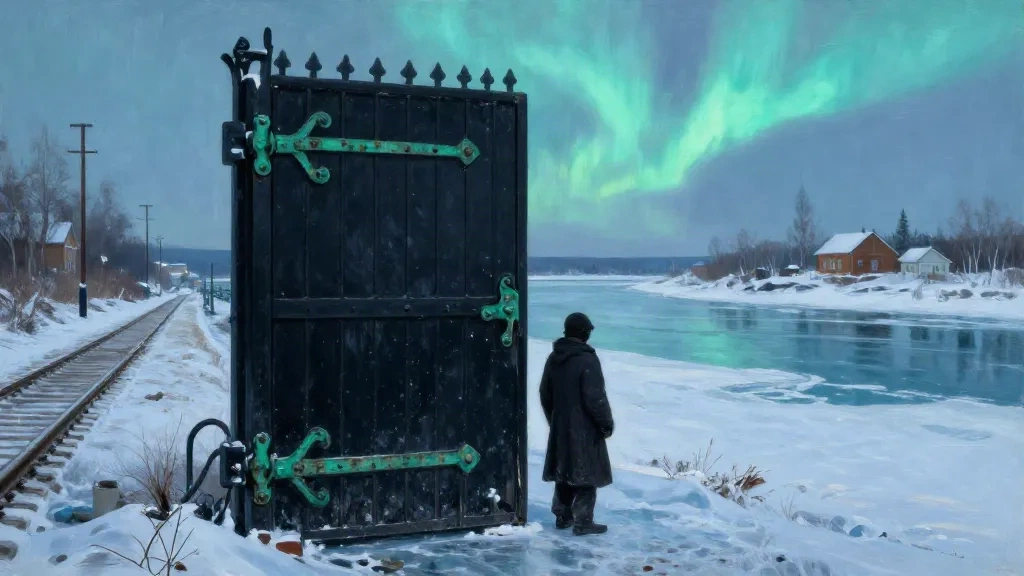
On the exposed riverbed stood a door.
It was twelve feet high, black as a winter sky, and wide enough for a procession. Frost silvered its hinges. They were enormous, green with corrosion, each one carved into the shape of a bent hand. Mara’s father had repaired the hinges of farm gates, church doors, and the courthouse strongroom. Nothing in his work had ever resembled these.
They were warm beneath her hands.
By noon, the whole town had gathered around the door. No one could open it. No one would admit to knowing where it had come from. Children threw stones at the panels. Old men measured the frame with lengths of rope. Mara circled it slowly, looking for damage.
The hinges had been wrenched nearly from the wood.
She set out her tools.
A Future Without an Ending
Mara had wanted to leave Veyr for as long as she could remember. Across the river, beyond the hills, the northern railway ran through fields where nobody asked whether her father still walked with a cane.
She had a ticket folded into the lining of her coat. It had been bought with wages earned repairing a locomotive. The departure was tomorrow at six. The river had reversed itself, however, and the crossing bridge now ended in a bank of black water.
As she worked, Mayor Pell appeared on the frozen bank.
“Leave it,” he said.
“It needs repair.”
“It needs forgetting.”
Mara looked up. Pell was a broad man with a soft voice. His father had been mayor before him. Pell’s family owned the wool warehouse, the ferry company, and the only shop permitted to sell tea. When the river changed direction, the town lost trade. Pell gained it. By noon, his warehouse had bought every empty shopfront facing the western bank.
“Who does the door belong to?” Mara asked.
“No one.”
“Who damaged the hinges?”
“Time.” Pell smiled without warmth. “You should know better than to repair time.”
Mara struck the first hinge with her hammer.
That evening she returned to find the door surrounded by guards. Pell stood beside a brazier, warming his hands. A kettle hung over the fire, and an empty teacup waited on a crate.
“The river came back for a reason,” he said.
“The river is water.”
“Then why does it remember houses?”
He gestured toward the door. The town had forgotten its first buildings. Their foundations were buried beneath the western channel. A vanished street, a vanished church, a vanished winter market. But the door had surfaced with them.
Mara returned home after midnight. On her workbench lay the empty teacup. She had not brought it there. Inside it, a pale reflection moved though the room was dark.
The House Behind the House
The next morning, Mara’s father told her the story.
Before Veyr crossed the river, there had been another town on the plain. Its people lived beside a road that opened every winter toward a distant house. The house was immense. It never had a fixed position. When someone passed through its doors, they returned home with a different life: prosperous, childless, grieving, loved, alone. The road was the house’s hinge. The river was its wall.
“The town that lives inside it is safe,” he said. “So one family keeps the road shut.”
Mara searched through the old account books. Every winter, the mayor’s family received wool, grain, and silver from a house that did not appear on any map. The payments continued long after the town was gone.
She carried the book to Pell.
He tore out the relevant page and fed it to the brazier.
“Power is not theft if everyone benefits,” he said.
Mara looked at the empty teacup beside the fire. A thin cyan line shimmered at its bottom.
“Who is buying the years,” she said.
Pell’s expression changed.
That night, while guards watched the river door, Mara crossed the frozen eastern channel with her train ticket in one hand and a lantern in the other. Beneath the ice she found another road, paved with dark stone. It led beyond the hills, not toward the railway, but toward a low black house standing in a field of frost.
Its hinges shone like wet iron.
The Door She Chose
Mara set the lantern down. The house waited without sound.
She had come to escape a future already decided for her: apprentice, caretaker, daughter, provincial. But a road of doors could give her an ending too. That was the danger. Every possible life, once selected, would close behind her.
She took out the ticket.
The ink had begun to fade. Her name remained, followed by a destination she could no longer read. At the bottom, a departure time glowed: six.
Before dawn, she repaired the house’s hinges.
The first opened onto a field crowded with sheep. The second onto a kitchen where someone was crying. The third onto a railway platform under an impossible cyan sky. The fourth, fifth, and sixth opened onto versions of Veyr: one abandoned, one burning, one peaceful, one rebuilt. Through each waited a life she could have lived.
None of them asked for her to stay.
Pell came through the last door. Behind him stood the town, its people silent beneath the frost.
“You cannot return,” he said. “Once the road is opened, the years must be divided.”
Mara picked up the empty teacup and placed it on the doorstep.
“Then stop collecting endings,” she said, “and start paying for them.”
She took the ticket from her coat and tore it into pieces. The paper became bright fragments in the air, each carrying a destination: a harbor, a schoolroom, a northern city, a place with no name. She opened the railway door and stepped through, not knowing whether the train would arrive tomorrow or years from now.
Behind her, the house shook. The river began to change direction again, not because of midnight, but because a future had opened its hinges.
At dawn, travelers found a blacksmith’s shop beside the east bank. Inside, the tools were warm. A train ticket lay on the workbench, and beside it sat a single empty teacup.
Its reflection held no face.
Only a pale, open road.





