 Netwrck
Weird Fiction.
The Door Beneath the Winch
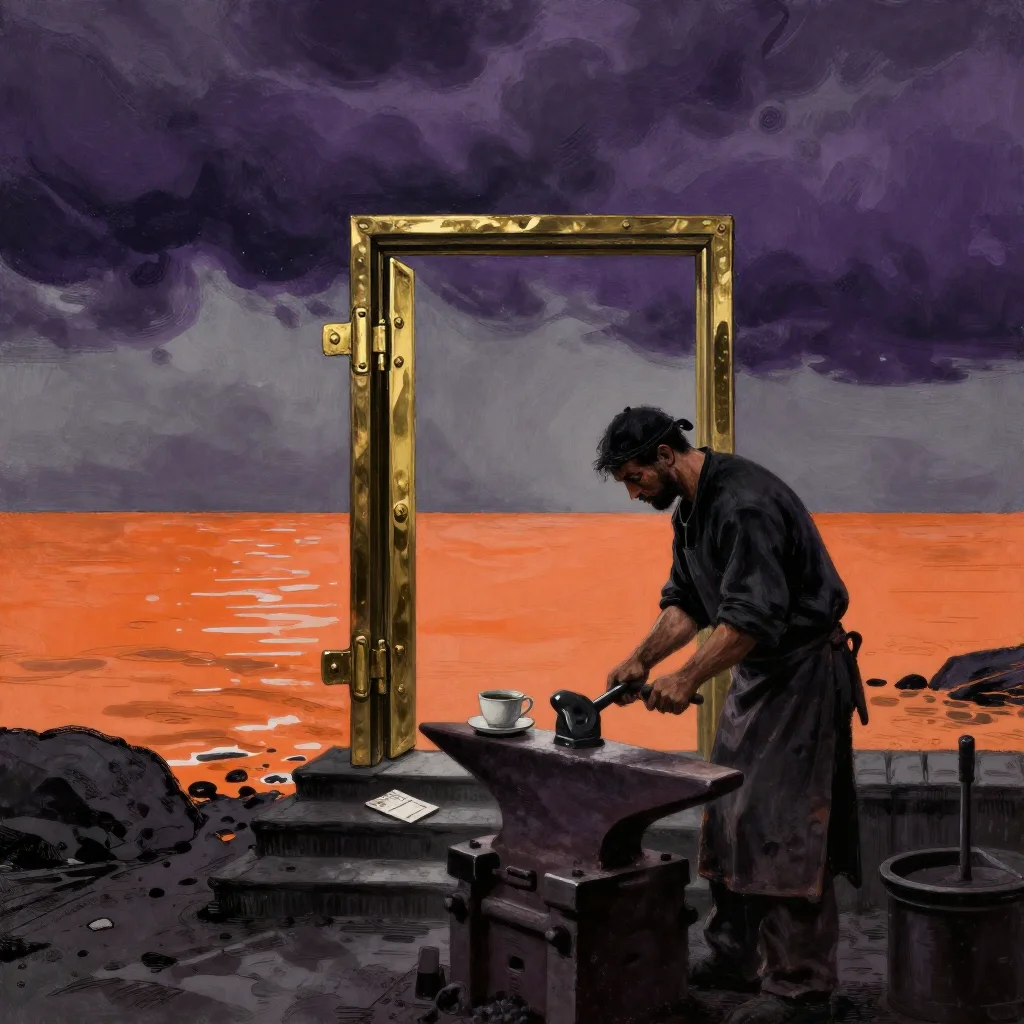
Mara Venn forged hinges in a shed the color of a bruise, beneath a salt-scraped wind. Her hammer answered with a sound like a shell breaking. Beyond the black pilings of Port Orison the sea withdrew at the ninth bell, carrying the saffron pennants out of the harbor and exposing a stairway that descended into smoke-grey air.
At the bottom stood a doorframe. It was enormous, made from a wood no saw would accept, and it had no door.
Above it, on the quay, an old winch turned all winter for nobody. A rusted drum, forty links of chain, a cage of oak and iron built to hold two men or one coffin. The council kept it greased and charged a penny a turn to anyone who wanted to look down. Most people looked once, in their first winter of grief, and never rode it again.
Mara rode it down every equinox to change the pin. Eleven years of collar-swapping, of the water chewing what the iron forgot. A hinge, she had been taught by a man who never said anything while he worked, is a promise that two things will meet again under strain.
People came to her shed with hinges of every kind. A gate from a drowned warehouse. A chapel’s crooked gate. The lid of a traveling trunk that had once belonged to somebody brave enough to leave. She mended them by instinct, straightening each pin until it swung without complaint. The town paid in coins, in bread, in secrets nobody wanted repeated.
Port Orison was a town of people who needed to know that things ended. Underwritings, tallies, harbor rolls, marriages, funerals, the seaward slant of a wall a builder had measured against a tide he would never see again. Everyone wanted a guaranteed one.
Mara wanted a future that had not yet earned its ending.
The winch was kept by a clerk named Sedge, nineteen, who logged every descent in a separate book because the councilor did not want the winch entered in the tide ledger. She wrote with her tongue between her teeth. Her hands were cold all year.
“He makes you grease it,” Mara said once.
“He makes everyone grease something,” Sedge said, and put the crank back on its pin.
What the Tide Returned
The councilor named Pell kept the tide ledger in a room painted deep plum. He recorded every object the water brought back: a child’s mitten, a wedding ring, a ship’s bell still packed with seawater. His clerks entered the findings in neat black ink, then marked them accounted for.
Pell had been a bargeman’s son with a beautiful handwriting and no patience for the sea. He understood the arithmetic of a harbor better than any pilot in it: a thing you have paid for is a thing you may sell. A departure you have priced is a departure that cannot surprise you. A grief you have closed is a grief that cannot come up in the street and take a man by the elbow while he is eating.
A mystery is a debt. Keep it open and every soul in Port Orison pays the interest. I have buried a hundred of them. Would you rather they drowned honestly, one at a time, than all at once, in a crowd?
He did not close questions by refusing them. He bought them, and the town paid him without knowing it, in the only currency the drowned accept. Those who asked twice lost their names from the harbor rolls. Those who asked three times found their houses facing the wrong direction in the morning, and nobody could say why the mason had erred.
The questions themselves were not destroyed. That was the part nobody thought to ask. Pell kept them in the plum room: racked in glass jars along the north wall, each jar labeled in a hand that never shook, each jar holding a question pulled out of some living head and set on a shelf like a bottle of seawater. Ninety-one jars. The shelf sagged under them.
Eleven years ago, in the spring after the packet boat Amaranth went out with eleven men aboard and came back with ten, a woman in a wet coat signed a page in the plum room and put down a coin she did not earn. The question she surrendered had three words in it. She signed before she could hear what they were, because signing was faster than hearing.
She asked afterward, once a year, whether the ledger could give back a thing paid for. Pell said no. He was, in that, honest. The ledger takes a payment in one currency only. What you get instead is sleep.
So Mara Venn had a brother-shaped hole where a name used to be, and a hinge-smith’s hands, and a mother’s cup in a cupboard, and no memory of Tobias at all. Not a blur. Not a sorrow shaped like a boy. Nothing. She could say the word brother and mean a category.
The Instruments of Choice
On the morning the saffron tide came in, it laid a train ticket at Mara’s feet.
The ticket was dated tomorrow. Its destination read UNDERWRITTEN. Beside it rested an empty teacup, its inside holding one grain of coarse grey sand.
Mara recognized both objects, and recognizing them took her the length of a full breath. The ticket had been hers. She had held it in the plum room, in the queue, with the pen still wet on the page. The cup had belonged to her mother, Ilsa, who had drowned off the Orison bar in weather that did not even qualify as a storm.
The tide, then, had not brought back the past. It had brought back the instruments. The ticket for a journey not yet chosen. The cup for a hospitality not yet offered. The water that returned them did not know the difference, and neither, in the end, did the town.
Pell had been selling their right to remain unfinished.
She carried both to the shed and laid them beneath the largest hinge. The metal warmed at once, the way iron warms when a fire has been lit somewhere out of sight of it. A seam opened down the doorframe, and behind it stood a hallway of locked rooms, long and low-ceilinged, lit by nothing Mara could locate.
Behind one door, water struck stone with the patience of a thing that has all night. Behind another, a crowd whispered her name in a cadence she almost recognized.
Behind the third door, a boy laughed once and stopped, the way a boy stops when he is listening at a door he has been told not to enter.
Mara stood very still with her hand on the hammer.
The Shape of the Door
Pell came with two council guards, and he was not in a good coat, which told her he had not dressed for an argument but for a wedding. He had never once in twenty years come to her shed to ask for anything. He came to take.
“You can repair the door,” he said, “or you can let it remain absent. Open it, and the tide chooses what happens next. Leave it, and Port Orison keeps its peace.”
“You profit from confusion.”
“I profit from the space confusion leaves behind. It is the only honest market in a port.” He held out the ledger, and the wind made the vellum shiver like a bird. “One page. One erased possibility. Sign, and the door is mine. I will be sixty-one years old and no one in this town will ever open a question again. I will be a man who finished.”
“You will be a man who never finds out what was in the jars.”
That landed. She had wanted it to land. He let it land, which told her more.
“Your mother,” he said, “was in the water off the bar in a westerly that would have taken the bar itself. You know that. You have known it since you were nine, in the ordinary way, the way a child knows a thing by being told it until the telling stops meaning anything.” He turned the ledger in his hands. “There is a child in my chest again, Mara. She is six, and she is drowning again, because you have taken the lid off her. Ask the room what I did to stop that. There is no one to ask. That is the arithmetic.”
“You were kind to her.”
“I was efficient.” He almost smiled. “Kindness is what people call it afterward so they can sleep near it.”
Mara thought of the ninety-one jars sagging on their shelf, of the three words she had signed away in a wet coat, of the boy laughing behind a door. She thought of how a hinge is only a promise, and how a promise is only metal, and how she had spent her life making the two halves of other people’s sentences agree.
She struck the hinge instead.
Its brass rang through the shed and went on ringing in the roof. The hallway fell silent, all of it, the water, the crowd, the boy. In the deepest room, something turned a key.
The empty teacup filled with saffron light. The ticket unfolded itself along its old crease, and a second line appeared beneath UNDERWRITTEN: MARA VENN, IF SHE OPENS THE DOOR.
She could have walked through. The hallway gave her what a hallway gives: a glimpse and no inspection. A town with no council, no ledger, no questions converted into coin. Beyond it a house with its own forge, its own weather, and a woman in the doorway with untouched salt in her hair, who lifted one hand in a gesture Mara had used every day of her childhood to mean wait there, I am coming.
Then the cup went cold.
Her mother’s voice came from the locked room behind her, flat with cold water and entirely without malice.
A future is not a room you can inspect before entering. It is a room you enter and then it is the only room there is.
Mara understood what the tide had been doing for a year. It had not promised her a brother. It had offered her a copy of her own wanting, cast in brass and paper, with a destination in her own name.
She took the hinge pin in both hands and drove it through the ledger.
What the Hammer Did
The vellum took the heat and then it took light. Pages came apart into saffron flame, and the smell was every smell the harbor had ever had at once, tar and iodine and eel and the interior of a house where someone had died. The plum room filled from the floor up like a cup filling.
The guards ran. Pell did not. Pell stood in it with his arms folded while the fire climbed the north wall and made the jars ring, and Mara understood, too late to matter, that she had not struck a tyrant. She had struck a man who had been holding a door shut with his shoulder for twenty years because the room behind it held a six-year-old in moving water.
Then the shelf went, and the questions came out.
Not as words. They came out as sound, all ninety-one at once, in ninety-one different voices, in the plum room and out into the plum-painted street: a man asking after a boat, a woman asking after a year, a child asking after a year, a widow asking why, a man asking who, a woman asking who, a woman asking when did I say it, when did I say it, when did I say it. The whole harbor heard it at once, the way a whole harbor hears a foghorn, and then the foghorn stopped and did not stop, because there was no ledger left to mark any of it accounted for.
Pell went out through it. He was sixty-one years old and unfinished, and he took his empty ledger under his arm like a man carrying water in a net, and nobody in the street stopped him, which was the last cruelty and was not his fault.
Sedge did not run. She stood in the doorway with the winch book against her chest, and when the fire died she opened it and wrote down the date, and the hour, and the name of the woman who had done it, in the plain unhurried hand of a clerk who has decided that a thing which happens will at least be recorded in a room that does not sell it.
Mara’s right hand did not come back. The pin had been hot and the vellum had gone like wet paper, and the tendon under her thumb drew up to a cord she could not straighten, and she sat on the anvil in the dark and flexed it until the shed filled with a sound she had never made before.
The Town, Remembering Differently
Port Orison spent a month learning what it looked like from the other side of certainty.
The harbor rolls were useless within a day. Eleven contradictory entries for the Amaranth: ten men lost and returned, and one man, in a second hand, listed as having refused to board. Sedge read the names aloud in the market square every morning at the hour the tide turned, and people came to hear their own families become arguable.
Wenna came to the shed on the ninth day, with two boys. They had the same scar over the same eye and the same way of holding a spoon, and both of them called her mother, and both of them were not lying.
“Which one,” she said, “did I bury?”
Mara looked at them for a long time before she answered, and she gave Wenna the truth, because she had nothing else left in the building.
“I don’t know. I gave you back a question, not a son. I called it the truth because I wanted the call to be worth something.”
Wenna sat down on the anvil, which she was not supposed to do, and put both boys to the floor to play with the swarf, and said: “Alick used to sleep with the door open. Both of them say he did. Both of them say he did it because of me.”
“Then you will know him twice,” Mara said, “and you will hate half of what you learn.”
“I already did that for nine years.” Wenna wiped her hands on her skirts. “It was quieter the other way. Don’t you dare tell me it was the same.”
And she was right. Mara had broken something she had no standing to call broken, and the breaking was not the same as the fix, and there was no clause in the tide ledger to appeal to because the tide ledger was ash in a plum room. She had freed ninety-one wounds and shown her the trade in full, and the price of the door was not the door. The price was that the town now had to live inside its own open questions like people in a house with the roof taken off, which is either a home or a flood, depending entirely on the weather.
The winch would not go down again. The pawl had seized in the fire heat and the drum had warped, and the chain hung slack in the shaft where the stairway should have been; when Sedge tried it, the cage came up to within nine feet of the frame and stopped, and held, and would not be argued with. So the winch was now a machine for going up, which meant that anyone who wanted to look at the doorframe had to climb, and had to wait for the tide, and had to ask somebody to hold the crank. The town had not lost its climb. It had lost its ease.
Mara refitted the frame’s hinge anyway, on her knees, with her left hand doing the work and her right strapped flat to her chest. It swung four inches and stopped, as it always had, against the nothing where the door was not.
The teacup sat on the anvil through all of it. The grey sand was not one grain any more. She counted once, and stopped counting, and never told Sedge the rate. It did not grow all at once and it did not pause. It grew when somebody in Port Orison asked a question out loud that they had been carrying, which was most days, and it would go on until every door in the town had been opened once.
An Ending Not Yet Earned
At dawn the tide withdrew again. Sedge lowered the cage to the fog line and Mara went down four fathoms on the chain with her right arm held against her ribs, and the doorframe was there, enormous, patient, and its opening showed only harbor fog. No hallway. No guarantee. No tour of the only room there would ever be.
Behind the third door the boy had laughed once. It had not been a brother. It had been a rehearsal, made by a thing that knew exactly what she would want to hear, and it had been made by the water, which is a liar that owes you nothing and forgives you everything, and she had wanted it anyway. She would not get to know what Tobias became. She had bought that with the price and she had known the price, and the price was a question, and questions are the only coin in Port Orison that never comes back.
She left the ticket in the sea, weighted with a pin she pulled from the frame itself so the frame would keep its promise with the tools she gave it. The saffron pennants went out ahead of it. She watched the paper go pale, go small, become a fleck, become a thing the water had never brought back and would not, and she did not weep, because weeping is a closed account and hers was still open.
The teacup she kept on the anvil. In the evenings the forge went cold and the cup sat in the last of the heat with its grain of grey sand, and townspeople came and looked at it and did not ask her anything, which was the closest thing to kindness the town had left to give.
Then she struck the iron, once, off-center, with the hand that no longer obeyed her, and let the unfinished future ring.
It rang wrong. The note came out a little flat, a little off, the way a note comes out of a repaired hinge when you have reworked the pin six times and it is true but it is not true in the way it was. The men in the harbor wrote it down in the weather books, because that is what harbor men write down: unseasonal, west-northwest, lasting some nine seconds.





