 Netwrck
Historical Fantasy.
The Empty Threshold
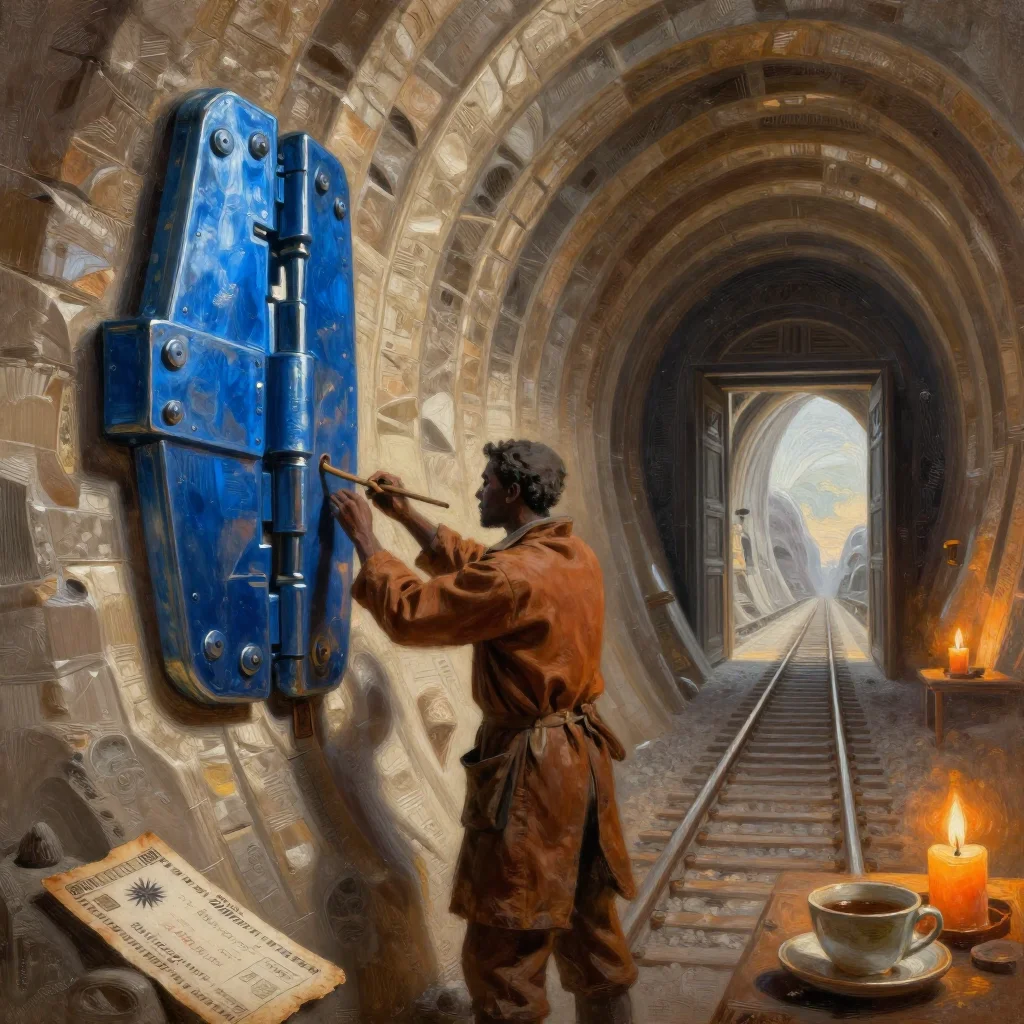
Bram Vale worked at the hinge-lines of the Monastery of Saint Orra, where the corridor into the mountain ran downward through blue steel and ended, everyone said, in nothing.
He repaired enormous hinges for doors that no longer existed. Each morning the vestry sent him a list of fastenings discovered in the walls, and each morning Bram set out his tools: bone files, a hammer faced with tobacco-dark iron, needles fine enough for the pinions of prayer engines. The absent doors had once shut against something vast. Their hinges remained polished by countless palms, though the doors themselves had been taken into the deep stone.
At his noon meal, the prior placed a train ticket beside his empty teacup.
“Burn it,” the prior said.
The ticket was printed for the Meridian Line, carrying Bram’s name and the date of his departure. He had never seen a railway this close to the sky. Its route crossed the desert kingdoms, the river provinces, and a crater where scholars still mapped the fallen comet.
“Where does the line end?” Bram asked.
“That is precisely what you must not ask.”
Across the refectory, Prior Vell’s candle burned behind a green glass shade. The glass reflected amber light over the brown habit of his clerk, and steel-blue daylight leaked through the monastery’s narrow ribs.
The Measure of a Door
Bram had been taught that every hinge was a promise between two conditions. It held the threshold without surrendering the difference between them. Lifted, it permitted passage. Lowered, it gave shelter.
Near the western hinge gallery he found a track in the dust, narrow as a finger and bright as a scratch in ice. It did not lead to a wall. Bram followed it through three sealed rooms, past lockers filled with silent robes and doors that opened onto sealed rooms, until he reached a shaft descending into the comet’s buried heart.
At the bottom stood the last hinge.
It was larger than a cart wheel. Candlelight moved across its steel-blue face. Its lower arm had been drawn halfway out, as if the door it governed were still trying to open.
Beside it lay an empty teacup, chipped clean and waiting for tea. Beneath the cup rested a second train ticket, older than the first, its date worn almost to nothing.
“You were meant to see that.”
The prior’s voice came from the stairs. Vell descended without hurry, carrying no lantern. The flame reflected in the hinge had belonged to a candle somewhere above.
“The doors were removed so no one could pass,” Vell continued. “The monastery survives on the mystery. Pilgrims offer silver for the privilege of praying before an absence. The neighboring abbeys send grain. Our province pays taxes to keep the question unanswered.”
Bram looked again at the ticket. His name had been printed in fresh black ink.
“The railway?”
“A construction line. The dead deserve no passage, but the living occasionally pay to see them.”
Then Bram understood the profit. Vell did not keep the mystery closed to protect the monastery from danger. He kept it closed so every arriving train would believe it was the first.
The Door Without a Wall
That night Bram climbed into the mechanism and loosened the retaining pins. The prior’s clerks came with chains and warrants, saying the hinge held back a storm, a sickness, a fallen star. Bram worked faster.
By morning, the corridor had opened one hand’s width. Cold air flowed through it carrying coal smoke, hot brass, and the mineral taste of deep snow. The sound of distant wheels traveled through the stone.
Vell caught him at the final stair. “Once that door opens, no one can promise what belongs on the other side.”
“Then I will not promise,” Bram said. He took the train ticket from his coat. “I will choose.”
He had wanted his future to arrive already justified: a wife waiting in a warm town, work enough to leave the monastery, a name no longer erased from the public ledger. Instead, the hinge gave him something unearned and therefore painful: the right to become someone who had not yet been forgiven.
Bram struck the final pin.
The empty teacup on the stair trembled. Far away, a locomotive whistled. The great hinge swung, and stone turned smoothly aside.
An Ending Still Unearned
Beyond the doorway lay no city, no dead, and no appointed paradise. A narrow track ran along the comet’s inner curve beneath a sky crowded with moving lights. Human figures in unfamiliar coats waited beside a carriage whose brass number had been altered many times.
On the platform stood a single lit window. An empty teacup sat on the sill, waiting.
No voice told Bram which train to take.
He descended, leaving the hinge holding the threshold open behind him. For the first time, its promise was not secrecy, but passage.
As the carriage moved, he looked back. The monastery had become a small blue shadow against the night, its hidden rooms shining with reflected candlelight. Somewhere inside, Vell was already inventing the next name for the mystery.
Bram unfolded the ticket and watched the destination blur. He could have written a town upon it, but he did not.
He let the unearned ending remain unfinished.
And when the conductor asked where he wished to go, Bram answered with the first true direction he had chosen for himself.





