 Netwrck
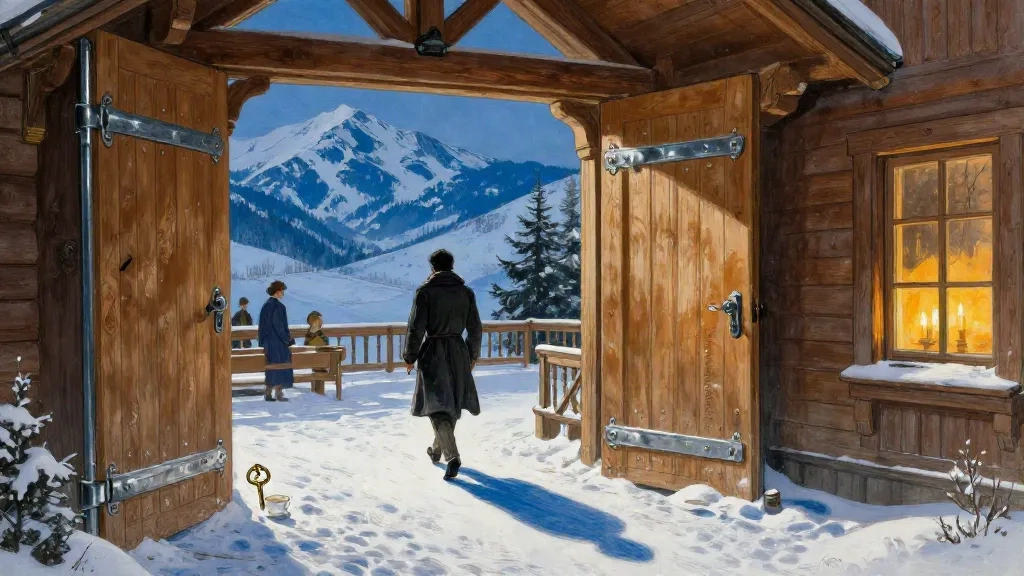
Historical Fantasy.
The Shadow at the Platform
Mara Voss first saw the train in January, though winter had not yet bitten the rails. It arrived beneath a tobacco-brown sky, its lamps trembling in the snow, while the platform and its lamplit passengers remained in darkness. Then the lamps came on all at once, revealing coats, parcels, and faces waiting beneath the sign for VEYR WINTER RESORT.
But the platform was empty.
Mara stood beside the iron gate with her tool roll over one shoulder. She was twenty-nine, broad through the shoulders from twenty years at a forge, and accustomed to people describing her hands before her face. That morning the conductor looked only at her palms.
“You have the look,” he said.
She showed him the empty teacup she always carried, its white enamel chipped above the rim. “Of what?”
“A hinge that remembers being used.”
He placed a train ticket in her hand. Printed for the winter of 1897, its destination read only: Veyr. The year already lay twelve years behind her. By dusk she stood before the resort, where every window burned with reflected candlelight and the snow beyond the lamps held shadows cast by buildings not yet built.
The Doors Without Hinges
The Veyr occupied seven terraces above the frozen river. In winter it received no guests. In summer it received no guests. Yet every evening the kitchens cooked enough for four hundred, the ballroom pianist played without wages, and chambermaids turned sheets in locked rooms.
Mara was the resort’s hinge-mender. Its doors hung absurdly tall and broad, carved with mountains, ships, crowns, and names worn smooth. Each had one perfect socket empty. Steel had flowed out of them generations ago, leaving blue shadows beneath the lintel.
“Who owns this place?” she asked.
“The Veyr Trust,” said the housekeeper, Mrs. Bell, carrying the same empty teacup Mara had brought, though hers was unchipped. “We repair the hinges, ma’am. Nothing more.”
“Door hinges?”
“Resort hinges. They hold the seasons in their proper order.”
That night Mara tested the smallest door. She pressed her shoulder to the oak and felt inward, outward, and once backward through time. On the train ticket, a departure time appeared in red: 3:40.
Across the terrace, a clock chimed three.
Mara set to work.
What the Trust Preferred
She poured new steel for the ballroom door, the kitchen door, and the nursery door. Each completed hinge changed Veyr. The pianist stopped midphrase. Snow began melting on the north lawn. In the dining room, place settings multiplied, each empty teacup glowing with candlelight reflected from a room where Mara could not see.
The Trust came to her before dawn.
Its directors waited in a steel-blue parlor around a table polished to tobacco brown. Among them sat the conductor, wearing no coat and snow melting in his hair.
“You are restoring capacity,” said one director.
“I am repairing hinges.”
“Capacity is a weight. Released carelessly, it crushes the people beneath it.” He placed a brass key before her. “Veyr admits only the futures that have earned their endings. We call it mercy. Mystery kept closed preserves a thousand delicate possibilities.”
“And the ticket?”
“Yours.”
“I never bought it.”
“You will. If you continue.”
The key opened a narrow door behind the clock tower. Beyond it waited a forge, bright as winter sunrise. Mara saw an older version of herself, white-haired and smiling over the same anvil. A young man lived in the village below the river. His face was kind, or would be. Each glance showed her a life not yet lived.
“Choose,” the director said, “and the ending becomes earned. Refuse, and Veyr remains closed.”
Mara took the brass key. At the threshold, the empty teacup in her hand began to fill with dark, hot tea.
The Door That Could Wait
She poured the tea onto the forge floor. Steam rose in the shape of railway smoke.
“You misunderstand,” Mara said. “A door is not a verdict. It is a promise that passage will be possible.”
She drove the brass key through the empty hinge socket of the clock-tower door, then set the teacup beneath it. Cup and key. The one meant to be filled; the one meant to open.
The Trust’s parlor split like struck iron.
Mara ran to the unfinished door and hung new steel from her roll: two hinges, plain and strong, with no crest or hidden maker’s mark. Beyond it lay the village road under a clear morning sky. No train waited. No conductor offered her an ending.
Her future remained unwritten.
From the ballroom came the first notes of the piano, unfinished and alive. Mara closed the door neither fully nor completely, leaving room for winter to pass and for spring to follow.
Then she walked toward the river, carrying the empty teacup, and the shadow of Veyr fell behind her as it finally should.





