 Netwrck
Historical Fantasy.
Iron for the Unopened
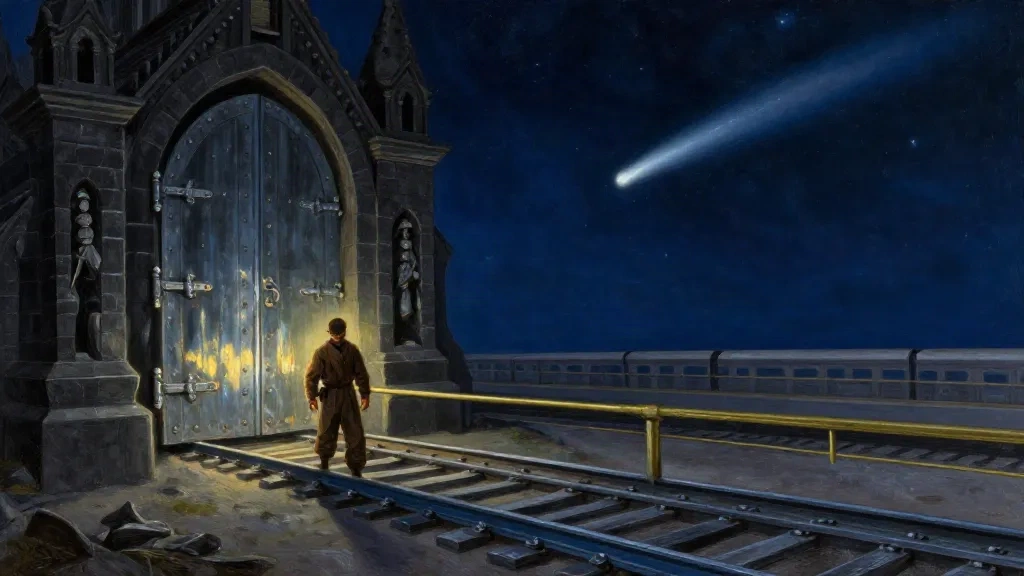
Brother Ansel hammered each hinge beneath the comet’s blue steel sky. The doors were ten fathoms tall and set into the monastery’s outer shell, where starlight came down in hard, polished blades. They had stood there since the founding, though no gate had ever opened and no road passed beyond them.
When the hinges failed, Ansel repaired them. He faced the metal until it yielded, then dressed its scars with tobacco-brown oil. The work kept his shoulders broad and his hands steady. It also kept him from asking why iron was forged for thresholds no traveler could cross.
His concrete desire was plain: to leave before the monastery decided what his life had been.
Every dawn, the bell named the fathers and sisters who had died. Every dusk, the prior read the departures recorded in the stone ledger. Ansel had no page. He was neither alumnus nor relic, merely the smith assigned to the vacant doors.
One winter morning he found a train ticket inside the western hinge. It was creased as though carried through several countries. Its destination read Tomorrow, Platform Nine. The departure time fell two hours ahead.
Bring no one who has already been accounted for.
The Keeper’s Empty Cup
Prior Lucan saw the ticket during morning prayers. He placed it beside an empty teacup, then folded the paper into his sleeve.
“The doors are not exits,” he said. “They are seals.”
Ansel had been told the doors were locked. Locked, he knew, is a word for something that can be opened. Lucan’s warning had a different weight.
For three centuries, the monastery had accepted food, fuel, and pilgrims from the valley below. In return it gave iron to their furnaces, weather forecasts to their farmers, and silence concerning the doors. The prior’s order had never been questioned. It had simply been maintained, along with the roads, the river tolls, and the old law that prohibited questioning a man’s right to vanish.
Ansel learned the truth from the hinges.
Each repair revealed small marks beneath the surface: names, dates, arrows. Names of people who had chosen to leave. Dates extending centuries beyond the founding ledger. Beside one mark, fresh and shining, was his own.
Lucan had permitted the possibilities, then prohibited their study. The valley prospered from the uncertainty. A sealed future could be blamed on heaven, inherited, bargained with, and taxed.
A Journey Paid in Brass
Before vespers, Ansel removed the largest hinge pin.
The inner corridor trembled. Beyond the door came the hush before a storm, smelling of hot metal and winter rain. Somewhere below, a whistle answered.
Lucan caught him at the threshold. His empty teacup rang against the rail as he seized Ansel’s collar.
“If you go, the valley loses its certainty,” he said. “People will build roads where none remain. They will send children into doors that open onto nothing.”
“Then we should let them choose.”
“Choice without proof is cruelty.”
Ansel held up the ticket. “You call a locked door proof because you profit from the lock.”
The prior’s hand loosened. Behind him, the monastery bell rang without a striker.
Ansel placed the empty teacup on the door’s sill, then slipped the hinge pin into his coat. It was a plain iron token, made for repair, not prophecy. He would take no relic. He would carry proof that the lock had been opened, even if the road vanished behind him.
The Future Without an Ending
At Platform Nine there was no train, only a track suspended along the comet’s curve. Candlelight from the monastery reflected on the rails, turning them steel blue and tobacco brown.
The ticket burned in his hand. Its printed destination blurred, not into another place, but into blankness.
Ansel understood then. No future had an ending there. The doors did not reveal what came next; they gave the living a place to refuse the ending others had chosen for them.
He stepped onto the rails. Behind him, the monastery doors stood open. The valley below shouted in anger and wonder, voices dividing over the road now stretching into the dark.
Ansel did not look back. For the first time, the future had no ending.
Only the sound of iron being repaired.





