 Netwrck
Historical Fantasy.
The Door Without a House
Elias Vale kept his forge beneath the Vesper Rooms, where winter snow packed the windows with white glass. The resort stood empty for eleven winters, yet every morning its shadows arrived before dawn: long blue shapes crossing the frozen garden, bending beneath invisible eaves, gathering at the doors of rooms that had no rooms behind them.
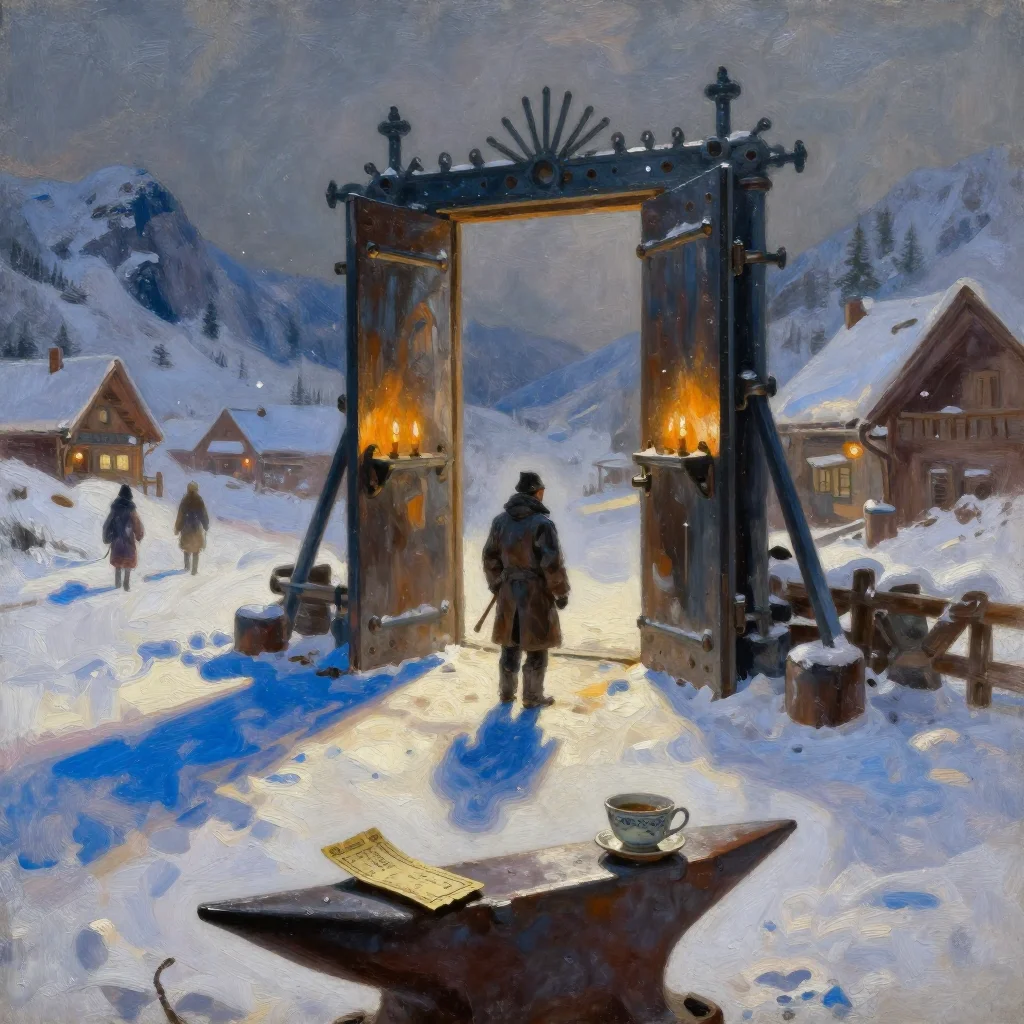
Those doors were enormous. Their frames rose twelve feet into the rafters, their hinges as long as a man's arm and forged from some metal that held no rust. Guests left them ajar before disappearing, Elias had been told, and in the morning the hinges screamed as if something on the other side had tested their weight.
He repaired them anyway. The Vesper Rooms paid in coal, candles, and board. A local power called the Ledger Trust owned the resort and the mountain road. Its directors declared the empty doors a curiosity, the shadows a trick of chimney smoke, and every question a disturbance. The Trust did not sell rooms. It sold certainty: a sensible explanation for every disturbance, provided no one asked too deeply.
The Ticket in the Anvil
On the coldest evening, a train arrived without sound. No locomotive, no whistle, only a carriage standing beside the platform with frost on its windows. A woman in a traveling coat stepped down carrying an empty teacup in one hand and a paper ticket in the other.
“You are late,” she said.
“The train is late,” Elias replied.
She gave him the ticket. Its date was three days ahead. Its destination read WINTER END, and beneath that, in a different hand, was his name.
The woman told him the Trust had built the resort around a bargain. Every future that failed to arrive was made to pass through these doors. The doors accepted it, returned the years it would have lived, and kept the ending in storage. People paid dearly for certainty that their lives would conclude in a particular direction. The Trust controlled the terms, the ledger, and the shadows.
“You want to open something,” Elias said.
“I want you to choose a future that has not yet earned its ending.”
She set the empty teacup on the anvil. Candlelight trembled inside it though it held nothing.
What the Shadows Kept
That night the absent doors opened. They opened inward, one after another, without wind or hand. Beyond each was a life unfolding: a boy learning to sail, a bride crossing a flooded city, an old man planting trees in a country that no longer existed. The shadows on the snow were not absences. They were possibilities, pressing against the seams of the world.
Elias entered. In the first doorway he saw his own forge, younger and brighter, with a woman waiting beneath its chimney. She had died before he came to the mountain. He had loved her anyway, in the private hours after his craft had become a reputation.
The Ledger Trust found him before dawn. Men with brass seals barred the corridor and offered a new bargain. Let the doors close, and they would restore the life he had just seen. Give it an ending, make it earnable, and they would preserve it forever.
Elias understood then why the Trust profited from silence. A mystery kept closed became a debt. A life denied an ending could be rented, taxed, and traded.
He drove the woman’s ticket into the anvil. The paper caught fire without burning his hand. Across every open door, the unfinished lives turned toward him, waiting for the stroke that would either fix their hinges or seal them forever.
The Door He Left Open
At sunrise Elias struck the final hinge. The sound passed through the resort, through the mountain, through the years stacked inside the walls. Doors that had waited for generations moved freely. Their shadows stepped into the snow and became ordinary people: cold, startled, alive.
The woman with the empty teacup did not leave. She poured tea from a flask into the cup, and the candlelight vanished into something warmer. “A future,” she said, “is not a room waiting for its tenant.”
Elias packed his tools and left the Vesper Rooms. He did not choose the life behind the first door. He chose the road beyond the resort, where no ending had been purchased and no shadow knew his name.
Years later, travelers spoke of a blacksmith who repaired hinges for doors that stood in open country. They said no door ever closed behind him. Whenever a storm gathered over the mountain, his forge burned steel blue, tobacco brown, and reflected candlelight, and somewhere beyond the snow, the future opened its eyes.





