 Netwrck
Folk Horror.
Doors Without Houses
In Frostwake, every bridge bore a promise carved into its iron railings, and every river kept the oath where daylight could not melt it. On rainy market days, children spat over the water to make the current repeat what they had promised. On dry ones, they held their breath and watched to see whether the river had believed them.
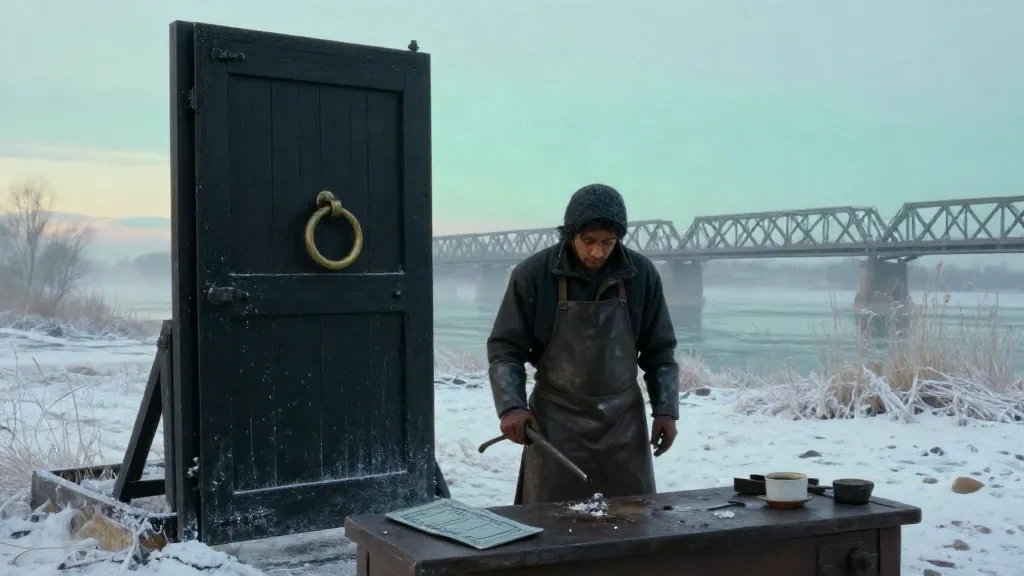
Mara Venn repaired hinges for the enormous doors that stood along the eastern bank: doors three yards high, oak thick as ship timber, their brass pull rings cold beneath even summer sun. No walls, houses, or courtyards remained around them. The doors had simply been there when her grandmother first carried her there to learn the trade.
“A hinge is a promise to open,” Grandmother used to say. “Keep it oiled. Do not ask too soon.”
Now the doors opened onto mist. Iron stairs. Fields beneath snow. Rooms where clocks leaned together like frightened children. Mara’s hammer made each day’s arrangements: the blue door with the hare carved at its threshold, the white door with a wreath split down the middle, the green door whose wood sweated salt.
Beside the tall black door, on a crate kept dry beneath an oilskin roof, waited an empty teacup. It had done so for eleven years. Its rim bore one pale print, added each morning and fading by dusk.
Mara’s desire was small enough to carry in her apron: she wanted a future that had not yet earned its ending.
The Railway Clerk
Every seventh morning, the railway clerk came without a train.
He was a narrow man in a buttoned coat, carrying tickets cut from gray paper. Frostwake had no railway, but his boots left fresh mud on the frost and each footstep shook dust from the bridge railings. The river slowed when he approached. Mara hated the way it made itself polite.
“One stop,” he said each year, placing a train ticket on the crate beside the teacup.
The ticket bore no station, only the date that morning and a departure time: six minutes after the impossible dawn.
He offered passage for those who wished to escape what they had done, what they had failed to do, or what others had done to them. Mara had never taken one. The first winter she received the ticket, her father drowned while repairing the north bridge. She believed the river had taken him because she had once wished aloud for him to stop drinking.
So she kept the ticket folded beneath the empty teacup and repaired hinges instead.
That morning, however, the black door spoke through its keyhole.
“Mara Venn,” it said.
The latch lifted by itself.
The Mayor’s Ledger
Beyond it stood a railway platform under a sky the color of thin ice lit from below. Frost lay on the rails, though the air smelled of warm iron. At the far end, a cyan dawn pressed against the horizon without a sun.
Mayor Pell waited beside the departure carriage. He had governed Frostwake for thirty years and made the river narrow every winter with sluice gates sold to the mill beyond the hills. The mill paid by the span. The river paid in drowned livestock, missing sleep, and forgotten names.
“You finally came,” he said.
“The clerk said one stop.”
“The clerk says many things.” Pell raised a brass token, stamped with the town seal. “The railway buys mistakes. The river merely collects them. I built this platform so the town could forget its losses in private.”
Behind him, the dawn brightened. Mara felt its weak, deceptive warmth.
“Where does it go?” she asked.
“Nowhere tender. But everyone on it stops being afraid.”
From within the carriage came Grandmother’s voice, counting from one to thirty-three.
Mara understood then. Pell had not merely profited from the mystery. He had made the doors obscure a choice he could not control. The river remembered what had passed, but the railway had been built to carry that memory away.
She stepped onto the platform.
The clerk unfolded her ticket. A new line appeared in black ink: RETURN PASSENGER: 1.
An Ending Not Yet Earned
The carriage contained every person Frostwake had erased in the name of progress: the father drowned for his drinking, children folded into ditches when the mill bought the land, brides written out of parish records, old women who had kept too many useful secrets. They sat in patient rows. None looked angry. That frightened Mara more than grief could.
“You can bring one back,” Pell said from the platform. “That is the price of the return passenger. Leave me in charge of what the river loses.”
Mara looked at Grandmother, who folded her hands over an apron still clean with oil.
“I could restore him,” the old woman said. “It would be kind. It would also be a lie we asked the river to accept.”
The cyan dawn reached the carriage windows. Frost woke on every ticket at once.
Mara took the brass token from Pell’s hand and dropped it into the river below the tracks. The seal cracked. Water climbed the embankment, black and fast, carrying the name of every payment the mill had made.
“Then the river keeps the record,” Mara said, “and everyone ends what they chose.”
The father did not rise. The erased people bowed. One by one, they stepped down and became names in the air, borne toward Frostwake by a current that no longer waited for forgiveness.
The carriage doors swung shut.
Mara returned to the black door, slid the railway ticket beneath its handle, and poured bitter tea into the cup that had waited eleven years for a second hand.
At noon, she crossed the bridge and struck a third rivet into its railing. Then she turned toward the cyan horizon, carrying no ticket, bound by no ending, with the road still open beneath her boots.





