 Netwrck
Folk Horror.
The Door Beneath the Tide
Mara Venn was the blacksmith of Ellerstrand, though the town had no door that needed mending. Its people hung their coats on hooks, shut their cupboards with crooked latches, and complained when the wind worried the shutters. The doors belonged elsewhere.
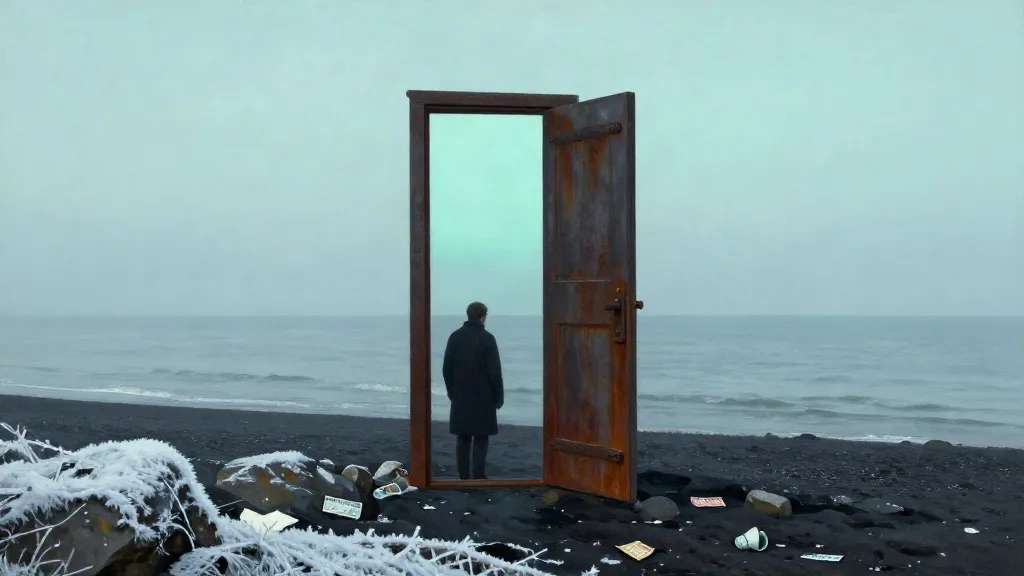
They appeared at low tide, standing upright in the wet sand beyond the breakwater. Tall as church naves, black as drowned iron, each fitted with hinges broad as dinner plates. Mara repaired them because there was no one else. She drew the salt from the pinholes, packed the sleeves with tar, and hammered until the seams shone. The doors never opened. They only waited.
Every tide brought back one forgotten object. A child’s shoe. A wedding ring. A brass button polished by no living hand. At dawn, the sea returned them to the shore, arranged along the tideline like a committee waiting for a verdict.
Among them came a train ticket and an empty teacup. The ticket bore no destination, only a date three days in the future. The teacup had a hairline crack through its handle and smelled faintly of bitter leaves. Mara kept both beneath her forge.
The Price of Knowing
The town’s power was the Harbour Trust, three families who owned the cranes, the ferry, and the ledger that recorded every death. Their spokesman, Iven Rook, came to the forge the morning Mara found the ticket.
“You’re seeing things,” he said.
“The sea leaves things.”
“The sea leaves rubbish.” He tapped the ledger tucked under his arm. “And rubbish should not be given a history.”
He offered her enough silver to mend the church roof. He offered her a place on the winter ferry. He did not ask what she intended to do with the ticket. That was worse. He knew it could be useful.
Mara’s father had vanished when she was nine. No body, no message, only a pair of spectacles recovered from the tide. Since then, she had repaired hinges for men who claimed the doors led to forgotten houses, and she had told herself that usefulness was the same as loyalty.
That night the largest door appeared below the cliff. Its hinges were not rusted. They were freshly cut.
A Future Without an Ending
Mara descended at moonrise. The door stood where the water should have been, reflected in black sand. On its surface, no paint, no handle, no threshold. When she touched the iron, she heard a sound like a train arriving through fog.
The empty teacup sat at her feet. The ticket warmed in her pocket.
A voice came from behind the door. “Choose,” it said. “You may enter before the train leaves, or you may return and keep the town’s secret.”
Mara imagined the train. Not a destination but a departure: a carriage with warm windows, her father’s name on the ticket, a future in which Ellerstrand was small behind her and no Trust owned the roads. She wanted it with a violence that frightened her.
“What happens to the town?” she asked.
“It forgets you.”
“What happens to the doors?”
“It forgets them.”
Then the ticket split along its old fold. A second date appeared beneath the first: tomorrow.
Mara understood the offer. She could save herself, or she could force the town to remember what it had buried. Both choices would cost her a life, though not the same one.
She took the teacup and struck the door’s lowest hinge.
The Tide Chooses
Iron screamed. The sound woke every sleeping window in Ellerstrand. Behind the door, the train vanished. Instead, a room opened: her father at a table, older, pouring tea into two cups.
“I thought you had gone,” Mara said.
“I went where the town could not follow.”
He looked at the broken cup in her hand. “Your future has not earned its ending.”
Mara set the cup on the floor. “Neither does your disappearance.”
She hammered the hinge again. The door buckled. Across Ellerstrand, every returned object began to glow under the impossible dawn, cyan light climbing the rooftops without lifting the darkness.
Rook and the Trust came down to stop her. Mara kept hammering until the door lay flat in the sand. The sea took it, then the ticket, then the cup.
At sunrise, the town remembered. Names returned to the ledger. Her father’s name returned to her. The doors remained, but their hinges were open.
Mara no longer repaired them for closure. She repaired them for whoever came carrying a future they had not been allowed to name.





