 Netwrck
Folk Horror.
The Door Without a Wall
Mara Vale was the blacksmith of Hallowmere, where the river divided the town and changed its course at midnight. By day it ran east beneath the black water, carrying ice and willow leaves toward the salt marshes. By night it flowed west, keeping its secrets on the town side.
The north bank held the houses, the inn, and Mara’s forge. The south bank held the cemetery and the old customs house. A stone bridge joined them when the river behaved. At midnight, the bridge stood dry in the wrong direction, as if the river had briefly removed itself.
There were no doors in Mara’s town. Not ordinary doors. In childhood, she had seen a farm door open onto a winter morning, a child’s door open onto a room full of sleeping birds, and once a cellar door open onto a blue country beneath the stars. Each appeared for a moment, immense and wrong, then vanished when touched.
Mara repaired what could not be found. The County Works Office brought her hinges from distant buildings: iron crescents, black bars, rings wide enough for a grown woman to pass through. She straightened them, heated them, and fitted them to empty doorframes. When the frames disappeared, the hinges remained warm.
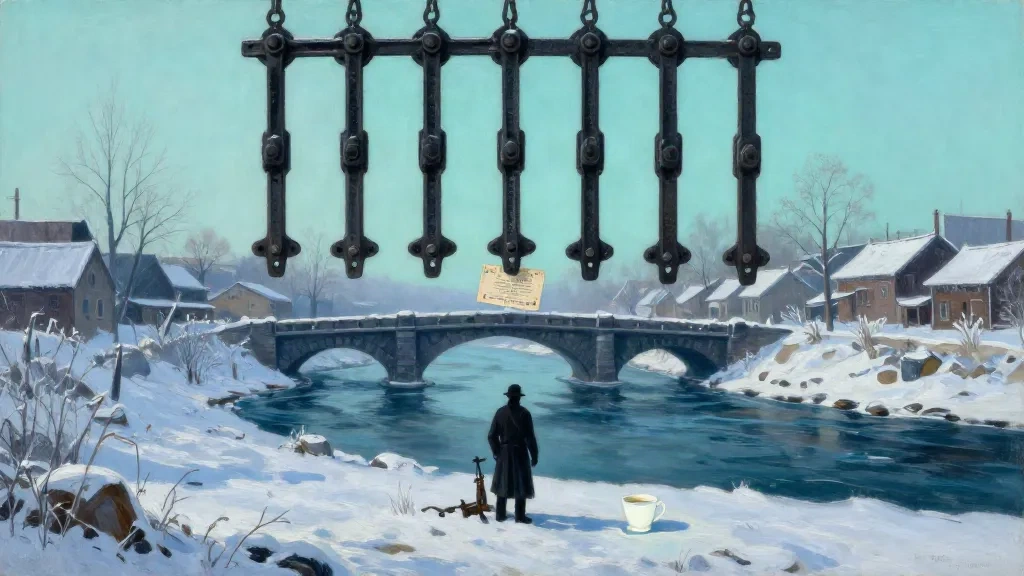
Door Eight Hundred Four was the largest. It stood in an abandoned lot behind the customs house, though no wall, roof, or threshold surrounded it. Eight enormous hinges floated above the frost, each carved with a different river bend. At their center hung a train ticket, stiff with cold, stamped for a departure that had not yet happened.
The Toll of the Unopened
On the ticket, the destination read: Tomorrow, Platform One. Mara kept it in her coat. Beside her forge sat an empty teacup, white china crazed by frost, which she had once received from the customs clerk. He told her the cup belonged to a woman who had chosen a life in the south. She had placed it on the table, boarded the midnight train, and left it behind.
“She never came back,” he said.
“Which life did she choose?” Mara asked.
He looked toward the river. “That is the toll. If you open one future, the town must close another. The county owns the hinges. We collect the difference.”
The customs house had no windows now, though Mara remembered counting them. The clerk’s sons kept the doors closed. They stamped travel papers and measured shadows at midnight. If a shadow crossed the bridge in the wrong direction, they seized it and stored it in stone jars. The river carried away only the days they had successfully hidden.
On the night the ticket began to soften in Mara’s pocket, the empty cup filled with black water. She crossed to the customs house. Inside, the clerk’s sons sat around a brass map of the river, sealing small pieces of night beneath glass.
“The future is profitable,” the eldest said, “when nobody reaches it.”
He placed his hand over the map. Where Mara had seen a branching line, he showed only a single road. Where she heard running water, he heard nothing.
Behind him, one of the stone jars began to ring.
What the River Carries Back
Mara struck the jar with her hammer. It split. A black shadow escaped, shaped like a woman carrying a suitcase. It crossed the floor, passed through the locked door, and stood beneath the eaves. The clerk’s sons rushed after it, but Mara planted the cup in the doorway.
The water climbed over the threshold. The empty cup became a moon, cold and white, and the customs house filled with a sound like thousands of train wheels turning beneath the earth.
Door Eight Hundred Four opened.
Beyond it waited a blue dawn. The frost lay silver on the fields, but the sky burned softly cyan. A platform stretched between two forests, its lamps shining without heat. A train waited with its doors open. The conductor raised one gloved hand.
“Passenger?” he called.
Mara stepped toward the platform. The iron hinges pulled tight around her shoulders. Behind her, the clerk shouted that the town would vanish if she boarded. The river would choose one bank, the houses would lose one another, and every hidden tomorrow would collapse into the tomorrow she had chosen.
She understood then. The power had not been keeping the mystery closed to protect them. It had been keeping them from choosing. Mystery was the lock; uncertainty was the price of freedom. The clerks called it necessary because uncertainty could not be taxed.
Mara placed the train ticket in the conductor’s hand.
“Is my ending valid?” she asked.
He read the stamp. “Only if you accept that it may be revised.”
The Unfinished Morning
She boarded. The doors closed behind her. The train began to move, yet the dawn remained fixed beyond the windows. In the customs house, the clerks rushed to seal the map. The river reversed beneath the bridge, carrying the stone jars, their stolen shadows, and every name removed from the public record back toward the marsh.
At dawn, Hallowmere stood on both banks. A crowd gathered in the abandoned lot. The custom house had lost its doors, and the empty teacup rested on the steps, shining with clean water.
Mara returned at noon, carrying no certainty. The ticket in her pocket bore a new date.
She left it there.





