 Netwrck
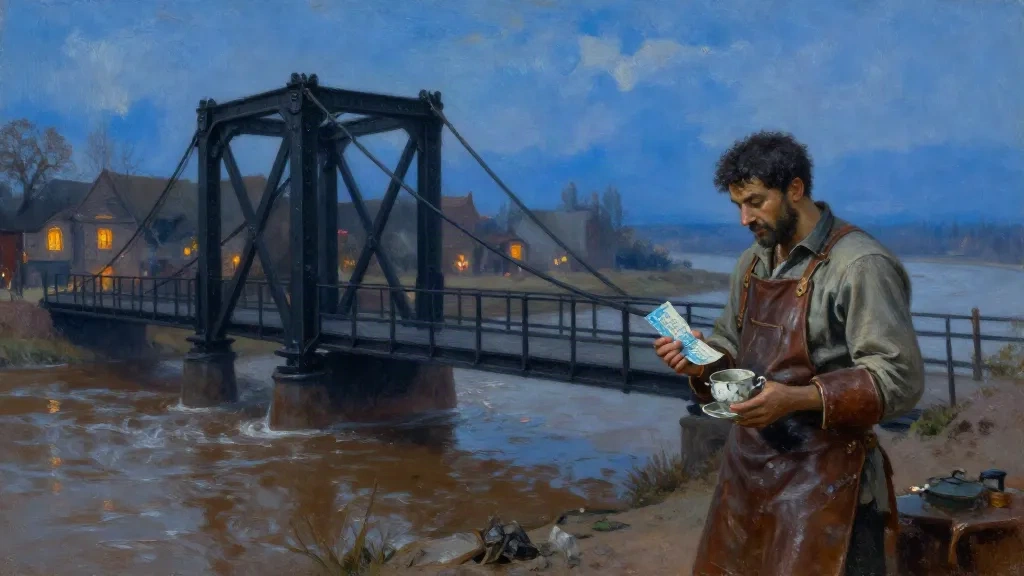
Historical Fantasy.
The Door Without a House
On the first frost morning, I found an iron hinge embedded in the mud beneath the eastern bridge.
It was larger than a cart wheel, blackened by weather, and shaped like a crescent moon. No door surrounded it. No house stood nearby. I crouched and brushed the silt away with my fingers. The hinge was warm.
Across the water, the bridges of Bellwether showed their brass nails in the gray dawn. Every bridge in our town was a promise: a plank, a span, a wager that the other bank could be reached. The river was the witness. It kept the reflections of those who crossed and the voices of those who did not return.
I had repaired hinges for thirty years. Temple gates. Strongroom doors. The thick oak entrance to the almshouse. My father had taught me that a hinge was the quietest part of a promise, the part that allowed it to open.
This hinge had no door. Yet when I lifted it, the whole eastern bank shifted with a groan of stone.
The Office of Unfinished Journeys
A boy came running from the station in a blue coat, carrying a tin dispatch box.
“They found another one,” he said.
They meant another hinge. By noon, the Mayor’s office had sealed the eastern bank with red cord. By evening, the Mayor himself arrived in a carriage polished like a mirror.
Mayor Voss did not enter the bridge. He stood where the old tollhouse had been, watching me hold the hinge against my chest.
“You will forget this,” he said. “The river has been paid.”
Behind him, his clerks carried a ledger thick as a winter coat. In Bellwether, the Mayor controlled what people remembered of departures. He sold safe conduct to the living and silence to the dead. A person who learned the true ending of a journey could be made to forget the beginning. A town could change its history by collecting one brass stamp at a time.
Voss offered me more money than I had earned in a year. I refused.
That night, inside my forge, I found a train ticket tucked beneath my anvil. The paper was damp, its date six years ahead. The departure station was Bellwether Central, though no railway had reached our town in twenty years. On the reverse, someone had written: Bring the empty cup.
The Cup That Held No Water
The empty teacup sat on my mother’s shelf. It had been there since she died. It was blue china, chipped at the lip, and smelled faintly of tobacco. My father had used it to mix pipe ash with peppermint. After his disappearance, I kept the cup filled with nothing.
On the ticket was the same crescent mark as the hinge.
I took both to the river. The water below the eastern bridge ran brown, though the sky was steel blue. Reflections of our town trembled on its surface: chimneys, roofs, and the Mayor’s carriage, all upside down in the current.
When I set the cup on the water, it did not sink. It traveled against the current toward the locked bank. A pale light moved beneath it.
Then the river spoke.
It spoke in the voices of vanished passengers, each one saying a different destination. Some begged forgiveness. Some named children never born. One said only, “Do not let him stamp the page.”
I reached for the cup. The hinge opened beneath the surface, a great iron jaw in the riverbed. I could have crossed into whatever lay beyond it. I could have found my father, or learned whether my mother’s last journey had ended in the river.
But the ticket had not given me a return journey. It offered one future among many, and Voss had built his power by making certain futures disappear.
A Future Not Yet Earned
I chose the unfinished road.
At dawn, I carried the hinge, ticket, and teacup to the eastern bridge. Voss’s clerks waited with hammers. The Mayor stood among them, smiling as if the river had already agreed to his terms.
“You cannot open a door,” he said, “without knowing what lies behind it.”
“No,” I replied. “But I can refuse to lock one.”
I placed the ticket on the bridge rail. The empty cup went beside it. Then I drove the hinge into the iron rail, joining promise to promise.
The bridge rang like a bell.
Every chain across the river tightened. Candlelight flared in the windows of houses no one had entered for years, reflected in long bars of gold. The river gave back the town as it had been: workshops open, boats departing, names scratched into bridge posts.
Voss rushed forward. His clerk raised a stamp, but the current struck it from his hand. The ledger opened. Pages tore loose and became leaves, then white birds, then rain.
I climbed onto the unfinished road. The hinge turned beneath me. Ahead lay no arrival, only the next span waiting to be built.
Behind me, Bellwether kept its bridges. But for the first time, it did not keep their endings.





