 Netwrck
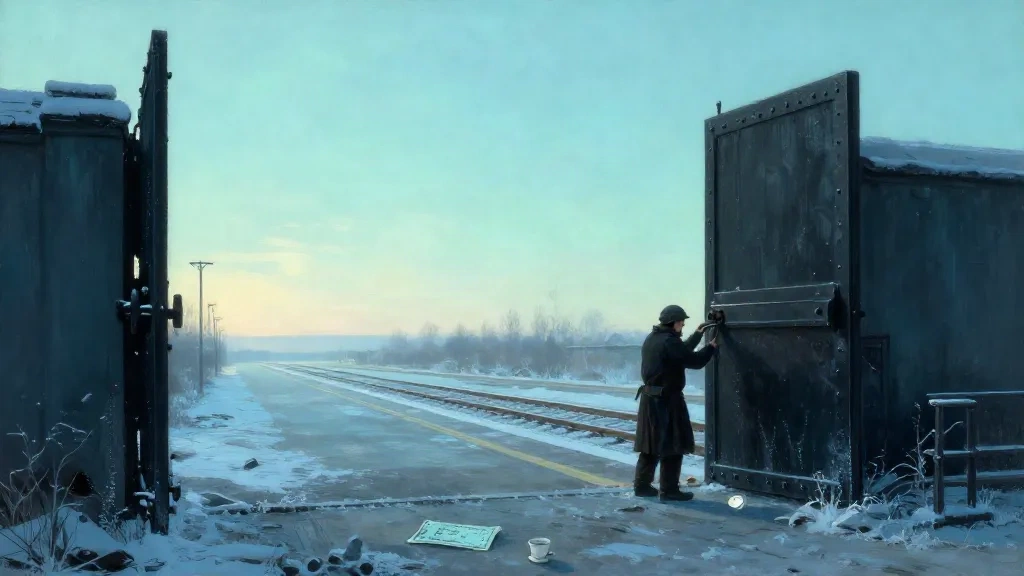
Folk horror. A blacksmith, a closed cinema, and a valley whose doors were all ordered from the same shop.
The Last Projection
After the avalanche swallowed the highway, the cinema lost its audience but never lost its pictures.
Frost silvered the ticket booth in a rind you could flake with a thumbnail. Wind worried the torn posters into pale confetti and pinned them to the drifts. The marquee still said TONIGHT: CONTINUITY in letters nobody had bothered to unscrew. Every night at 3:17, the abandoned screen brightened with a light softer than dawn, and the empty auditorium filled with the dry mineral smell of a room that had been breathing all winter with its mouth shut.
The films showed places that might have been. A river dammed into a perfect circle of glass. The town beneath a green second moon. Children grown tall, their names never spoken. Each ended abruptly: a blackout, a scream swallowed by the projector, or a train departing without its passengers.
Marek kept the cinema for the hinges.
They had arrived in February along the old mountain road, freight doors cast from iron thick as bellies, thirty-one of them, each bearing a brass number and a shipping weight in pounds. The locks had no keyholes, only shallow hand-shaped hollows, as though the lock wanted to remember a palm. No one living remembered ordering them. The freight manifest listed a consignee in a town that no longer had a name on the county map. At dawn the doors were waiting beside his forge, stacked in the snow, cold enough to burn the skin off your knuckles if you touched them bare.
He was a blacksmith because his father had been one, and because uncertainty, unlike grief, could be beaten into a useful shape. Grief is soft metal. It dents. Uncertainty is iron: you can heat it, draw it out, put it under the hammer and make it hold an edge.
That was the story he told. The truer one sat in the back of the forge on a shelf above the water butt, wrapped in oilcloth: a single hinge, hinge-leaf shaped, unfinished. Eleven years he had left it there. Two plates, no pin. He told himself it was waiting on a customer. He told the forge, the snow, the alder tree outside the door, and once, in the first year, Elia's name, that some mornings you simply are not yet finished with the day.
On the seventh night, the screen showed his own workshop.
Marek stood at the anvil with his back to the door. Across from him stood a woman in a red coat, holding an empty teacup. He knew her face before the film began. He knew the pale seam of the scar beneath her left eye, the one she had gotten from a dropped horseshoe at the ford, the summer before the fever, when laughing had still been an ordinary act between them.
Then the picture froze.
The Door That Breathed
Beyond the screen, a knock came from inside the wall.
It was not a knock so much as an interruption: three soft failures in a rhythm that had been going for years, patiently, under the plaster, and had only now found somebody listening.
Marek took his hammer and entered the projection booth. The projector stood warm and turning, its empty reels whispering like grain in a sieve, its lamp throwing a circle of nothing at the far wall. Behind the plaster he found an enormous iron door breathing cold through its seams. It was set flush in the masonry like a tooth in a jaw, and around its frame ran a continuous line of small hinges, each stamped with a number, and the numbers ran 1 through 31.
Beside it rested a train ticket, dry as paper kept in a book. The date was the following spring. The destination was printed in his own handwriting: HOME.
He sat down on an overturned crate. He did not keep horses. He did not own a carriage. Yet the carriage in the film had carried his wife away during the winter fever, before the roads closed, and Marek had run the whole length of the valley with his hand open and nothing in it. He had promised her he would follow when the forge was ready.
For eleven years the forge had needed another day.
He turned the ticket over with the flat of his hand, the way you handle something that might be either a door or a trap. On the back, faint embossed letters: VALID ONCE THE FAR SIDE HAS EARNED AN ENDING.
Below the embossing, in the same hand, smaller, as though the ticket had been printed twice by different people who agreed on almost everything: Do not come back through empty.
He repaired the final hinge. The door swung inward upon a field of impossible cyan light, and the cold came out of it with a smell of new snow on hot iron.
Beyond the threshold stood Elia, older by a single winter, holding the empty teacup.
“You always waited until it was safe.”
“I am safe now,” he said. Which was true, and which was the exact shape of the lie. The safe thing had been the forge. The safe thing had been the hinge with no pin. Safety was the word he had used for eleven years to keep a man at an anvil.
Behind her, the road shone with hooves. The train waited beneath the soft cyan sky, its windows full of people he had failed to become.
Marek took one step. The ticket in his pocket became burning ice.
“If I open it,” he said, “what happens to today?”
“Everything stays,” Elia answered. “The thaw. The empty roads. The families who have nowhere to go. You, waking alone. But you will not be the man who abandoned me.”
It was the cruelty, and the mercy, that she did not say you will not be the man who abandoned me for nothing.
The Toll of Closure
A shadow crossed the cyan field and thickened into a man in a municipal coat.
He carried the cinema's brass ticket punch like a scepter, and his shadow, cast backward into the field by no visible light, ended in a row of small locked gates.
“Mr. Voss,” he said. “The Board has rules for doors.”
Marek recognized the coat before he recognized the face, because he had made the coat's predecessor: a hinge of that same municipal steel, three years into the frost, for a gate Voss said was for the deer.
“The cinema is a civic safeguard,” Voss said. “People are not permitted to purchase the future before it has earned its ending. Grief makes poor contracts. You would not want to sign for a spring and be given a summer.”
He offered Marek the train ticket back, edge-first, like a man returning a knife he has decided not to argue about.
“You should know what you are refusing,” Voss said, and for the first time there was something almost gentle in it, and that was worse. “I did not invent this. The southern county installed the first projection equipment thirty years ago, in a town with no name, to keep a steel plant from finding out what a strike would cost. They found a man who could weld a future shut. I collected admission fees. I confiscated objects. I reported every future that became inconvenient.”
“A town that feared the future could not object when its council borrowed against what had not yet happened,” he said. “I kept the wages of six hundred people in a bad year. Ask them whose fault it is that they were fed.”
Behind Voss the field filled with doors. Schoolhouse doors. Hospital doors. A border gate with a red lamp. Every locked exit in the valley, reclassified as necessary, stacked to the horizon like shipping containers, and Marek saw, because Voss had laid the doors out for him to see, which ones he had forged.
There were more than he remembered. The shutter bolts for the labor hall, which Voss had said were for ventilation and which had been closed on a Thursday in November, the same week the roof trusses let go. The sluice-gate pins for the dam, replaced in a hurry, cheap iron, exactly the grade the county specifications had forbade. He had read the county specifications. He had read them because the county paid him eleven hundred marks for eleven months of honest reading.
“You forged them,” Voss said. “You forged the hinges on this door. Every lock in this valley is downstream of your forge, Mr. Voss. You do not get to be the man who opens the door. You are only the man who built the frame.”
“I made hinges,” Marek said.
“You made hinges,” Voss agreed. “But you made them to close. That is the whole of your craft, and now you would like it to be the whole of your innocence.”
What the Far Side Owes
Marek struck his own ticket against the nearest hinge.
The impact rang through the auditorium and kept ringing after the sound should have ended, rolling up into the rafters, and the silver film peeled off the walls in long strips, wrapping Voss from the ankles up. Voss clawed at the images. Behind each one, Marek saw a fact, because that is what the future has instead of an argument: Voss had sold riverside plots to families with children and a mortgage, knowing the dam would fail in a wet spring, because a flood raised the value of the ground above the flood line. He had let the labor hall stand empty and unheated through a January. He had signed the order that kept eleven men on the road the night the bank gave, and had classified the two that did not come back as weather.
And in every scene, standing off to one side, half-lit, holding a sledge: himself. Thirty-one years old, apron black, taking the money, asking no questions because asking questions is a luxury and he had wanted, with a ferocity he had called duty, to be a man the county could not refuse.
Voss defended no accident. He had simply learned to call profit a closed door, and to keep the frame maker from asking who was locked inside.
The clock struck 3:17 again, and struck it wrong, a half-beat late, the way a heart does when it is being counted.
Elia lowered her teacup. No steam rose from it. And in that absence, more exact than any words, Marek understood what the future had been withholding: a life together was not a life restored. She was not eleven years owed back. She was one winter older, holding a cup that had never been filled, standing on a platform because the future had no imagination for the ordinary arrangements of a life, only its grand ones.
The film had never promised that loving her again would erase the years he had refused to enter. It had promised only that he would stop being the man who refused to enter. That was a smaller thing. It was a forgeable thing.
“Then let it earn one,” he said, and set his shoulder to the door, and put the hammer against the last hinge.
It was not broken. He had been bracing for the joy of a break, and there is no joy in that, only arithmetic. The hinge unfolded like a pair of black wings, one leaf in each hand, and inside it were every absent hinge in the cinema: the hinges of storms not brought, floods not released, the slough gate that did not drop and took the lower hamlet with it, the door of a house where a woman lived who would have lived. Thirty-one hinges, one for each that had come to the forge in February, and all of them present at once, and all of them waiting on a pin.
Marek looked at the one in his coat pocket, the hinge with no pin, the eleven-year hinge, the one he had forged so that he would always have a reason to be unfinished.
He struck it into the door instead.
Consequences of an Open Hinge
Silver film folded around Voss, closing from the feet up, and the man kept explaining, all the way to the shoulders, that the valley would come apart without him, that the municipal coat was not a uniform but a set of duties, that a locked door is only a door with a promise attached. The projector slowed. There was no moment of decision, which Marek would remember as the great cruelty of it. Between one frame and the next, clerk and clerk, road and river, closed fist and empty grave, all of it went to a single undifferentiated grey, and the only thing left of the Board's safeguards was a coat under the seats, patched with thirty-one small locked gates, which the projectionist's boy found in the morning and which no one could later agree on the correct number of.
The train horn sounded. It sounded the way a horn sounds in a picture, which is to say it did not wake anything.
Elia did not step aboard. She set the empty teacup on the platform, squared it with two fingers, and turned toward Marek.
“Come home,” she said, “before dawn.”
He could not. Not yet. There were people in the valley whose doors had been closed by men like Voss, and the field beyond the screen was brightening with the unfinished futures of all of them, and he had learned tonight that a future with no ending is not a sealed one. It is a held breath. The people it belonged to would be spending the rest of their lives on the platform, not boarding, not leaving, holding their coats, waiting for a man with a sledge to come and tell them the gate bolts were cheap.
So he did the unglamorous thing. He took the sledge out of the field, and the count of what he owed, and he did not follow Elia.
An Ending Still in the Iron
By the thaw the road was open four days in April. Marek drove the blacksmith's cart east with the empty teacup wrapped in a square of felt on the seat beside him, and in his coat pocket the ticket, and a list.
The list was not noble. That was the part the film had got wrong. It was a list of what he could measure, because only measurable things survived contact with him: the eleven names of the men who had worked the bank the night it went, whose families still received a widow's stipend with a word like inclement written on it. The thirty-one doors, each with its number, each with a hinge he had put in, each now opening onto a consequence he would have to live in the ordinary weather. The dam, which could not be unbuilt by one man but could be unbolted, or at least reported, and the eleven hundred marks, and the years of the specification he had read, and the six hundred people Voss had fed in the bad year, who would have to be told the truth about where that food came from and what it had bought.
They would not thank him. He had made a small private calculation about the first four visits, the one he had been making in different costumes for eleven years, and he knew the number: none. He did it anyway, and the not-being-thanked-for turned out to be the first honest weight he had lifted off the anvil since the winter fever.
In the third week he found the woman whose name was on no list, in the low house past the sluice, the one the flood had missed by a margin he could calculate exactly, which was the margin of his own ignorance, four hours and eleven minutes. She had locked her door from the inside. He stood on the step and did not knock, because he had made the bolt and knew what it was for, and he sat down on the step and waited, which was the only skill he had left.
She opened the door at dusk.
“You'll want a signature,” she said. “Everyone wants a signature at first.”
“I want your name written down,” Marek said, “in a book, so that the next man has to read it before he closes anything.”
She looked at his hands, then at the felt bundle under his arm.
“What's in that?”
“A cup she never filled,” he said. “I'm carrying it back to the man it was promised to.”
She made a sound that was not a laugh and not pity. Behind her, on the table, a kettle steamed. It was a small, ordinary, unearned miracle, and he did not deserve it, and he stood on the step and let it happen to him anyway.
That night the cinema door closed without a sound. He had left it ajar, as he had left the forge ajar, his whole life, and something vast and unsentimental drew it shut. The thirty-one hinges took the weight without a sound, because he had ground every pin to a whisper, eleven years ago, on the first morning, when he swore he would never be the man who made a thing that pinched.
He had kept that promise. That was the whole of what he had managed. It was not a small thing. In the morning the frost was silver on the ticket booth and the wind had taken the confetti of the posters, and the marquee said TONIGHT: CONTINUITY, and the screen was dark, and would stay dark, and the hinges held.





