 Netwrck
Historical Fantasy.
The Door Without a House
In Bellwether, houses leaned toward the river as if listening for a knock. At noon the water ran beneath the iron bridge in a patient steel-blue sheet. The brick quay smelled of coal, river mud, and the tobacco-brown leaves stored in the customs warehouse. Candlelight from the assay office trembled across the current, breaking into little gold coins.
That was where Elian Voss worked. Not on locks, nor gates, but on hinges.
They came to him wrapped in canvas, each one too broad for a wagon, each bearing a hinge thick as a bell's clapper. The first had been found in the nettles beyond the eastern cemetery, green with river moss. The second rested upside down in an old kiln. Elian tightened its screws, poured oil into the black seams, and asked no questions. Questions were currency in Bellwether, and the customs magistrate collected them best.
For seventeen years he had repaired hinges that belonged to no door he had ever seen. His apprentice, Sera, claimed the doors were buried beneath the town. Elian said the hinges were waiting.
Every seventh night, the river changed direction.
At midnight, its current reversed without a flood or a falling tide. Boats swung at their moorings. The bridge's shadow crossed itself. Water that had approached from the north withdrew southward, carrying foam, leaves, and occasionally secrets no magistrate could afford to lose.
The town called the reversal the Turning. The customs magistrate called it disorder.
The Price of a Straight Answer
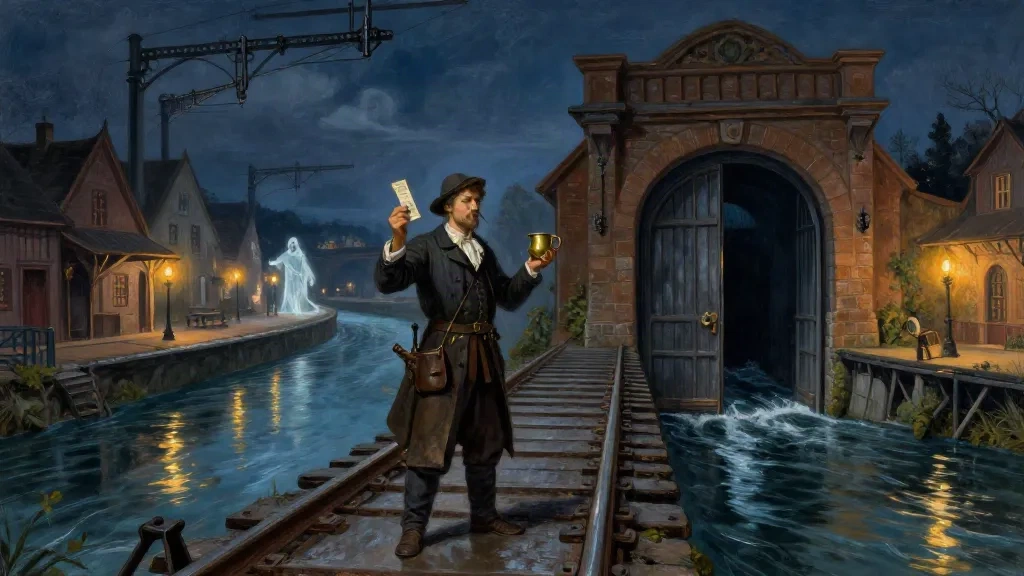
On the morning after the latest Turning, a train ticket lay on Elian's anvil.
It bore no station name, only a departure time: midnight, tomorrow. Beneath the time, a return date had been printed in pale ink and then rubbed away. The ticket smelled of rain and machine oil.
On the bench beside it sat an empty teacup, white porcelain split across the handle and mended with a brass wire. Elian had repaired that cup himself. The magistrate had carried it on the night the river first turned, when Elian was only twenty-three and the customs office still smelled of wet wool.
“You were meant to forget that night,” the magistrate said.
He was leaner now, but his coat still had the brown shine of old velvet. He placed the ticket near the forge's cold mouth.
“The river does not reverse,” he said. “The bridge does. The reflection slips. Men become confused, and confusion is expensive. Anyone who repeats the old story pays for it in customs, permits, and questions.”
Elian looked at the cup. A stain of tea remained in the bottom, the shape of a narrow door.
“Who bought passage?”
“No one.”
“Then who gave the ticket?”
The magistrate touched the brass wire. “Power does. It gives us a future we can recognise, and charges everyone who wants another one.”
Outside, a boy shouted that the bridge had begun turning backward. The magistrate's face tightened. He pulled a ledger from beneath his coat and slid it across the bench. In it, the Turning appeared every seventh night for two hundred years, followed by the same entry: unverified, closed by order.
Elian understood the profit. Uncertainty kept the town divided against itself. East-bank families paid for river charts. West-bank millers paid for permits to cross. The magistrate sold certainty to both.
The Hinge in the Current
Elian took the largest hinge from his rack. It was cold despite the forge, and beneath its rust lay an inscription: WHEN THE WAY RETURNS, OPEN BEFORE IT ARRIVES.
He carried it to the quay with the ticket in his pocket and the mended cup in his hand. The reversed river ran beneath the bridge, carrying candle flames upstream. On the far bank, windows shone in a row that had no houses behind them.
Sera waited there with a lantern.
“The doors aren't hidden,” she said. “They're waiting for someone to choose the side they open from.”
The bridge groaned. Along its railings, the hinges Elian had repaired began to turn by themselves, all at once, their iron mouths facing the water.
Below them, a vast door-shaped darkness opened in the current. No wall surrounded it. No building cast a roof across it. Yet through its gap came the smell of hot metal, distant bells, and a winter night years away.
On the opposite shore stood a railway platform without tracks. A train waited there, silent except for the clink of a porcelain cup against a table.
The magistrate's men arrived with lanterns and ledgers. They shouted that the sight was a reflection, a trick of the current, a violation of the town’s agreed order.
Elian placed the empty cup on the bridge's central stone.
He had spent his life making absent things ready to open. He had repaired hinges without doors, cups without tea, rails without trains. The work had taught him that a future was not a destination already written. It was a joint waiting to be set.
The Ending He Chose
The train's invisible carriages filled with candlelight. One window brightened.
The cup trembled in Elian's hand. He could step aboard and find out who had sent the ticket, who had left the cup, and whether the river had been turning toward something or away from it. That answer belonged to the magistrate: another closed page, another licensed mystery, another way to keep Bellwether divided.
Or he could remain on the bridge and choose the future that had not yet earned its ending.
Elian set the great hinge between the cup and the darkness. He drove one final pin through it.
The impact rang through the bridge and beneath the city. The door-shaped opening widened. The river stopped.
For the first time in two hundred years, the Turning did not occur.
At dawn, the customs office stood on the west bank, though no one remembered it crossing there. The magistrate's ledger opened to a page filled with blank lines. The cup remained whole, brass wire bright beneath the reflected candlelight, holding a little water from the reversed river.
And in every house along the quay, a hinge turned toward the east.





