 Netwrck
Hopeful Science Fiction.
The Note Under the Pier
On the morning the winter began, the sea returned a white feather.
Iona Vale was fifty-eight years old and had stopped pretending she could hear the difference between a lie told well and a lie told tired. She found the feather jammed sideways in the drain pipe beside Bellwether Pier, bright as a scrap of sky torn loose and dropped. It did not belong to any bird nesting on the cliffs. The harbor had brought it back anyway, along with a child’s blue mitten gone stiff with salt, a rusted key, and a brass button polished by ten thousand tides.
The cold came in behind them. By noon the air had gone brittle, and the green cross of Sayer’s Pharmacy lay reflected on the wet asphalt like something drowned. Children came home under it, their breath shining. Beyond the breakwater the sea struck the rocks without rhythm, and the pilings complained in their sleep.
Then a voice from behind the piano, soaked to the elbows, holding a fist-sized key she was not supposed to have: “Did you ever love him?”
Mara Fenn was sixteen. She had stolen the key to the bell cage, the one the council kept locked since the winter the lights failed, and she had brought it to Iona instead of the sea, which told Iona everything about the girl and nothing at all about the man.
“I loved the sound of him being right,” Iona said.
Mara’s mouth twisted. “He was right about the lights.”
And a note sounded inside Iona’s left ear: high, clean, startlingly warm. It came with a small cost she did not notice until later — a needle of cold going into the pad of her thumb, as if someone had pressed a snowflake into the bone.
It happened whenever someone spoke truly. A fisherman admitted he had been afraid of drowning. A woman said she had pretended not to recognize her brother at the herring festival. Councillor Sarn told the council meeting that the harbor lamps had gone dark that year because he had cut the money instead of the oil, and had signed the order himself, and had gone home to bed. Each true sentence added a note to Iona’s music whether she wanted it or not. And each one took a little heat out of her hands, which she had been spending for forty years on wedding marches and funeral hymns and one annual herring song that the whole town sang badly and meant entirely.
What she had never written was the piece that would outlast her. Something her grandchildren could play after everyone who had ever helped her had gone. The town had other plans. The temperature fell eleven degrees that week and kept falling, and the canals sealed, and the pipes coughed cold instead of hot, and the winter stopped behaving like a season.
The Winter That Refused to Be a Season
It lasted a generation. People called it the Long Cold at first, the Freeze, the Hunger, once the White Year, the way a child names a dog it cannot punish. By the second winter the town had stopped counting seasons and started counting birthdays, which are shorter and easier to spend.
Hoarfrost grew on the piano strings in the music shop. Iona had to play with gloves on and then, when the pads of her fingers went dull and would not feel the keys at all, without them. Odile Sayer, who kept the pharmacy with the green cross, caught her in the aisle one morning and took both her hands in her own, which were warm as bread.
“You’re giving it your heat,” Sayer said. “That’s what the note takes. I’ve watched you do it for eleven years. Whoever you’re listening to, they are getting warmer off you.”
“I know.”
“Do you?” Iona had looked, once, at the fingers. In February they were white to the second knuckle in a heated room. She had put it down to age, the way the town put most things down to age.
The music went strange. The truth-notes crowded together, frantic and discordant, because in a town where the truth was a load-bearing wall, every true thing anyone said was structural. Repeats turned to ornament: we are safe, we are sorry, we will remember. Nobody was lying much any more. That was the trouble. Lies had edges. A settled sentence has no place for a person to get a foothold.
One morning in March the tide came up and left a silver spoon on the harbor steps, laid out neat as a gift.
It belonged to the Bellwether Hotel, which had burned the year before the cold, where guests had once eaten porridge out of bone china and a night porter had rung a small bell at four in the morning. A child of six or seven stood over it with her boots in the surf.
“That’s my gran’s spoon. That’s hers, I saw it, it’s on the picture.”
Her joy was real. No note sounded.
Iona bent and lifted the spoon. The silver held the pale sky, and the child’s face, and the cold coming down between them. The feather had been nobody’s. This spoon was nobody’s either. The sea was not returning what the town had lost. It was returning what the town had forgotten, and offering it to whoever was standing nearest, wearing certainty like a borrowed coat.
Possibility, dressed as a fact. A generous lie with salt in it.
The Silver Spoon and the Rule
Iona had two kinds of knowledge and had never been able to reconcile them: what she could hear, and what the town had agreed to hear. Eleven years ago the harbor lights on the south channel had gone out for one night in November, and the herring boat Wrenmary had struck the channel stones in the dark and gone down with eleven aboard. The council’s finding was a squall, a fault in the lamp, a bad course, eleven families and one evening of daylight to bury them in. The town had voted, quietly, over years, to stop discussing it. The bell in the tower was never rung again. The hotel burned, and its china went into the sea, and the sea had begun handing it back.
Now the town wanted to be thawed with the wrong song, and Iona could feel it pressing at her: sing the spoon as hers, sing the feather as an omen, give us a spring we can live inside.
She wrote a rule on the back of the herring-song chart and nailed it above the piano.
Sing anything. But say the name, or say you don’t know.
“You may sing a true thing, a borrowed thing, or a thing you made up,” she told them that first night, with eleven adults and four children in a shop that smelled of paraffin and cold metal. “You may sing whatever keeps you warm. But if an object came out of the sea, you tell us whose it was, or you tell us plainly that you don’t know. That is the only rule. The rest of you can invent everything else, and I will play it.”
Mara Fenn, who had not been invited and had not left, said from the doorway: “That’s not music. That’s a confession.”
“It’s both,” Iona said. “Most good music is.”
She taught the shopchildren to strike spoons against their palms until the sound came out round instead of thin. She taught the dockworkers to answer each other in call and response, hauling, hauling, the way rope answers a winch. She gave the returned things their parts: the white feather took the highest line, thin as a window; the silver spoon kept time, bright and metallic and slightly wrong, a quarter-beat ahead of everyone; a ship’s bell she had bought for eleven pounds at a Rotterdam auction laid the foundation; the bottles made hidden glass songs that only worked when you were slightly out of tune. The old keys became rhythm. Nobody was a hero in it. That was deliberate. She had seen what the town did with heroes: it put them in a bell tower and locked the door.
“It has to be easy to begin again,” she said. “Everything we build here, someone will have to be able to start over on a bad night without me.”
What the Bell Remembered
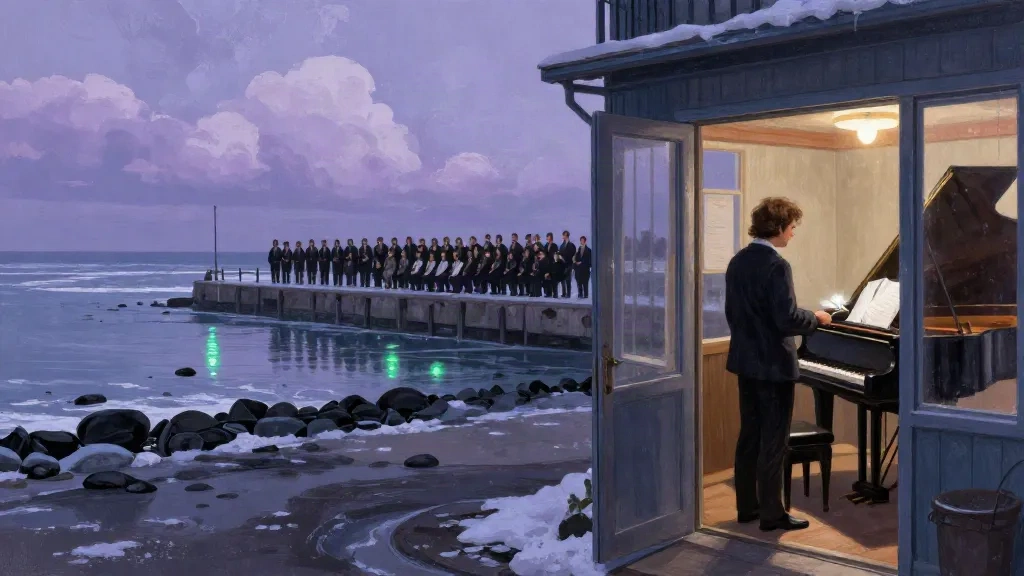
On the coldest night, the whole town came in out of the wind, and the green cross in the window went white at the corners where the frost had got under the paint. Iona played the feather’s line, and the town sang whatever it could release, and the gaps in it were part of the music, and none of it was a lie.
The harbor answered. The waves came up and struck the breakwater in a steady pulse, a slow one, a patient one. The returned things began to move. Keys rolled across the floor and stopped against the stove. Bottles turned in the sawdust. The silver spoon trembled in the middle of the room.
Then Mara put the bell key on the piano lid, where everyone could see it.
“My father didn’t take the bell down,” she said. “The council did. He was fourteen. He was the one they sent for oil that night and he was on the slipway when the south lamp went out, and he has never once said so, and he has taught me for four years that a note that isn’t in the key is a wrong note.”
The room did not move. The pulse of the sea went on.
“Mara.” This was Hollis Fenn, forty-one years old, standing in the doorway with his coat still on.
“You told them a rule,” Mara said. “Say the name or say you don’t know. Say it to him, then.”
And Iona felt it come up through the floor of her, the way a note comes up through a bridge, and she understood with total clarity that she was the only person in the room who could not stop the next thing from happening. If she played, the town would hear the truth of the night the Wrenmary went down, and the truth had Councillor Sarn’s signature on it, and behind him the harbour board, and behind them forty years of not asking. If she played, it would end the Long Cold, because the sea was not keeping the winter. The sea was keeping the winter’s opposite: it was holding still a place the town could not leave until it had said the thing out loud in front of witnesses.
She thought of her mother’s funeral, of how the choir had sung the herring song anyway, badly, because nobody knew what else to sing, and how she had hated them for it, and how she had gone on singing it herself for eleven years.
She played the note under the pier.
It was not a large note. It did not fill the room. But it was the true one, and the town took it up the way a floor takes up heat.
What the Thaw Cost
The sea withdrew farther than anyone had seen in living memory. No ice cracked. No wind softened. The tide simply chose to leave, drawing back over the flats and standing off the town like a held breath, and exposing a black shore of stones bright as coal. And then the cold broke, all at once, the way a fever breaks — not gently.
The thaw came in small, stubborn acts: a gull on a cleared drain, warm water from a kitchen tap, children throwing a red scarf into the harbor and watching it travel outward instead of returning. But it brought with it everything the frost had been storing. The black stones gave up a smell, sweet and metallic, that the whole town recognized and nobody named. The council, with the water rising and the ledger open, found eleven names on the wrong page, and a payment to a lighting contractor dated three months after the night the lamp was reported dead.
Councillor Sarn resigned. He was seventy-one and had genuinely believed he was being prudent, and he said so, twice, in a voice that cracked on the second time.
Hollis Fenn gave up the choir. He taught his scales in the schoolroom until a parent complained about the bell, and then he taught them at home to four children and no music, and Mara stopped speaking to him for two years. The council rebuilt the seawall with the money they had been hoarding for the light, and the light came back that autumn, one lamp at a time, and cast a small orange circle on the water that the harbor did not acknowledge. The shop’s window was broken in May by a man whose brother was on the Wrenmary and who had spent thirty years being told it was weather. Odile Sayer put up a temporary green cross out of paint and cardboard because the real one was still frozen into its frame.
And Iona’s hands. In August she noticed that the shopchildren’s high line had begun to sit badly in her ear — not wrong, exactly. Absent, like a word on the tip of a tongue. The feather’s line. She could still play it, on the fifth fret, but she could no longer hear where it belonged.
She had given them her heat, and Sayer had told her so, and she had listened, and she had gone on taking the notes. She went and sat in the shop in the dark and let herself feel the full arithmetic of it: eleven notes that mattered, and a great many more that did not. She had not done it for the town. She had done it because the music was the only room in which she had ever been allowed to say anything.
The Shape of Spring
By midsummer the seawall stood. By autumn the music shop had a new sign above its door that nobody could agree who had painted it. The choir met every evening anyway, without its director, and the town had to invent its rules from nothing, and it invented them badly and often and loudly, which Iona took to be the point.
Years later, when her fingers missed most of the keys, the children gathered around the piano and played the feather’s high line themselves. They sang their own truths, small and changing, without trying to make them permanent. One of them sang that she wanted to leave; one of them sang that her father had been right about the boat, actually, about the ballast; nobody hushed anybody. The song had learned to continue without asking her permission. Each generation changed the arrangement. Each new voice added a color.
Mara came back in the autumn of the third year, in a coat that did not fit, having spent two years in a city where nobody had heard the harbor sing. She stood in the doorway of the shop with the bell key still in her hand — she had kept it, all that time, which said more than she was willing to say in words.
“Is there a place for a person who doesn’t know what they’re for?” she said.
“There’s a place for the second voice,” Iona said. “It’s the one that makes the first one honest.”
On quiet evenings, when the tide came in under a sky the color of the inside of a shell, Iona sat with her hands flat on the keys and did not play. The harbor breathed beyond the window. It did not forgive anyone. It was not a witness; it was weather with a memory, and it had handed her the whole town’s worth of forgotten things at the only door it knew. She had opened it. Now people had to carry what came out.
In the first snow-free winter that followed, the sea began returning objects again. A rusted key. A child’s mitten, blue. A brass button polished by ten thousand tides.
A small iron key came in over the breakwater and lay all day on the harbor steps, and the whole town walked out to look at it, and nobody could say whose it was, and nobody sang a note, and by evening somebody picked it up and took it home anyway, to be looked at on a shelf, a possibility wearing certainty, waiting to see what the town would decide it was.





