 Netwrck
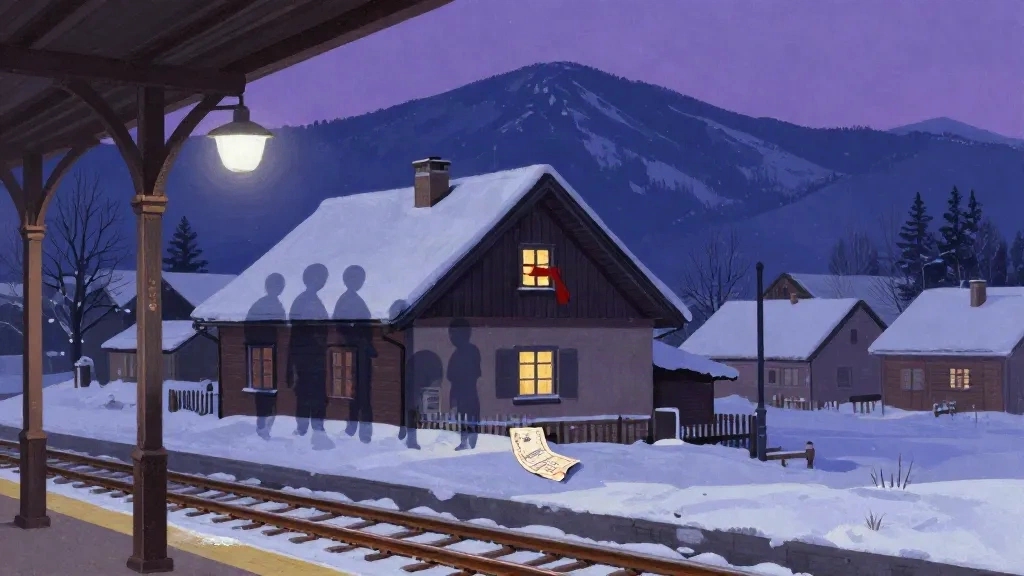
Fantasy.
Shadows at the Lift
By the time the first guests climbed from the mountain train, their shadows had already begun walking toward the resort.
They crossed the violet snow without leaving footprints. They slipped beneath hedges, through locked doors, and into chimneys, where they curled like blue cats around cold hearthstones. By dusk every lamp in Bellwether Halt burned cloud-white, and the village waited to see which houses would be lonely enough to answer.
Mara Vale was the village nurse. She carried a black leather case containing bandages, fever salts, three vials of peppermint, and a narrow silver spoon. The spoon was for listening. When she tapped it against a doorframe, the wood answered with the household's grief.
Her patients were houses. Some had grown too large for their families. Some had been empty since a child left. Some repeated the last words spoken inside them until the words had worn grooves in the floorboards. Nine Elbows said mother? in the voice of a boy who had grown to six feet. The cottage above the mill said nothing at all, loudly.
Every answer cost something. A name. A season. The habit of sleeping facing the door. When Mara had read the price aloud in the kitchen of Nine Elbows, the house had taken her son's laugh instead, and she had carried the loss of it up and down the valley for a year like a stone in her boot.
That evening she was early to the Bellwether house, though nobody had sent for her. That in itself was a symptom.
The House With Two Voices
Mrs. Ione Vey stood beneath the kitchen arch with a red scarf wound around both hands. She had been beautiful once in the way of women who were never interrupted. Now the beauty had been spent, the way a coin is spent, one purchase at a time, and what remained was the shine of it.
Her daughter Elian had returned that afternoon after six silent years, carrying a train ticket in one gloved fist. She stood with her coat still on, snow melting on her shoulders, in the attitude of a woman who had rehearsed the door.
“I did not come for a reconciliation,” Elian said.
“Then why did you come?”
“Because the stationmaster promised me a room with a clear view of the mountains.”
The house groaned. A spoon slid from the table and struck the floor three times, which meant it had heard something the occupants had not said aloud.
Stationmaster Rook entered without knocking. He was a narrow man in a coat the colour of oxidised copper, with a timetable stitched into the lining. Shadows gathered behind him, upright and impatient, the way people queue for a ferry.
“There is a defect in the timetable,” he said. “Mother and daughter occupy the same destination but different departures. I can correct it.”
VEY, I. — Halts, eats, leaves. Unterminated.
VEY, E. — Origin unrecorded. Arrives whole. Unterminated.
Mara set down her case. “You are not a stationmaster. You are a scheduler of endings.”
“I am the office that notices them.” He touched the stitching at his cuff. “Every ending has a cause. Usually someone failed to leave on time.”
Elian held up the ticket. “My train leaves at dawn.”
“Then the house must be empty before dawn,” said Rook. “No unfinished business. No misplaced shadows. No one returning. The building is not permitted to be surprised.”
Mara drew the spoon from her case and struck the arch. The answer came up through the grain, slow, the way blood comes back into a limb.
“Your patient is not sick because she is empty,” she said. “She is sick because she has been holding both your voices in separate rooms, and neither room has a door.”
Ione's mouth moved. “The boy,” she said.
Rook's face did not change, but the shadows behind him leaned.
What the Spoon Held
In the corner of the kitchen, low down where a child would have sat, the house had begun again. It was a small argument made of nothing: a door closing gently, a latch lifted and set down, a breath held past comfort. The Bellwether house had been playing it every evening for six years, and no one in it had ever once mentioned the noise.
Mara knew the noise. She had heard it in her own kitchen in March, in the space between one cough and the next, and she had told Ione Vey to be patient, that spring would bring the cure, that the frost in the lungs was only a tenant and tenants leave.
She had been wrong. She was still standing in the room where she had been wrong.
“You came early,” said Elian.
“Yes.”
“Why?”
Mara listened to the house instead of answering, and the house, which had heard her lie in March as clearly as it heard everything, said nothing on her behalf. Her son Ferryn had been eleven. He had laughed like water going over stones. The house at Nine Elbows had taken it, and three months later he had gone, and Mara had spent a year telling herself the two facts were unconnected, which is the shape most of her grief had taken by then: two solid objects with a gap she would not look into.
“Because a house that has scheduled an ending and a house that is sick look identical from the road,” she said at last. “And I would like to be wrong twice tonight instead of once.”
A Train Before Morning
At midnight Mara climbed to the Bellwether attic with Elian. Below them the resort's shadows began removing themselves from the buildings, folding out of chimneys and doorways with the distaste of animals leaving wet hay. One by one the dark shapes boarded an imaginary train. From the mountain the real locomotive answered, three notes, unhurried.
“She has been standing at the same window since you left,” Elian said.
“I know.”
“Then why did you wait?”
“Because waiting made me certain I was the one who had been left. If I had gone back first, I would have had to be the one who came back, and that was a person I did not know how to be.”
Mara raised the spoon and struck the attic wall. The sound she wanted was not listening. The sound she wanted was a door opening in a wall that had no door.
A violet crack split the plaster from floor to rafter, thin as a hair, and inside it Ione appeared as she had been years ago: young, furious, folding the same red scarf into a square and refolding it wrong on purpose so that the child would have to ask her why.
Elian knelt. She put her hand through the crack up to the wrist, into a kitchen six years gone.
“I did not know how to come back without becoming the child who had gone,” she said. “She would have been waiting for a girl. I was not a girl anymore. I would have been an apology, and she would have had to accept it.”
Ione's image lifted the scarf. “I did not know how to miss you without becoming the mother who was abandoned. So I kept the window. If I kept the window, I was the one doing the keeping, and no one could do it to me.”
Below, on the frozen platform, Rook slammed his timetable shut. The sound came up through the floor.
“Correction impossible,” he called. “Their departures overlap.”
“Then change the schedule,” Mara said.
“The stationmaster does not change schedules. The schedule changes the stationmaster.”
Elian drew the ticket from her fist. She held it up so that both women, living and remembered, could see the printed mountain and the hour of departure, and then she tore it in half, and the paper came apart not as paper but as two red threads.
She tied one thread around her mother's wrist, above the fold of the old square. She held out the other to Mara.
“If you are going to break his arithmetic, do it with a witness.”
Mara took the thread. She had held a great many things in a great many houses and had given very few of them back.
The house caught.
Eleven Houses Hanging
What went through Bellwether Halt that night was not wind. Every bell in the village rang once, the lift bell, the chapel bell, the bell on the bootmaker's door that had no clapper and had never once rung.
And eleven houses discovered, in the same instant, that their endings had not been filed.
Mara felt it go round her like a dropped thread in a sleeve. The schedule had not been only the Veys. Rook carried it because someone had to, and the something had been the winter's list: eleven houses in the valley whose last conversation had finished, whose people had said what needed saying and gone upstairs and would not come down. Nine of them had asked. Two had merely stopped.
“You have taken their exits,” Rook said on the platform. He had not come up the stairs. His voice came through the frozen window like something being read aloud from a form.
“I have taken their paperwork.”
“It is the same thing.”
“No. Paperwork is what the living sign. Exits are what the dying get.”
Rook looked at her for a long moment, and something in his face that she had taken for cruelty turned out to be the exhaustion of a man who had once, himself, been on a list and had been talked out of it. Then he said, “You understand that a held house is not a healed house.”
“No,” said Mara. “I understand it is a house.”
The house caught properly then, the way a heart catches when it is told at last what the trouble is, and the shadows in every room of the Bellwether house stopped on their way out and turned, and came back inside, and sat down.
The Line That Stayed
At dawn the real train sounded its horn. Its windows shone cloud-white against the violet mountains, and every carriage was full of people who had paid and expected to arrive.
Elian did not board.
She set the second half of the ticket in Ione's hand, and Ione closed her fingers around it, and the paper did not become thread this time. It stayed paper. That was the whole of the magic, and it looked like nothing.
“I will stay until the next one,” Elian said. “Not because the schedule demands it. Because I choose to return.”
“There may not be a next one,” said Rook.
The Bellwether house released a long breath, and the smell of it went through the room: cold iron, peppermint, wet wool, the particular warmth of a stove that has been banked for six years and asked to burn again. Downstairs the shadows stepped back inside the walls, and the house, which had been holding two rooms apart, let the wall between them stay.
From Rook's pocket fell a timetable with no departure times in it, only endings. He picked it up, and the copper of his coat had begun to go orange at the cuffs, at the seams, at the place where his hands had held the book shut for longer than any hand should.
“There is no train for this,” he said.
Mara tapped her spoon against the platform stone. The sound went out flat across the ice and did not come back, which meant it had been heard.
“There is now,” she said.
Far beyond the resort, another whistle answered. Rook looked north, into the country of the next valley, and for the first time in his service his own shadow was a quarter step behind him and getting further behind.
He hurried after it.
What the Line Cost
At the Widow's Kiln, a man named Tobin Fell had been waiting six days to die.
He had asked, in the last hour he could still ask anything, that the house be released, and Mara had read the request to the Kiln herself, and the Kiln had accepted it, and the acceptance had been filed with Rook. She knew the request number. She carried it the way she had once carried the sound of her son's laugh: in the boot, in the heel, on every step.
The house was still holding him. He was conscious, and furious, and he knew exactly what she had done, because the Kiln told him, continuously, in the voices of everyone who had ever died in it, that the release had been granted and then ungranted and then granted again by an incompetent woman with a spoon.
“You could ask him to forgive you,” Ione said from the doorway, and it was the cruelest thing anyone had said to Mara all winter, and Ione said it with love.
“I could ask him,” Mara said. “I would not have the nerve to call it forgiveness if I did.”
She went to the Kiln anyway. She sat with Tobin Fell for four hours and told him the truth, all of it, including the part where she had chosen his house over nine others without asking any of the nine, and the part where the ninth of the nine had been a boy of eleven who had stopped speaking three days before he stopped breathing.
He spat at her. Then he asked her to send for his sister.
He died on the ninth day, with the sister holding one hand and the spoon in the other, tapping the bedframe, keeping time, which is a thing the living can do for the dying that the dying cannot ask for and never know they were given.
Ione Vey lived three more weeks. The reconciliation had not been a cure; it had been a hospice, which is the same service offered later and with better lighting.
Mara told Elian the truth on the second night, because Elian had come to her already knowing and would have found out the pretending, and because Mara had learned in March what it cost to be the person in a room who knows and does not say. She was not going to build another year of her life on that construction. She had built one already. It had not held.
Elian did not forgive her either. She stayed anyway, and shouted at her, and once, in the worst hour, said you told my mother spring as though Mara had invented the season. Which, in a sense, she had.
The Patient Returns
The house was buried in March, as houses are, quickly and without argument. Elian Vey stayed in the valley. In April she went to Ione's sister and learned the names of the people her mother had been; in June she was carrying the black leather case down the road to the Widow's Kiln; in August the bootmaker's bell rang by itself and everyone in Bellwether Halt pretended not to hear it.
She did not take the spoon for a year. When she did, Mara gave it to her at the door, in the snow, and neither of them made a ceremony of it.
“It only listens,” Elian said.
“It does more than that,” said Mara. “Houses do not need to be heard. They need to be answered. Tap it when you have something to say, not when you want to know.”
Elian looked down the road at the dark shapes of the guests arriving out of the violet evening, several hours early, as they always did, and were already walking toward her.
She knocked. She waited. She tapped the spoon against the doorframe, and the wood answered, and for the first time all evening the answer was not the same thing she had been afraid to hear.
It was company.
Inside the Bellwether house the red scarf still hangs on the banister, bright as a coal, and it is not a sign of departure. It is a thread. Somebody ties it off. Somebody else, eventually, unties it.





