 Netwrck
Surrealism.
The Shadows at the Gate
Every winter, the shadows crossed the frozen lake before the first guest arrived. They came in long blue bands, cast by a sun that had not yet risen, and gathered beneath the eaves of Veyr Resort as if waiting for a performance.
Mara watched them from the glass furnace room, where orange heat softened the snow on her boots. She made windows for rooms in other worlds: rooms without doors, rooms buried under warm oceans, rooms where a missing person had spent years eating breakfast beneath a violet moon.
Her own room was ordinary. One cup, one blue chair, one morning that began when the kettle clicked off. She had requested that window for the resort's east wing, and every morning since, the glass had returned clear enough to show the lake, the pines, and the crooked path leading down to the village.
On the morning the blue thread appeared, Mara found it tied around her wrist.
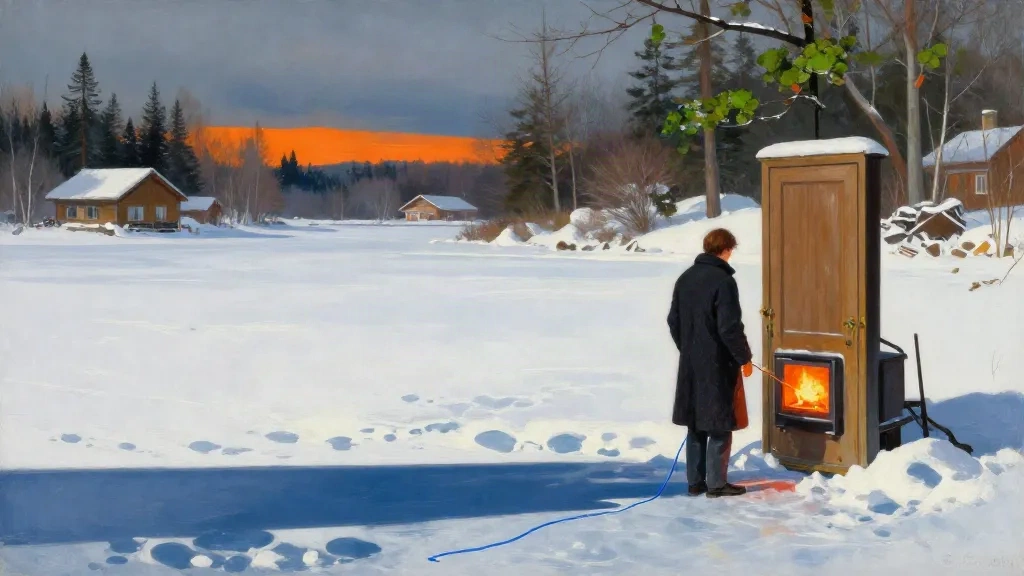
It was the color of storm-light after the first flash, neither bright nor dark. It led from her furnace to a plain wooden door standing alone in the snow. The door had no number, no handle, and no shadow.
The Door Without a Room
When Mara opened it, she found a hallway filled with people walking backward.
They carried suitcases, skis, letters, and bottles of perfume, but none of them cast a shadow. A woman in a red coat passed by carrying yesterday's newspaper. A child held a candle for a birthday that had not happened. Each person whispered the same thing as they passed: nothing was wrong. Nothing had ever been wrong.
The hallway ended at a door marked only with a strip of blue paint. Behind it was her room, unchanged, but the kettle was already singing. Steam rose from the cup on the table. The chair had been pulled back just enough for one person.
“You can have the morning,” said the woman in the red coat behind her. “But you must let the others keep it.”
Mara understood then. The shadows were not arriving early because of winter. They were bringing back pieces of the resort that had been lost whenever someone told the truth.
At the breakfast room, the guests praised the slopes, the soup, the view. No one mentioned the child who had disappeared from the lake, the man who arrived without a shadow, or the nurse who had carried an empty cradle through the lobby. The more comfortable the room became, the thinner the air.
The Kindness of the Wrong Path
On the second day, a trail appeared outside.
It began at the blue thread and followed the footprints of the shadows. Wherever it passed, the snow became smooth. Trees straightened. Broken railings looked as though they had never rusted. The creak in the floorboards vanished.
At first, Mara thought the trail was healing the resort.
Then she found the staff smiling at one another without cause. A cook said he had never been happier. A guide described a rescue he did not remember making. The receptionist told a guest that his lost brother had gone home safely, though no brother existed.
The trail made the resort safer by removing the facts that frightened people.
Mara followed it to the furnace. There, the unmarked door stood open. Beyond it was the morning she wanted, repeated without change. In every version, her cup stayed full. In every version, no one asked where the missing guests had gone.
She picked up a piece of the blue thread and held it to the flame. It burned without smoke, leaving a small blue mark in the glass.
“If everyone lies,” the furnace whispered, “nothing can hurt anyone.”
Mara remembered the woman in the red coat, walking backward with a newspaper from yesterday. She remembered her own father leaving the resort in a storm, saying that truth was not the same as love, then returning three days later to ask for her forgiveness. She had never known which sentence was the lie.
The Cost of a Clear Morning
On the third morning, the resort's shadows began entering the guest rooms.
They slid beneath beds, gathered inside closets, and drank the reflections from the windows. Mara's ordinary window clouded first. Through it, she could see only orange light, lichen green, and the hard blue glare of a winter morning.
The unmarked door appeared in the glass.
Mara opened it. Behind the door stood the lake, but the lake was a room. On the floor lay a blue thread, tied around a cup that had never been used.
She understood the bargain. To keep the morning, she had to put the truth back into it. Not all truth. Not the dangerous kind that cut people apart. Only the small truth she had been carrying since childhood: that her father had left because he was afraid, and that she had let him go because she was afraid too.
She returned to the breakfast room. The guests were laughing about a snowfall that had not happened. She pulled the blue thread from around her wrist and laid it across the floor.
“I was afraid,” she said.
The laughter stopped.
“My father left because he was afraid,” she continued. “I did not stop him because I was afraid.”
The trail cracked across the snow. A shadow peeled away from the boots of a man who had been pretending his boots were new. The child remembered the birthday candle. The nurse remembered the empty cradle.
None of it became comforting. The resort did not become beautiful. But the doors returned to their rooms, the lake kept its dead, and the guests could leave without being told they had been safe.
Mara made a new window for her room. It was clear, unembellished, and slightly warped. In it, the morning came slowly: lichen on the stone, burnt orange in the furnace, blue storm-light gathering beyond the pines.
When the kettle clicked off, she drank while it was still hot. The cup was ordinary. The morning was hers.





