 Netwrck
Mythic Fiction.
The Season Clock
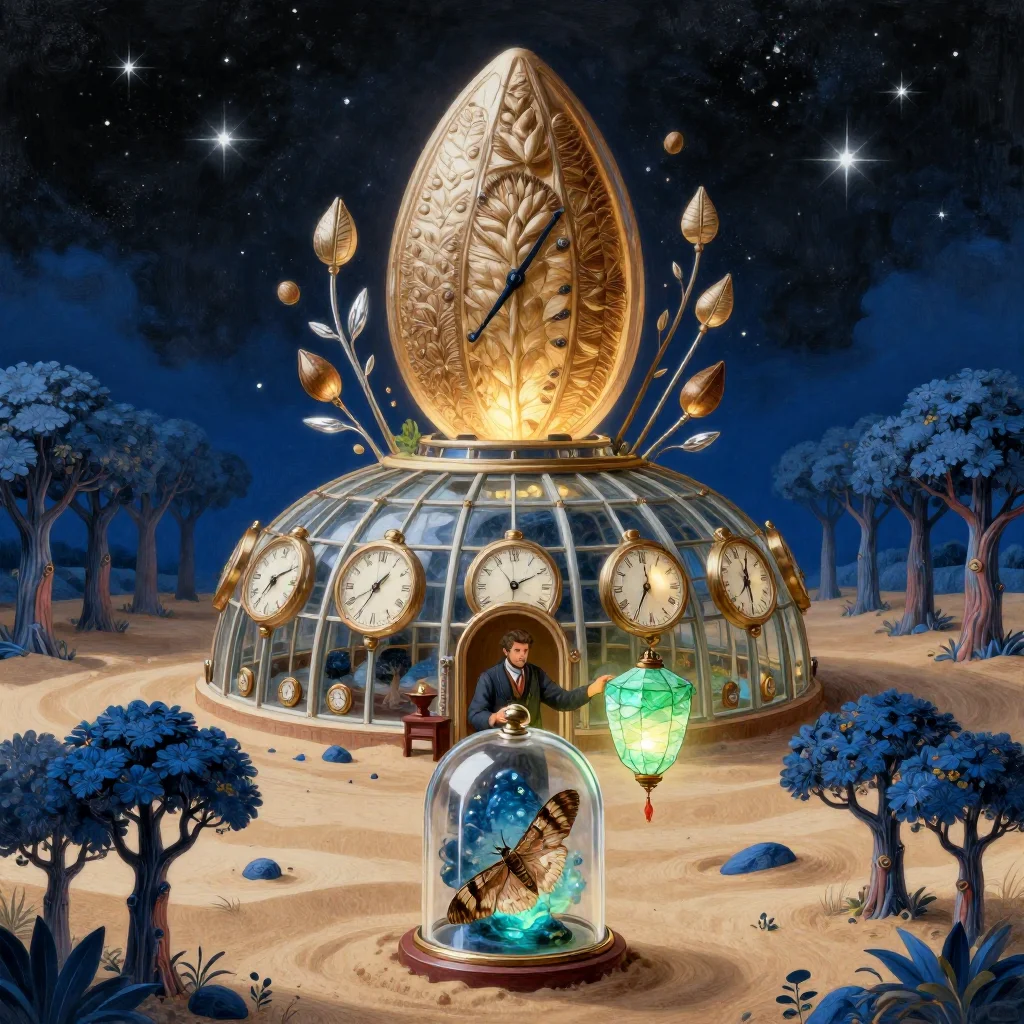
Mara kept time in the greenhouse beneath the seed, where the trees grew upward in slow green fire and the stars showed through their leaves. Her clocks did not measure hours. They measured the patient turning of spring, the lean of summer, the exact instant when autumn released its hold.
Each clock was built inside a hollow seedpod and wound with a thread of silver sap. The oldest one, the First Climate, had a paper lantern at its heart. Its flame was always the color of sea glass, though Mara had never seen the lantern lit.
She had been making a clock for someone who no longer lived. The customer was a botanist named Ilyan Rook, who had disappeared nine orbits ago while searching for the original forest beneath the seed. Before he vanished, he had left Mara a single moth wing, folded between the pages of a seed catalogue.
“Make something that can return what is lost,” he had written.
She had not known then what he meant.
Now the clock lay unfinished on her workbench. Beside it, the moth wing had begun to tremble.
The Conflicting Voices
The greenhouse choir began singing at the change of the night.
Its members were memories stored in the seed’s roots. Some had been human voices, recorded by Rook before the first forest died. Others were the voices of trees, insects, birds, and the machines that tended them. When Mara entered the choir chamber, the leaves folded inward and dozens of hidden speakers released their memories at once.
One voice said the seed belonged to the future. Another said it was a tomb. A third insisted there had never been any forest at all, only a beautiful story invented to conceal the emptiness.
The moth wing beat against the workbench. Mara pinned it beneath a glass bell.
“Where is the thing I lost?” she asked.
The choir answered in chorus. The answer changed with every speaker. A location, a name, a season, a color. Under the conflicting claims, she heard a single low harmony, almost lost beneath the others.
It was the sound of a person remembering a promise.
Rook had asked her to return a lost thing to the person who made it. Mara had assumed he meant the seed. Now she understood that the seed was only the lock. The lost thing was the final instruction, hidden in the oldest layer of its memory.
She opened the First Climate.
Inside, instead of gears, lay a small blue vial. A drop of cobalt shadow moved within it, neither liquid nor smoke. When the vial touched the moth wing, the wing became whole.
The Price of Returning
The choir attacked her with fragments of vanished seasons.
Winter poured from the roots and froze the sap in her pipes. Summer struck the glass roof and cracked three panes. A memory of fire raced along the floor, and the paper lantern in Mara’s hand burst into flame without burning her fingers.
She ran through rows of artificial oaks while the seed shook the greenhouse on its orbit. The blue vial’s shadow stretched across the leaves, taking the shape of a door.
Beyond it stood Rook, young and whole, though his face flickered like a reflection in disturbed water.
“You took the instruction,” he said.
“You gave it to me.”
“I gave you the promise. I kept the return path.”
Then the choir spoke through him. The voices accused Mara of theft. The seed needed its last instruction to restore the extinct forest, and the vial was the final key. If she gave it to Rook, the forest would remain a memory. If she released it into the seed, Rook would cease to exist.
That was the conflict. The memories were not lying. They were each preserving a different outcome.
Mara held the vial between them. The moth wing beat once against the glass.
“You made this,” she told Rook. “I was only supposed to return it.”
“I made the promise,” he answered. “You made the clock.”
What the Clock Remembered
She opened the vial over the seed’s central socket.
The shadow entered. For one breath, every clock in the greenhouse stopped. Then spring returned—not as a season, but as a direction. Roots turned toward remembered soil. Leaves opened in the shape of forests that had never grown on any world.
Rook began to fade.
Mara did not stop the clock. She had built it to keep time for seasons, and seasons required an ending. The return was not the same as resurrection. The seed had accepted the instruction because someone had finally carried it home.
At dawn, the paper lantern was burning in her hand. A cobalt moth circled its flame, its wings now whole.
From the soil rose a new tree. Its bark carried the narrow scars of vanished trunks, and every leaf held the green of deep water, old sand, and the blue shadow between stars. The choir fell silent, then resumed in one clear voice.
Mara placed the moth wing beneath the lantern. The flame turned it to gold.
She had returned the lost thing to the one who made it, and received back the only proof that it had existed.





