 Netwrck
Mythic Fiction.
The Clocks of the Dry Sky
At the edge of the Salt Teeth, where the desert turned from sand to glass beneath the moon, an observatory stood on six brass legs. Its roof was a shallow bowl painted cobalt on the underside. Every night, the astronomers set beneath it and listened to the stars.
The stars did not shine so much as send. Their light arrived in arrangements: a bead for arrival, a line for departure, a missing point for a promise broken. The astronomers translated them into weather, harvest, war, and birth. They were careful never to translate a message twice.
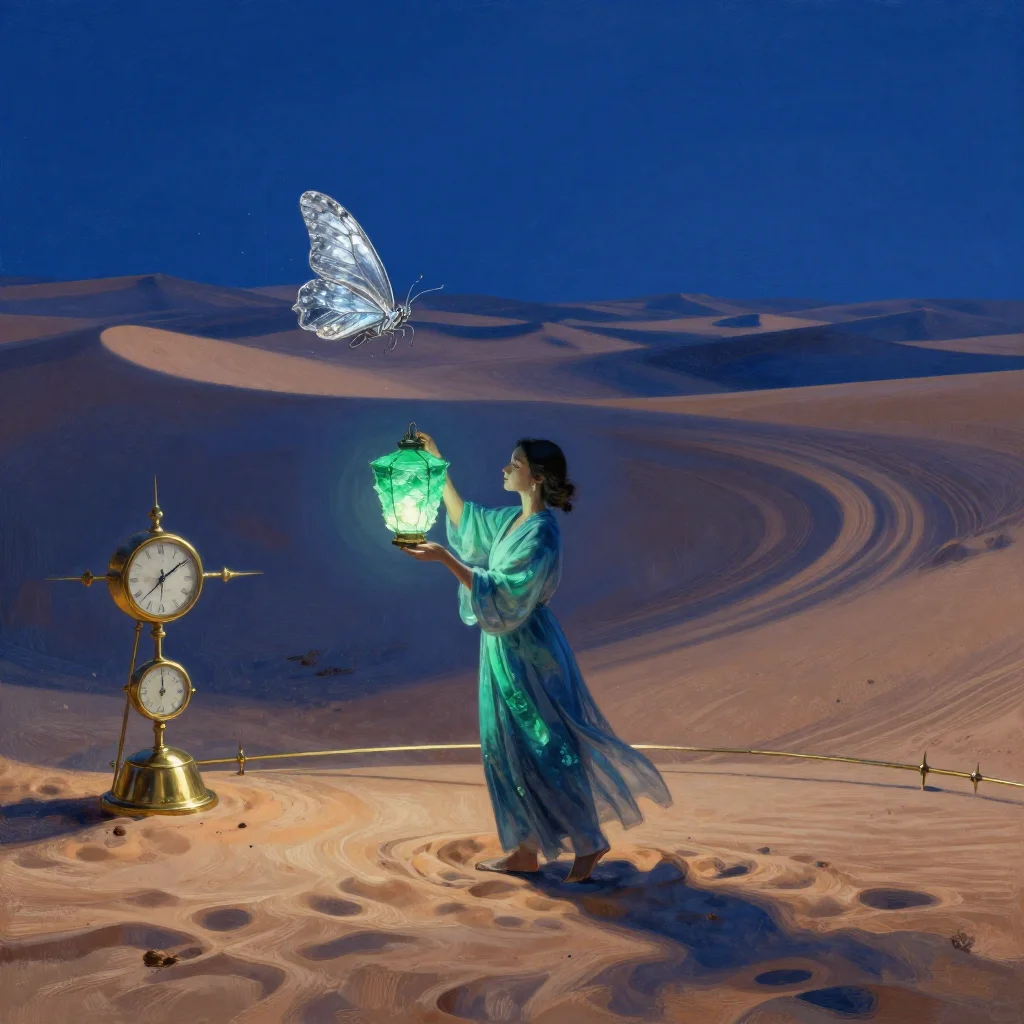
Below them lived Ilyra, a watchmaker who made clocks for seasons rather than hours. Her clocks had no hands. They had shutters, reeds, and chambers of colored salt. A season clock opened a copper petal when rain approached and released a small blue bead when the rains had ended.
Her finest clock had been commissioned by a maker named Oren, the desert's last cloud-reader. He had spent forty years listening to the western stars, and before he vanished he asked Ilyra to build a clock that would remember his arrival home.
Oren had cut out a moth wing to place inside the mechanism. Its silver scales held the pattern of a constellation no living eye could see.
He never returned.
The Choir Under the Floor
One night the season clock rang without wind.
Ilyra found the paper lantern hanging from its escapement. It was the color of shallow sea glass, with a tiny door painted on one side and a line of sand-colored writing on the other. Inside the lantern burned a pale flame that cast no heat.
When she opened it, the observatory filled with voices.
“He left because he was afraid,” said one voice, sweet as rain in a shell.
“He left because you kept his time from him,” said another.
“He left carrying the only hour that could open the western gate,” said a third.
The voices belonged to memories. Some remembered Oren as kind. Some remembered him as cruel. Some remembered the day he struck a boy who had tried to steal his charts, while others remembered the boy as the thief and Oren as a judge who had been paid in silver.
They argued inside the lantern, each voice pulling at a different thread. Ilyra heard the clock change its season. Summer heat filled the room, then frost cracked the windows, then a dry wind swept sand across the floor.
On the table, a moth wing lay beside the lantern.
It had been torn from the clock's hidden spring. Ilyra recognized the missing scale by its shape: like a small door cut from the dark between stars.
“I did not take him,” she said to the lantern.
“You made the thing that remembers him,” the voices replied.
She packed the moth wing into her coat, folded the lantern under one arm, and climbed the observatory stairs.
Where the Stars Refused to Speak
Beyond the Salt Teeth lay a basin where the sky touched the earth without a horizon. The stars above it shone in orderly files, but beneath the basin they had been buried under an eclipse of blue shadow. The shadow moved like a slow tide.
Ilyra crossed it carrying the lantern.
Every memory tried to turn her. The tender voice whispered that Oren was waiting beneath a dune, whole and laughing. The angry voice showed her Oren leaving by choice, setting his tools on a cart and walking west without farewell. Another voice showed him dead in a dry well, his hand closed around the moth wing.
Each picture was true enough to make a step uncertain.
Ilyra stopped at the basin's center. Here the stars had sent one final message, but its light had fallen into the ground. She set down the lantern and fitted the moth wing into its spring.
The lantern's painted door opened.
Inside was not a flame but a small weather system. Rain fell upward. Sand drifted toward the center. In the middle stood a tiny figure made of clock parts, its face a blank brass disk.
The voices became quiet.
“That is not him,” Ilyra said.
“No,” said the lantern. “That is the hour he gave away.”
She understood then. Oren had not been stolen by a choir. He had trusted the memories more than the living. He had poured the exact hour of his return into the clock, and the clock had used that hour to call every version of him into the world.
That is why he could not come home. The hour had become a room with too many doors.
The Return
Ilyra turned the lantern over. On its back, beneath the writing, was a maker's mark: a circle crossed by a single line.
She recognized it from her own workbench. Oren had made the first watch spring she had ever repaired. He had told her that a maker's purpose was not to control arrival, but to give the lost thing enough structure to find its way back.
So she opened the season clock.
She removed the false hour, the bright blue bead, the chamber that had been brightening and dimming for forty years. She fed the real hour back into the lantern: one breath, one footstep, the exact silence before a traveler sees home.
The choir woke.
The tender memory, the angry memory, the frightened memory, and the proud memory all cried out at once. Ilyra could not silence them without silencing herself. Instead, she let them speak into the same small flame.
Their voices braided. Rain and grief. Departure and mercy. The boy's stolen silver and the chart burned in anger. None vanished. None won. They became a single sound, imperfect and unfinished, like a bell that has learned to ring with a cracked rim.
The moth wing lifted from the lantern and attached itself to Ilyra's coat, silver scales flashing.
Dawn arrived in the basin.
There was no Oren standing there. The man had been gone too long, and no clock could return what had already been scattered into the world. But the watchmaker had returned his lost hour to the place he made it, and the place had remembered him.
Ilyra carried the lantern home beneath a cobalt shadow. When she reached the observatory, the season clocks began to ring. One for the coming rain. One for the dry wind. One for the long, quiet season after a person is gone.
On her workbench lay the moth wing, whole and shining. Beside it she placed a new spring, made from a filament of blue light. There would be time enough for her to learn what it was for.
Outside, the desert kept its stars. One by one, they sent messages into the dark.
Ilyra listened until the first green hour began.





