 Netwrck
Mystery.
The voice under the storm
By the time the storm reached Kettler’s village, the doors had begun changing places.
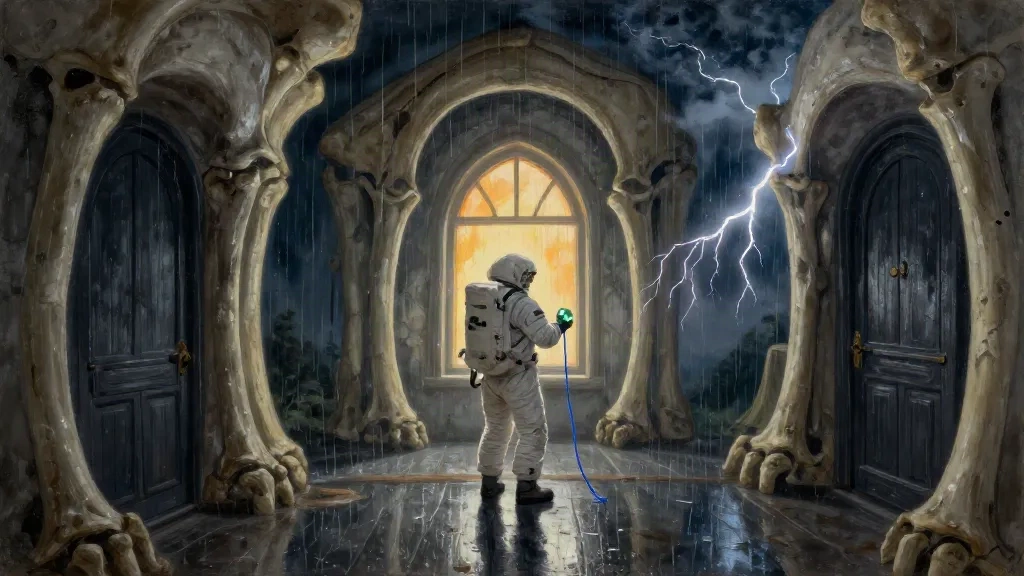
They moved with the rain’s silver fingers. A cooper’s workshop appeared beside the chapel, then vanished behind the school. People opened doors expecting rooms and found corridors breathing cold air. They stepped through and emerged on balconies under the giant’s ribs, where black rain hammered the bone-white beams.
On the highest gallery lived Mara Venn, once an astronaut named Tomas Venn. She had not descended from orbit in eleven years. Earth, according to the official records, was a rumour transmitted by unstable satellites: perhaps a blue sphere, perhaps a story invented to comfort the people who had built their homes inside the sleeping giant.
Mara had stayed in orbit because leaving would make the rumour true. She floated above the planet, repairing weather engines and listening to the world’s thin electrical chorus. Then the storm arrived, and beneath its static she heard her sister’s voice.
“You always listened for me,” the voice said. “I was there, Mara. Under everything they called background.”
Mara landed before dawn. The village had changed again. Every door faced a different room, and every room held the same green stone: wet, faceless, warm as a living hand. She carried one in her pocket. A blue thread had been tied around it, though she could not remember doing so.
Doors with no hinges
The village had no map that remained true for more than an hour. The old surveyor, Iven, kept drawing the rooms anyway. His marks filled a roll of waterproof paper: a square for shelter, a slash for danger, a small circle for voices.
“The doors aren’t moving,” Iven told Mara. “The rooms are. The storm is teaching them new arrangements.”
He pointed toward the giant’s ribcage. At its centre, behind an amber window that burned even in the rain, a staircase descended into darkness.
“The first room is there,” he said. “It is the room where the village began. The records say its door was lost.”
“Records lie.”
“Records are made by people who need silence to remain useful.” Iven held out a second green stone. “Take this. The storm changes what is carried, not what is carried toward.”
Mara entered the stairwell. Halfway down, the amber window vanished. The walls narrowed until her shoulders brushed bone. Doors appeared in both sides of the passage, all shut, all breathing.
Behind one, her sister hummed a childhood tune. Behind another, someone counted the days of a drought. Behind the last, the voice said her name.
Mara opened the last door.
The archive beneath breath
Inside was a circular chamber packed with shelves. Every object on them had been dismissed: broken spoons, cancelled notices, names scratched from ledgers, songs hummed by workers too tired to know they were singing. At the centre stood a brass recorder, tarnished green around its mouth.
A blue thread ran from the recorder to a hole in the floor. Mara followed it. Beneath the boards lay a second chamber, where the sleeping giant’s heart had been hollowed into a listening room.
Thousands of wires entered its walls. They carried gossip, weather reports, last words, market prices, distant songs. History had called them background because it could not afford to admit that the background had been speaking all along.
On the recorder’s label, someone had written: Mara, age nine.
Her sister’s voice returned, tired and close. “You asked me to leave a message before your flight. I did. You were already gone.”
Mara lifted the recorder. The blue thread tightened around her wrist. Above them, the village doors slammed open and shut. Rooms collided. People shouted from places that had no names.
She understood then. The storm had not stolen the archive. It had heard the archive’s silence and tried to correct it.
The sound that held
Mara pressed play.
Her nine-year-old voice filled the chamber: When I come back, you won’t have to call me. I’ll know where you are by the things you leave behind.
The green stones split. Blue thread poured from them and raced through the walls, stitching the scattered rooms into their proper order. The recorder continued, joining every neglected sound—the sister, the child, the vanished workers, the sleeping giant’s slow breath.
At sunrise, the storm lifted. Kettler’s doors stood where they belonged.
Mara returned to orbit with the recorder and a single green stone. The blue thread remained in the village, tied around the amber window. Whenever the wind shifted, it tightened, carrying a whisper from below.
History had called her sister background noise. Mara would spend the rest of her orbit proving that background was only another name for a voice waiting to be found.





