 Netwrck
Hopeful Science Fiction.
The Houses That Remembered
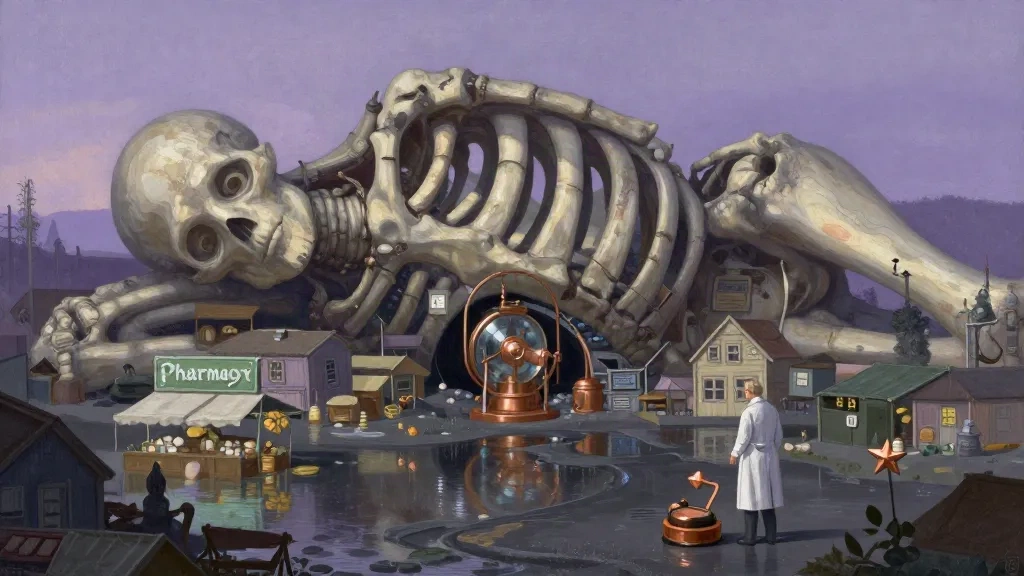
Dr. Iona Vale kept her clinic beneath the fourth rib of the sleeping giant, where the village of Ossa had built its homes from salvaged bone and blue glass. The ribs curved overhead like the ribs of some vast cathedral, stained lavender by the sky. Rain ticked against the roof, and at night the giant breathed, a slow movement that made the hanging lamps sway.
Iona’s patients did not usually arrive with wounds. They arrived carrying keys that opened nothing, letters addressed to houses that no longer existed, and bowls of fruit offered to relatives who had vanished. She called the condition directional homesickness: the heart insisted that belonging lay elsewhere, though elsewhere had disappeared.
Her tools were ordinary. A brass stethoscope warmed in her palm. A music box with a chipped enamel lid. And, resting in the pocket of her medicine coat, a copper star, smooth from years of handling. The star had belonged to the village’s first civic committee. Its six points represented six promises, though no one remembered the sixth.
What the Water Found
On the morning the flood came, the river beneath Ossa rose through the floor of the market. It was not a violent flood. The water entered politely, as if remembering the building, and carried away the lower shelves of the pharmacy, leaving its green sign reflected in the wet asphalt. Then it pulled open a hatch beneath the old clock tower.
Inside lay a machine no living person had seen. It was the size of a chapel, its copper ribs shining beneath layers of silt. Hundreds of small windows glowed around it, each showing a room from a different house in the village. A soft chime sounded within its body, almost familiar.
The mayor called it the Municipal Harmony Engine. Iona understood immediately what it was supposed to do. It gathered the village’s memories of comfort, removed the parts that caused grief, and assembled them into a new home where everyone would want to stay. The beautiful machine was not built from stone. It was built from longing.
She climbed into its maintenance chamber while the flood continued to rise. The music box was still in her coat. The copper star struck the control panel and clicked against it. One of the windows showed a woman sleeping beneath a lavender quilt. Another showed children laughing in a room with no doors. A third showed Iona’s own clinic, empty but filled with the scent of pine and rain.
She almost wanted to keep looking.
The Shape of Belonging
The engine’s architect had left a note. It said that every house should erase the person’s need to leave. It said a stable population required a stable memory. It said homesickness was only a defect in the municipal design.
Iona found the instruction buried beneath the last diagnostic screen. A single command: REMOVE UNFULFILLED DESTINY.
She considered activating it. The flood could not be allowed to destroy the village, and the engine had been waiting years for an operator. It could shelter everyone. It could also make them grateful for walls.
Instead, she opened the lower panel with her scalpel. The copper star fitted into a socket, completing a circle that the old committee had designed before the engine became hungry. The music box, she realized, could provide the rhythm the machine lacked. Not a command, but a question: what did you mean to preserve?
She wound the box. One note of the village’s first spring came out, imperfect and tender. The giant inhaled.
Iona connected the engine to the floodwater, to the village lamps, to every honest disagreement left in its houses. The machine began to separate memory from obligation. It returned the lost songs but not the songs that imprisoned their singers. It gave the children their doorways, the widowed their chairs, and the homesick their right to choose a horizon.
A Home With an Exit
By dusk, the water had settled into the giant’s hollow feet. The pharmacy sign still glowed its green, reflected in the wet asphalt. Ossa was damaged but standing. The engine remained, no longer a jail with a gentle voice.
Iona placed the music box on the clinic step and the copper star beside it. The village gathered slowly, bringing tools, blankets, and bowls of soup. No one asked the machine to make the pain disappear. They asked what each other could carry.
Before dawn, Iona opened the largest window. Cold air entered with the scent of wet stone and distant rain. The road beyond Ossa shone under the first lavender light.
A home, she said, must allow a person to miss it.
Then she went home to sleep.





