 Netwrck
Speculative Fiction.
The Patient Under the Floor
Dr. Ilyra Vale treated homesickness as a private organ, invisible but capable of swelling until the body split around it. Villagers came to her with complaints of windows that opened onto the wrong season, spoons that remembered another mouth, and doors that opened onto rooms they had left decades ago.
It was not superstition, and she never permitted it to be called so. A ferryman of the lower gate had a cough that began only when he smelled woodsmoke from the river road, and that smell was four hundred years dead, and his lungs knew it. She gave him anise and iron and told him that a taste can travel in the blood the way a debt does, and that a debt uncollected becomes a country you live in.
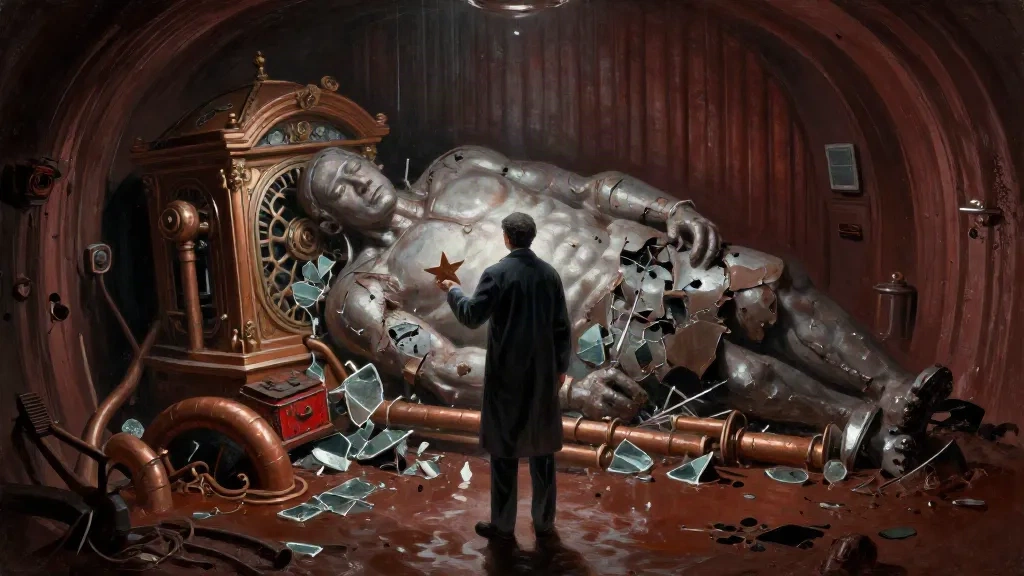
Her clinic occupied the seventh rib of the sleeping giant, a chamber of ribbed stone warmed by charcoal braziers. Pale winter light entered through gaps in the hide overhead and lay across the floor in narrow bars. The village had been built inside the body without asking it. Every ninth day the giant breathed, and the whole settlement swayed in its ribs, and no one woke.
On a shelf stood a music box painted rust red. Its copper star had been bent slightly, so each turn of the crank made a bright, uneven chime. Ilyra had bent it herself in the third winter with pliers borrowed from the apothecary. The lullaby the box played was her mother’s, and it came out of the instrument whole, and a woman who hears a lullaby played without a flaw will go home and report that the room she has been missing is empty. Nothing in the world is so frightening as a place with nothing missing from it. So the star caught. So the villagers went on listening for the catch in it.
“It is not the rooms that are wrong,” Ilyra told them. “It is the distance between where you are and where you believe you belong.”
On the morning the river rose, the bell beneath the square rang without being struck.
The Bell Without a Striker
The flood entered through the ancient drainage cut and poured into the market cellar. Barrels became boats. Lanterns floated past the apothecary, carrying bundles of dried herbs toward the lower gates, and men stood in the shallows with poles, hooking floating property toward higher ground with the calm of people who had already been robbed once and now knew the inventory. People carried children above their shoulders and watched the black water climb the giant’s ribs.
When the water sank, it left behind something beneath the newly exposed silt: a black metal lattice, delicate as a rib cage, extending from the square to the old river gate, its joints beaded with brass. Ilyra walked it barefoot, mud to the ankle, because she wanted her own feet to know what the reeve’s men would be told. Ninety-one junctions. A seam of solder at each one. She followed a line of rivets to a sealed chamber beneath the bell’s footing.
The lock accepted the copper star from her music box without force, without turning, the way a mouth accepts a name.
Inside, a machine stood beneath a glass dome. It was beautiful. Copper tubes curved around a central reservoir of clear water, and a hundred small mirrors turned above it like leaves in wind, each one angled at some fixed star no one outside could see. A sign hung on the dome by two chains:
Civic Continuity Engine
Every resident will remain where they are loved.
Engineer Saren emerged from the flood debris under the arch, coughing, one sleeve torn off at the shoulder. He did not ask how she had opened the chamber. He watched the dome instead, the way a man watches a fire he had banked for fifteen years.
“You are breathing it,” Ilyra said.
“I built it. I breathe it. There is a difference and no one has ever cared about it.”
The Second Circulation
The machine had been buried before the village moved into the giant. Its purpose was not comfort. It siphoned the villagers’ memories of other places, converting longing into fuel, and returned a polished version of the present as contentment. Saren said it without softening it, standing with his ruined sleeve against the dome, and she understood that he had been waiting years for someone with standing to come and ask.
“The first settlement was dying,” he said. “Not from hunger. From memory. People left because they remembered roads they had never taken. The machine gave them one place to be.”
How the water carried it
The pipes left the chamber and entered the sternum. From there they followed the ribcage the way a man’s blood follows his arm, and they ended at ninety-one hearths and at Ilyra’s own clinic and at the bell’s footing, and they breathed out a thin vapour in the small hours. That was the second circulation: not blood through the giant, but sleep through the village, drawn from the giant’s lungs and paid for in the giant’s water. Every dose of contentment held the river down by a hand’s width. The village had never known a hard spring. They thought the climate had improved.
“Then the morning we found the chamber,” Ilyra said, “the river rose.”
“The river rose because you stood over an open lock for a quarter of an hour,” Saren said. “It is a bellows. It only needs breath to drink.”
The leak
It would not hold unless everyone drank. One dose for a thousand people kept the thousand level; a single person who refused her share became a hole in the dike, and the pressure went through the hole instead of the walls. For fifteen years that hole had been Ilyra.
She had known. She had known the way one knows a bad tooth: constantly, without proof, and in search of anything else. She ran a private line, a thread of the machine’s vapour into the clinic’s one brazier, small enough to keep her awake, and because she kept awake she kept her memory of the north road intact, and because she kept her memory intact her doubts went out through the clinic walls like smoke through a cracked door, and the whole village had been slightly less contented for her sake since the year the machine was uncovered by nobody at all.
Her husband’s name was Caer. He had gone north in the ninth winter of the machine, a cooper, with a good hand and no patience, and the vapour had taken the going from everyone’s mouths but hers. The village remembered a man who had died of fever in a town with a bell tower. Ilyra remembered a man who had leaned on a gatepost on the last morning and said nothing at all, and she had let him go without answering him, and that silence had been so loud in the room that she had gone and put it in the machine within the hour.
Saren had done the same with a sister. Adra, who had left for the coast and had not written. He had taken a full dose and had edited out the part where she did not come back, and he had spent fifteen years coughing in his sleep, because a man who removes the worst of a memory has removed the reason his body was allowed to keep the rest.
“How many?” Ilyra said.
“At the last count, nine hundred and six of us took it. I never took a full one. You are not alone in that, at least.” He coughed. “That is not a comfort. It is a survey.”
The Second Flood
Reeve Osk came with four men and no torch, and stood in the doorway of the chamber with his hand on the frame, looking at the hundred mirrors turning over the reservoir.
“Seal it,” he said.
“With what,” Ilyra said, “mortar?”
“With stone. My wife walks to the lower gate at night and stands there. She has stood there every night for a month. She does not know the name of the road she is standing on the way to.”
It was true, and it was not the machine’s fault, and that was the shape of the thing at the heart of the whole affair. The holds had been thinning for years, the way a wall thins when people stop leaning on the side of it that leans back. Osk had not built the engine. Osk had buried his wife’s walking in it nightly, gladly, and had gone on doing the arithmetic of a happy household, and now the sum would not hold and the sum was not his fault either.
“You have been standing in a room where the pipes are open,” Ilyra said. “You smell the current. You think the leak is in the machine.”
“The leak is in you,” Osk said, and he was not being cruel. He was being a reeve, which is to say he was being arithmetic with a face. “Close it and nobody drowns. Every reeve before me closed a hole. It is the oldest work there is.”
He offered, and Ilyra understood the offer, and understood that he was right, and this was the part she had not admitted to Saren and never would: the ledge was real. Ninety-one people drank nightly. She had been taking nothing for fifteen years. A body of a thousand does not weigh a wound by arithmetic; it weighs it by arithmetic, and the arithmetic was on his side.
She said no. Osk went away without repeating himself, which she had learned to fear more than shouting.
That night she turned the copper star a quarter of a notch, because she needed a measurement more than she needed a decision. The pipes coughed. The mirrors slowed. The bell under the square sounded a fifth above itself, thin, and somewhere below the clinic a hearth four streets down gave a small choke as its vapour thinned. And in the reservoir the water climbed the copper ribs on its own, patiently, the way a man climbs stairs he has climbed all his life.
So she had her arithmetic in the cold. The machine ran on water. To return what it had taken it would have to run at flood volume, and at flood volume the river would come up through the cut and take the lattice, the bell footing, the dome, and a great deal of the square’s north side, and there was no arrangement of intention that would make those two facts stop touching each other. The dike and the river were the same instrument. The village had been buying peace with a lowered river, and nobody had ever been shown the invoice, and the invoice was written in rooms.
The Lever
She told Saren on the fourth evening, in the clinic, with the brazier turned low and the weather coming in off the hide in bars that moved across the floor and were gone.
“You have thought about how,” he said.
“I have thought about what it costs. Then I thought about how.”
The dome’s reservoir was fed by the chamber’s own seepage, and the flood would fill the chamber, and the machine was calibrated for a cupful. So she did not open the machine. She broke its calibration. She took the music box to the bench and set the bent star into the junction that fed the return line, and she understood at last what the star had been: not a key but a stop. Bending it had held the flaw in the lullaby. Setting it into the pipe would hold the flaw in the polishing, and the flaw was the truth returned unmilled, coarse, unlit, with the grit in it.
“Everyone gets the rough version,” she said. “All nine hundred at once, in whatever order the river decides. And the river, and the square, and the dome.”
“And me.”
“And you.”
Saren was quiet a while. Then he said, “I have been waiting fifteen years to be able to remember her properly. I did not know that was what I was waiting for. I want it stopped, and I am not going to be able to stop it, and I want you to know both of those are true at the same time.”
Then he asked for the copper star back, to hold, and she let him, and neither of them said anything else, because there is a point past which kindness becomes a way of asking to be absolved.
The Choice of the Body
At dusk the river came up through the cut for the second time, faster than the first, because the machine had already begun to drink. Water entered the chamber and climbed the copper pipes, and the mirrors above the reservoir turned up out of it like the underside of leaves. The machine sang in three ascending notes. Under the first, the braziers in every house along the ribcable flared. Under the second, nine hundred people woke standing up, in cold rooms, with their hands over their mouths as if holding something down.
Ilyra put her palm to the reservoir. Inside, small images moved: a boy flying a paper kite over a blue lake; an old woman opening a bakery she had never entered; a man looking from a train at the giant’s sleeping face. All gone. All fed in. Beside them, waiting, the coarse originals, blurred and ugly and shaking, and the two sets of pictures leaned into one another and did not agree.
She broke the glass. The sound was small and final, the sound of a cup being set down harder than a person meant to.
The coarse version
What came out was not a storm of images. It was worse: an inventory. Chalk dust from the schoolroom she had not entered. Train smoke, hot and chemical, from a platform she had stood on for six hours deciding not to leave. Sea salt and tar. A mother’s perfume, the one bottle, kept nine years past the woman. The bitter medicine of a winter fever, and underneath everything the copper taste of the machine itself, which had been in all of it for fifteen years and which no one had ever been able to smell because their own mouths had made it.
They came into the chamber in ones and twos and stood in the water, weeping. Some embraced the pain, which is a real and terrible comfort. Some held each other beneath the rust-red pipes while the mirrors came down one by one and lay on their sides in the water like drowned leaves. Others went out into the streets, because a house you remember badly is still a house, and some of them found that the difference could be repaired by ordinary work, with mortar and reason, over years.
The ferryman of the lower gate came last. He stood in the doorway with woodsmoke drying on his hands, four hundred years of it, and said, “It is a kitchen.”
“What?”
“My mother’s. I have the wrong window. I have had the wrong window my whole life.” He was not weeping. He said it the way a man says a thing he intends to spend the rest of his life on, and Ilyra wrote nothing down, because there is nothing to record that he did not already own.
The hole in the dike
She felt her own memory come back through her like cold water filling a boot. Not the polished one. Caer leaning on the gatepost, the boards grey, the frost in the cart ruts, his hands in his pockets going up and down in the small useless rhythm of a man who wants to be asked. And her: standing three steps inside the door with the ledger of the clinic under her arm, saying nothing, watching him wait out the full length of a count of ten, and then hearing the gate, and then standing a while longer in the kitchen with the frost coming off her sleeves.
That was the memory. It had been in the machine the whole time, siphoned, sedimented, polished, and returned to her nightly as a man dying of fever in a town with a bell tower, dignified, distant, safely gone, and the true one was that she had let him leave and known exactly what she was doing, and had gone on knowing for fifteen years, and had needed him dead in order to go on being a physician who forgives.
She sat down in the water on the step, which was a thing she had not decided to do, and was glad of it, and was not proud.
Margit went out through the crowd and past Osk without touching him and down toward the lower gate, and the reeve turned and let her go, because the whole village was watching and the oldest work there is still the oldest work. Saren sat with his back against the reservoir frame and said his sister’s name eleven times, and then began to say the rest of it, the not coming back, the nine letters that arrived and were cheerful, and he wept the way men weep when something long locked has been opened in a room they cannot leave. Ilyra went and sat down on the step beside him and did not offer comfort, because comfort was the other thing that had been offered here, and it had cost the village a river.
What the Village Became
By morning the river had taken the lattice, the bell, and most of the machine, and the square’s north side was a lake with the clinic chimney in it. The dome went downstream intact and was found eleven days later at the river gate, upright, the reservoir empty, a hundred mirrors still turning in the current.
The anger came in the spring, and it came honestly, and it came to her door. The village had been sold a climate. Nine hundred people had been taught, without knowing it, that a hard spring was a thing that happened to other people’s children, and the spring of the return was a hard one, and the north side went under to the eaves, and they came up the seventh rib to tell Dr. Vale that she had drowned a neighbourhood to make a point. Osk said it first, which she had expected, and which was, she thought, the honest place for it to start.
She did not defend it. She took the accounting: nineteen dead in the north side, all of them old or very young, all of them people who had been given a soft river for fifteen years and had no practice at a flood. She wrote their names in the clinic ledger and then she added, in the same hand, the reason, because a record that omits its own cause is a lie told to the living.
Some left. That was the cost she had named out loud and the cost she had not named, which was that the ones with the strongest memories had the strongest reasons to go, and they went in ones and twos along the real road in spring mud, carrying real bags, and the village got quieter in a way that took four years to stop being an ache. The houses did not match their memories, and the matching could not be done by mourning. It had to be done by work, and it was done, badly and slowly, by a village that had forgotten it was capable of anything it had not been given.
What stayed, stayed because they had nothing else to compare. The ferryman, who rebuilt his kitchen with the wrong window and decided the window was where he wanted it. Nine hundred households, fewer. A bell under a foot of silt that rang now only if struck.
And the clinic filled with a new complaint, and Ilyra treated it, and it was not homesickness and it was not sorrow. It was the second stage. Patients who could not stop weeping, and patients who could not weep at all, and one child of the fifth rib who could not say the word mother and had to hold up a hand shaped like a glove instead, and who would stand in the doorway for an hour making the shape and waiting for it to become the word.
Saren lived. He did not get better. He spent the rest of his life coughing and being the finest engineer in the district, and he never once permitted anyone to call what had been done to the village a kindness, and when the reeve died he read the engine’s own plate aloud at the grave, the whole poem of it, so that the ground heard the version that had been told to it.
The giant breathed on the ninth day, as it had always done, and the village swayed, and the bars of pale winter light moved across the clinic floor, and no one woke. But the breath no longer carried a voice in it. It was only enormous, and cold, and it fogged the windows from the inside and smelled, the way weather smells, of the ordinary iron and wet fur of a living thing that has never once been asked to keep anyone content. Ilyra stood in it with her face up, the way a person stands in rain, and let it take nothing from her and give her nothing, which after fifteen years was the largest thing she had ever been given.
On the shelf in the seventh rib stood the music box painted rust red, its copper star fixed to a straight, shining point. It played the lullaby whole now, without a flaw in it, the way her mother had made it, and there was no one in the village left to hear it as a thing with something missing.
Dr. Ilyra Vale left the key inside it. Then she opened both clinic doors, letting in the charcoal air and the pale winter light.





