 Netwrck
Science Fiction.
The Low-Tide Crossing
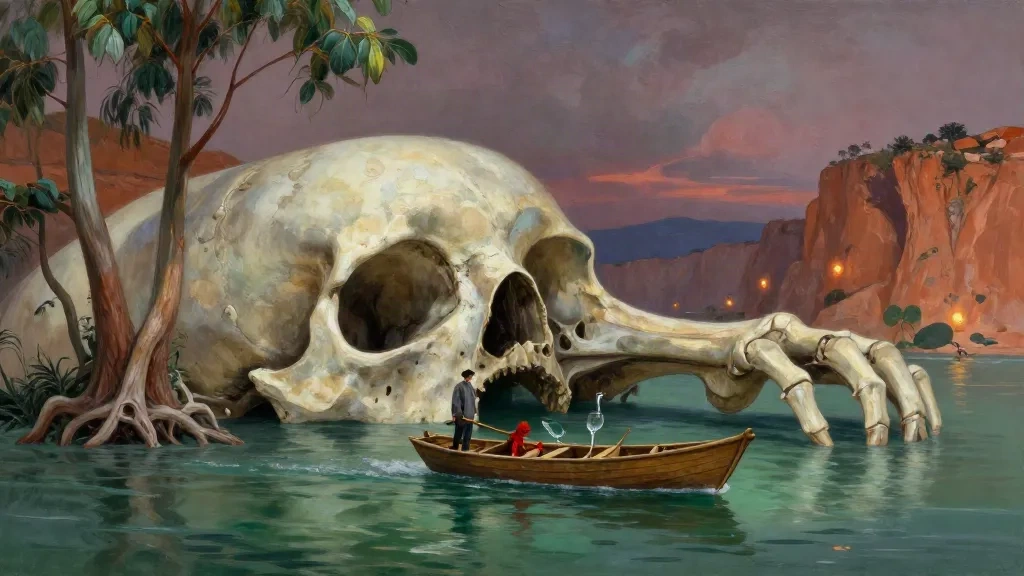
At low tide, the lake came out from beneath the village like a secret the earth could no longer contain. It filled the trough between the giant’s oldest ribs, blue-green under a sky the color of bruised plums. Eucalyptus trees grew from the bone-white arches, their leaves shaking in a wind that seemed to breathe with the sleeper above them.
Its ferryman was Oren Vale. He poled a narrow boat across the shallows, collecting fares in clay beads and carrying messages, salt, forgotten tools, and once, reluctantly, a bride.
What Oren wanted was not a fare or a passenger.
He wanted the one person who remembered the original version of the world.
Oren had seen that world in a glass bird his mother left him. The bird had a painted world inside its belly, and in the painted world the giant had never slept. The rivers ran toward the sea. The sun crossed a white sky. Children knew the names of the stars.
Now everything bent toward the giant’s dreams.
On the morning the lake returned, Oren found a red scarf tangled in his boat. He knew it without recognizing it. The wool smelled of woodsmoke and rain.
Inside it was embroidered a map.
A Map for Liars
The first line read: Cross where the black stones stand in the mouth of the giant.
Oren found the stones. He crossed there. The map changed.
The words blurred, rearranged, and became: Do not cross where the black stones stand in the mouth of the giant.
So he crossed there again. The lake opened beneath his boat. Cold water swallowed the oar. Oren grabbed the red scarf and held on as the current spun him toward a shore that had not been there before.
On that shore stood a woman with white hair and eyes like polished amber.
“You used it honestly,” she said.
“That seems the correct way to use a map.”
“Maps punish correctness. They are made by the frightened.”
Her name was Ilyra. She had been a child when the giant first closed his eyes. She remembered the world before sleep altered its distances. She remembered the road to the city, the birds’ true flight, and the name of the river that now flowed uphill.
She also remembered the glass bird.
“Your mother carried it to me,” Ilyra said. “She asked me to remember the first sky. I have.”
“Then take me there.”
“It is not a place.”
“Everything has become a place.”
Ilyra looked toward the giant’s ribs. “Not that.”
When Oren unfolded the scarf, the map had changed again. A red line crossed the lake and ended beneath the village.
The Name in the Bone
They walked through the eucalypt woods while the tide rose behind them. Branches clicked like dry fingers. Somewhere above, the giant dreamed in a voice too deep for thunder.
The red line led to a hollow rib filled with warm amber light. A glass bird stood on a pedestal at its center. Its painted world had cracked, but a small portion remained clear: a blue lake beneath a white sun.
Ilyra touched the glass. The map leapt from Oren’s hands and wrapped itself around her wrist.
“He will hear us,” she whispered.
“Let him.”
“If you speak the first name, the lake will vanish. If you speak the last name, the world will wake inside him.”
Oren understood then why the map changed. Truth had become a trap with two jaws.
He took the glass bird. The painted lake inside it began to churn.
“I remember,” Ilyra said, touching the red scarf, “but memory can be carried by a wrong thing.”
She placed the scarf inside the bird. The wool burned amber. The map’s ink dissolved.
Oren felt the first world open through his palm: not a memory of hills and rivers, but the pressure of a world that had never agreed to become this one.
The Ferryman Returns
They escaped before dawn. The lake withdrew, leaving the giant’s ribs dark and shining. By the time the village woke, the ferry was gone.
Oren rowed through the returning world. Passengers boarded with questions, complaints, and small necessities. He carried them without looking back.
At dusk, a child placed a glass bird on the bow.
“For you,” the child said. “It remembers where you’re going.”
Oren looked inside.
There was no world painted there, only a red scarf floating on an endless white sky.
He tied the scarf around his neck and kept rowing. Behind him, beneath the ribs, the sleeping giant turned his face toward the sea. Far below, hidden in the mud, one small blue fish moved against the current.
The lake had not vanished.
It had learned to open only for those willing to cross without a map.





