 Netwrck
Folk Horror.
The Door Behind the Bakery
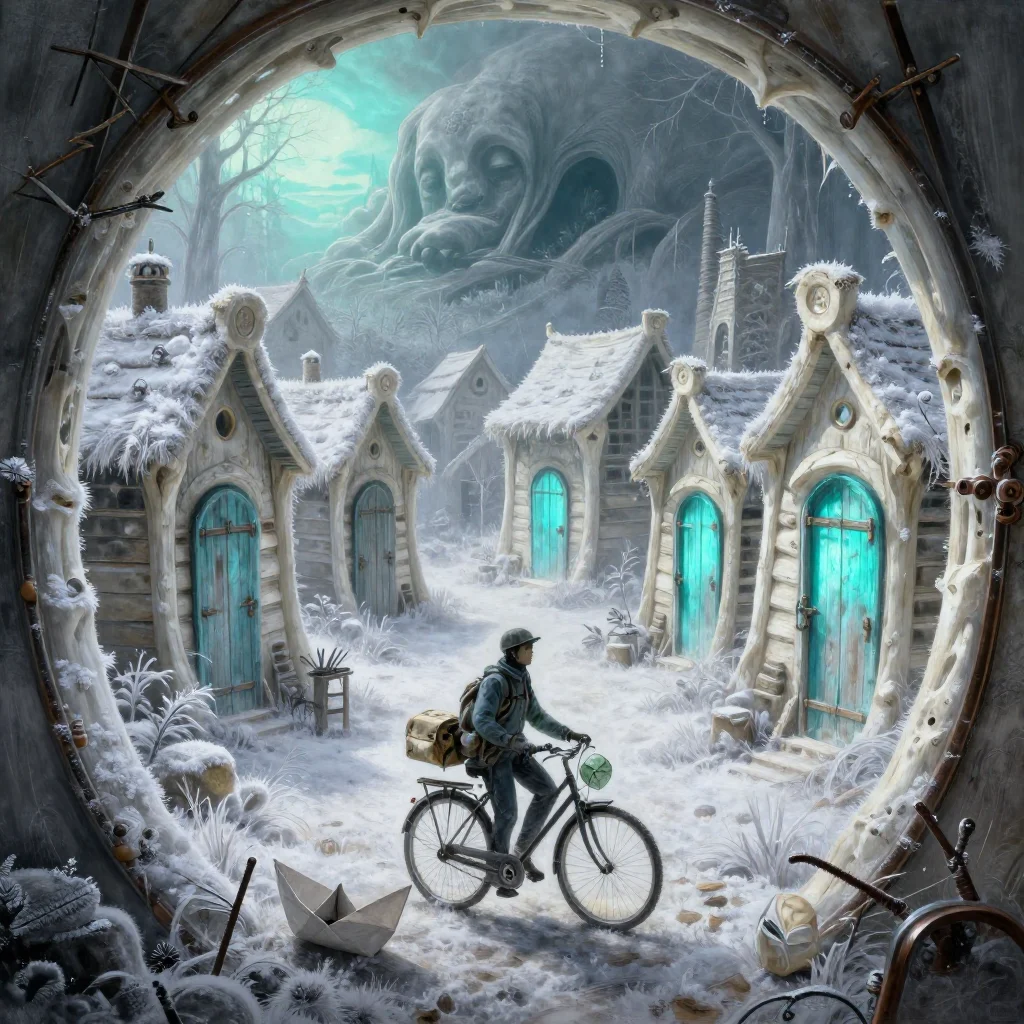
Mara’s bicycle had one gear, a bell shaped like a molar, and a habit of going where no road led. Each morning she locked its front wheel against the iron post outside her house, pulled on two wool gloves, and began carrying letters nobody admitted to sending.
The village climbed through the ribs of a giant asleep beneath the hill. Corrugated roofs leaned between the great white arches. Chimneys breathed pale smoke from old lungs. Frost silvered every nail and latch, but the iron stayed warm beneath Mara’s palm.
She rode to Mrs. Vale, whose door opened onto her pantry. She rode past the school, through its western wall, and emerged beside the clock. At dusk she crossed a locked bakery door and returned carrying a message addressed to someone dead since winter.
That day, the bicycle carried her through the village archive door without opening it.
Beyond it waited a stone room lined with pigeonholes. Thousands of letters sat in them, all dated tomorrow. Mara lifted one marked for a locksmith in the lower village. She remembered his hands, crooked and blue with cold, and realized she had watched him die.
Permission to Hear
On the archive floor lay a treaty sealed beneath a green stone.
Mara had been taught the story: long ago, the giant surrendered his voice to the village. In return, the villagers agreed never to wake him. They sealed his hearing inside the stone, granting the land one lawful privilege—to listen for danger through walls, snow, and sleep.
The seal had cracked.
Inside the treaty, someone had added a narrow clause in a different ink. If the giant heard a distant cry, the land must answer. The wardens had interpreted this generously: every sound was a cry; every answer, a command.
So the future listened to the giant.
Mara unfolded tomorrow’s letters. They pleaded for coal, flour, a surgeon, rain. Children born that morning asked for mothers already dead. The giant heard their voices, mistook them for alarms, and drew breath inward. The whole hill tightened. Streets buckled. Doors began losing their rooms.
Then it stopped.
Mara’s paper boat was pinned beneath her charm bracelet, and the green treaty stone had cracked in the damp archive. She used the boat to scoop the missing seal from its socket, then pressed the stone against her palm.
The law recognized her. The village opened its ears.
The Listening Below
Every sound entered her at once.
She heard the postmaster counting coins, horses stamping in the barn, flour settling inside its sack. Beneath those sounds came the old giant’s dreaming: bells buried in his sinuses, lost winters turning beneath his tongue.
And beyond him, a vast grey room where uncounted letters drifted without stamps.
“Why no more deliveries?” Mara shouted.
The village answered in stolen voices. A shutter rattled. A child coughed. The treaty replied:
Because the land has answered for every year in advance.
Mara understood then. The giant’s hearing had not merely listened to the future. It had eaten the road leading there. Every future letter arrived at the archive, was judged a disturbance, and was consumed as protection.
There would be no war, no flood, no accident to prove the warnings necessary. The treaty had manufactured a permanent emergency from possible tomorrows.
She opened the archive’s lowest door. Cold rose around her ankles. Down the stair, the giant dreamed in the color of an impossible dawn: soft cyan shining through his closed eyes, white frost at the corners of his mouth, iron-dark veins beneath the stone.
Tomorrow’s Weight
The final delivery lay beneath her heart.
Her own name. Tomorrow’s date. One sentence: Bring back the voice you borrowed.
Mara could return the stone, restore the giant’s hearing, and restore tomorrow. Or she could speak into the silence herself, becoming the village’s warning forever.
So she leaned over the stair and shouted every missing alarm into the dark. She recited coal shortages, fevers, names of the drowned. She called out flour prices, broken bridges, the danger hidden beneath the millpond. The giant shuddered as the future’s fears poured through him.
Then Mara stopped.
“Nothing is certain,” she said.
Silence gathered, then changed texture. It was no longer a locked door. It was a road, steep and uncertain, extending beyond the hill.
The grey room filled with unopened letters.
Below, the giant exhaled. Cyan dawn spread through the village as frost melted from the roofs. Mara’s bicycle rang its molar bell once.
Across the room, a sealed letter lay in tomorrow’s pigeonhole.
She did not open it. Courier as she was, she knew that some futures could be left to arrive in their own time.





