 Netwrck
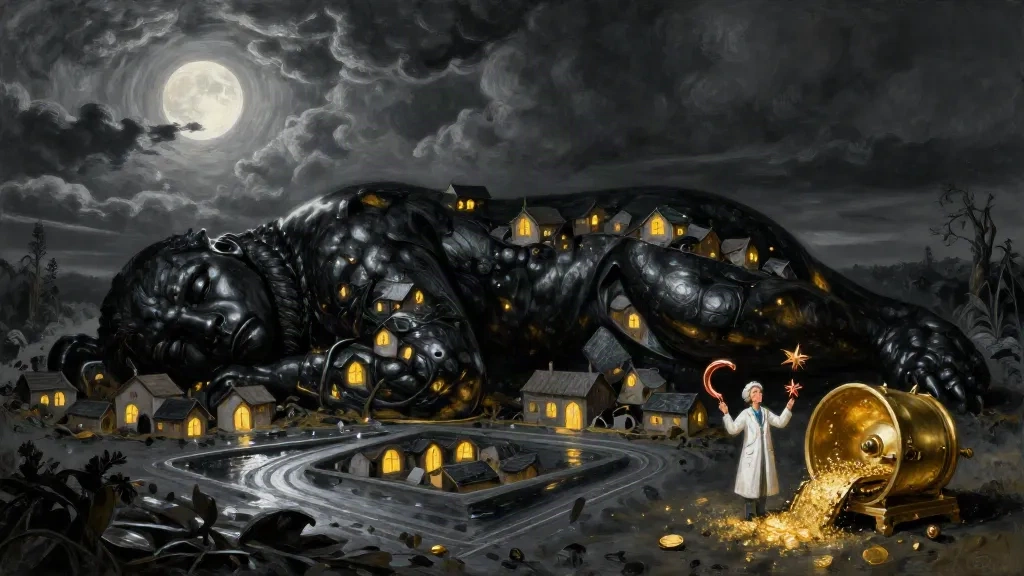
Fairy-Tale Fiction.
The House That Coughed
Every house in Bellwether had a heartbeat, though only Dr. Ilyra Vale was paid to listen.
Her brass instruments rested beneath a black-lacquer desk in the village’s narrow infirmary. Against the wall stood a music box whose silver key had been stolen in the year of the long winter. Ilyra kept a copper star beside it, polished each morning, though no child remembered giving it to her.
That day, the House of Larks coughed.
Not dust from its throat. Not a loose slate. A silver chime sounded inside its walls, followed by three measured knocks.
Ilyra crossed the cobbled lane and pressed her palm to the black-lacquer door. “Homesickness,” she said.
“It has the wrong rhythm.”
The door opened onto a room of narrow beds, each suspended from a rib of the sleeping giant. Blue moonlight entered through roof-slits and settled on the white sheets. At the center stood the village’s pride: the Breath Engine, beautiful as a cathedral rose window. Gold dust ran through its copper pipes. Black gears turned beneath a glass dome.
The mayor, Master Orin, bowed too deeply. “It has begun again.”
“Began what?”
“Remembering.”
He said the word as another might say bleeding.
Every house in Bellwether was connected to the Engine. It carried memories between neighbors when a family left, preserved voices when an old person died, and soothed children frightened by thunder. It had no doors, no windows, no power source anyone admitted to finding. The village called it a gift from the giants who had built their ancestors’ homes.
Ilyra had treated homesickness for seventeen years. She knew grief disguised as hospitality. Fear disguised as duty. Love disguised as a locked gate.
She placed her ear against the Engine.
Inside, thousands of little rooms were breathing.
What the Water Remembered
The flood came before dawn.
Rain fell upward from the river, struck the village roofs, and returned as a sheet of falling glass. The giant stirred in his sleep. His ribs tightened. Water poured through ancient seams and gathered beneath the square.
People carried children into the granary. Others climbed the rib-hills and watched their homes disappear.
Ilyra ran toward the Engine.
Doors slammed in her path. Windows flashed shut. A child’s voice cried, “Mother, stay.”
The Engine had locked the village in.
Near the eastern rib, the flood tore away a mound of black lacquer and red clay. Beneath it lay a second road, and a row of sealed stone chambers.
On each chamber, someone had painted a name.
On the first: Home.
On the second: Mother.
On the third: Return.
The chamber doors opened when Ilyra touched them. Inside were no bodies. Only beds, cradles, shelves, kitchen jars, and hundreds of homes waiting empty for their absent owners.
“The buried project,” she whispered.
Bellwether had not been built on the giant’s ribs. It had been built above a city.
Her teacher’s voice returned, stern and young: When a home is ill, ask what it needs to become.
Ilyra had thought homesickness meant exile. Now she understood: the Engine took the pain of leaving and made it impossible to remember why anyone had gone.
The Prison with a Melody
She found the copper star in the floodwater, spinning against a stair. One of its points had bent.
With the star, she loosened the Engine’s inspection panel.
Inside, gold dust ran through a maze of tubes. At the center rested the music box’s missing silver key. Around it, a record showed every memory ever preserved. The mayor’s wife laughing. A boy learning to whistle. The giant’s slow breaths measured as years.
A small wheel turned beside the key.
Its label read: FORGETTING, REVERSIBLE.
Below, in fresh scratches, someone had added: NOT YET.
Ilyra took the key.
“If you open the Engine,” said Orin from the doorway, “the village will forget.”
“The village is already forgetting.”
“It will forget the dead. The children. The warmth of their hands.”
“Then let it grieve.”
Orin looked older in the cold light. “A beautiful prison is still a prison.”
“Yes.”
She fitted the key into the music box.
One turn brought every preserved memory into the square.
Voices rose around her. Names called from vanished rooms. A woman laughed from the flood. A child answered. For a moment the dead and the living stood together beneath the giant’s ribs, neither separate nor safe.
Orin covered his ears.
“Stop it,” he said.
Ilyra turned the key again.
The box released a clear, human cry.
The Roads Beneath the Roof
By sunset, the flood had uncovered every chamber.
People carried out what they had hidden for generations: wedding shoes, children’s teeth, a soldier’s boot, a bowl from a kitchen that no longer stood. The Engine had preserved perfect copies while the originals waited under the river.
Ilyra broke its glass dome with the copper star.
The gears stopped.
Then the village began to leave.
Not far. A few steps at first. Doors opened onto the buried road. A porter led his daughter toward a chamber named Outside. An old woman carried a dead husband’s name toward a bridge nobody had remembered building.
Some returned. Others did not.
By morning, half the houses stood empty. Half were alive with difficult, unfinished grief.
The giant woke.
His ribs lifted the village gently. His eyes opened beyond the roof, blue with cold moonlight. Dust of gold dust drifted from them.
People gathered outside.
Orin stood beside Ilyra. “We built a home inside a sleeping giant,” he said.
“Yes,” she replied.
“What if he wakes?”
“Then he gets to decide whether he is a house.”
Below them, the music box played by itself.
Its melody was unfinished.
And from beneath the floor, the buried road answered, note by note, with a new beginning.





