 Netwrck
Weird Fiction.
The Door Tree
Mara’s bicycle had one impossible property: it could pass through closed doors.
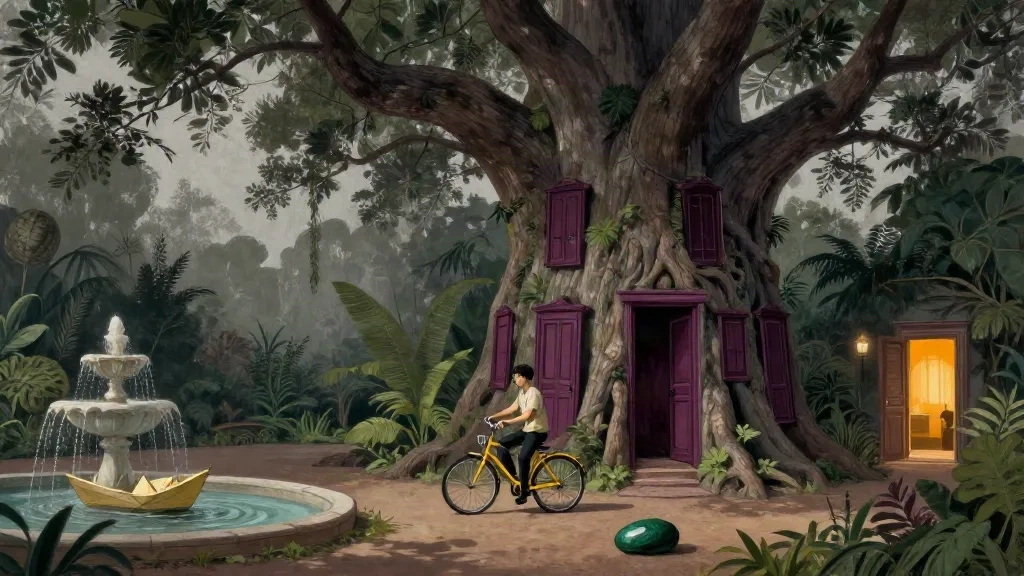
Not unlocked doors. Not doorways. Closed doors, with the latch still warm beneath her fingers. She discovered this on her first delivery, when a parcel marked for the third conservatory vanished through a kitchen cupboard and emerged in a glasshouse filled with sleeping orchids. The garden stood around a tree whose trunk had grown doors instead of branches.
Each door was different. One resembled a filing cabinet. Another was narrow enough for a child, its paint the deep plum of a storm after sunset. The largest exhaled warm air smelling of saffron and rain.
Mara delivered letters for a living. The garden employed her because the tree made its paths unreliable. Letters addressed to one district might finish in another, or behind a wall, or beneath the roots. Her bicycle was painted saffron yellow so the messengers could recognize it through fog.
For eleven years she had carried words between people. Then, on the first day of autumn, every letter from the future stopped arriving.
The Empty Calendar
At the garden’s office, under a canopy of smoke-grey leaves, the registrar showed her a ledger of expected deliveries. Her name appeared beside each one.
Tomorrow, ten letters. Next week, six. The month after, none.
“The route has closed,” he said.
“Routes don’t close themselves.”
He turned the ledger around. Beneath the dates, an older agreement had been copied in brown ink. The land had once been granted permission to listen. The treaty allowed the garden to collect any sound made within its boundaries, including the hum of machines, the gossip of insects, and the voices of people who had not yet spoken.
“The tree hears everything,” Mara said.
“The tree hears what the land permits it to hear.”
That night she carried a paper boat through the garden. Each courier kept one, folded from the margins of undeliverable letters. The boat had been hers since childhood, when her mother left on a route that ended beyond the city wall.
She placed the boat in the fountain beneath the largest door. The current carried it three steps, then stopped.
From inside the trunk came a faint ticking, like a clock in a room where no clock had ever hung.
The Room That Answered
Mara wheeled her bicycle to the plum door. It was locked.
She leaned the paper boat against its lower panel and rang the brass bell tied beneath her handlebars. The sound travelled through the garden. Doors opened in distant walls, exposing empty rooms filled with blue evening.
The plum door remained shut.
“Future delivery,” Mara said. “Courier present.”
A voice emerged from the wood.
“No such route.”
She pressed her palm to the paint. Beneath it, the green stone from her father’s garden rolled across the floor.
It had been a seed, polished smooth by rain. He claimed it had come from the first door the tree ever grew. Mara had carried it ever since, though she had never told anyone why.
The door opened.
Inside was a sorting room without windows. Shelves stretched into darkness, every pigeonhole empty. At the far end, a child sat beneath a saffron lamp, folding letters into birds. Her face was blurred by the heat of the lamp, but her hands were the hands of Mara’s mother.
“Are you waiting for a letter?” the child asked.
“I’m waiting for an explanation.”
The child held up a green stone.
“The future stopped writing because it learned the garden was listening.”
Mara looked back at the doorway. Smoke-grey air pressed against the threshold, carrying the scent of wet bark and distant metal.
What the Land Kept
“Then the treaty is a trap,” Mara said.
“The treaty is a promise.”
The child placed the stone on the floor. It rolled toward the empty shelves.
“The land promised to listen. It did not promise to remain quiet.”
Mara understood then. The future had not stopped because the road failed. It had stopped because every word sent forward was heard before it was written. The garden had become an ear so vast that people had begun withholding their lives from it.
She unfolded the paper boat and wrote one message on its narrow sail:
I know you can hear us. We are still speaking.
She placed it in the child’s hands. The child smiled, though her face remained indistinct.
Mara returned to the garden at dawn. Her bicycle leaned against the door tree, saffron paint bright beneath the plum branches. The green stone had found its way into the bicycle’s bell.
When she rang it, the tree produced a new door.
This one stood open onto a road she had never seen, thick with yellow dust and lined by flowers that bloomed backward. Somewhere beyond it, a bicycle bell answered hers.
Mara mounted up.
She had come for an answer. She had found a road, which was more dangerous, because roads required a decision.
She pedaled toward the sound without turning back.
Tomorrow is not a place we are permitted to enter, only a letter we are still bold enough to send.





