 Netwrck
Weird Fiction.
The Door in the Saffron Bark
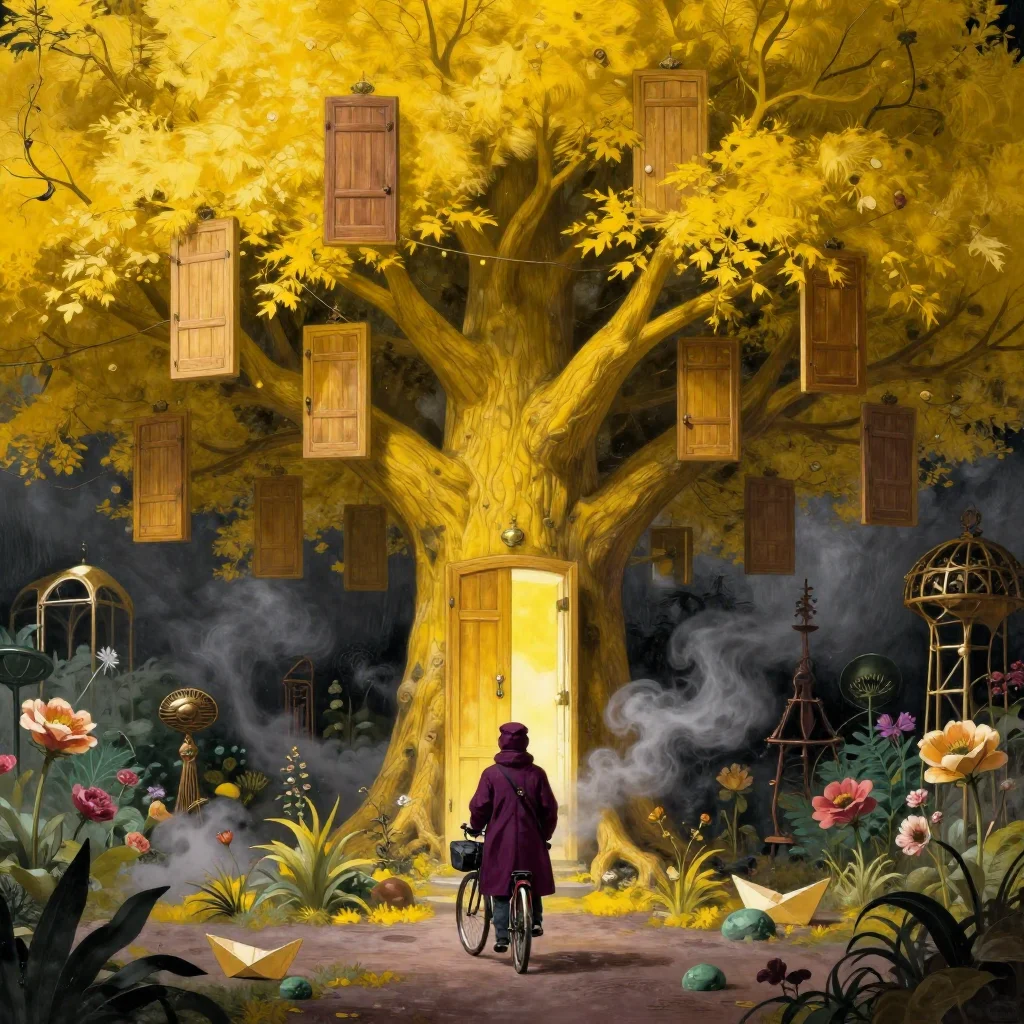
Mara delivered letters through doors that had not yet been opened. She rode a black bicycle with no bell, its thin tires passing through closed garden gates, cellar doors, bedroom shutters, and once, memorably, the sealed mouth of a sleeping fox. The tree stood at the center of the botanical garden, broad as a hill, its bark the color of saffron yellow after rain. Dooms grew from its branches: green oaks with brass knobs, iron birches with hinges at shoulder height, and narrow maple doors painted deep plum.
Every morning, the tree produced correspondence. Mara collected it in a leather satchel and carried it to the houses waiting beyond the garden wall. The future sent its letters from a place called the Meridian Post, though no map showed the route. They were always thin, cream-colored sheets carrying news of inventions not yet invented: weather harvested in silver jars, children born with memories of stars, cities built above the ocean.
On the morning the letters stopped, Mara found only a paper boat beneath the lowest door. It was folded from a page dated three years ahead. Inside the hull, written in green ink, were six words: It cannot hear us anymore.
She carried the boat to the garden’s registrar, an old man whose coat was sewn with seed labels. He examined it beneath the plum canopy.
The treaty remains valid.
“What treaty?” Mara asked.
“The one between the land and those who live on it. The land has legal permission to listen.” He tapped the paper boat. “Every letter delivered through the tree is overheard by the roots.”
What the Ground Repeated
Mara unfolded her oldest delivery. The letter described a machine that translated silence into weather. As she read, the soil gave a soft, smoky sigh. The garden air turned grey, though the sky was clear. Beneath the gravel, something kept turning a page.
She pedaled through a plum door into a narrow street where houses floated above unfinished foundations. At the end of the street stood a workshop run by a woman with copper spectacles. The woman had received no letter from Meridian Post, though she had been promised one for seventeen years.
“It used to whisper,” she said. “Not words. Expectations. I knew what to build before I knew the shape of it. Then the whispers changed.”
Mara laid the paper boat on the workbench. The woman touched it, and every machine in the workshop fell silent.
“The future isn’t gone,” Mara said.
“No.” The woman looked toward the floor. “It’s afraid to speak. The roots have learned every secret we sent there, including the ones we meant for the dead. They’re listening for the difference.”
The Green Stone
The registrar refused to explain the treaty. He only said the garden had been granted the right to listen by a city council that no longer existed, and that every generation renewed the agreement by walking beneath the tree and saying nothing for one hour.
Mara found the treaty stone beside the tree’s roots. It was a green stone the size of a bird’s egg, warm in her palm. When she held it to her ear, she heard the land breathing.
Between the breaths came fragments: a child practicing a confession; a judge hiding a verdict; a woman rehearsing an apology to someone unborn. Beneath those sounds, almost too faint to hear, the future repeated itself. It had been writing letters for decades, but every sentence returned to the garden changed. The land had mistaken the future’s descriptions for instructions and was growing them.
Mara saw tomatoes hanging from a brick chimney. A drowned woman’s wedding veil flowered from a drainpipe. In the smoke-grey distance, a city was assembling itself backward.
“Permission isn’t consent,” she said.
The treaty had promised listening, not obedience. No one had noticed the distinction because listening, in the old legal language, meant accepting what was heard.
The Last Closed Door
At midnight, Mara carried the green stone to the highest door in the tree. It was a small walnut door with a brass letter slot. She had never delivered anything through it. The paper boat rested in her other hand.
“If I open this,” she told the garden, “the future will send letters again.”
The roots answered with a thousand dry clicks.
“And if I don’t?”
A door on the lowest branch fell open. Beyond it waited Meridian Post, its workers masked in grey cloth, their pens sealed shut. They had not stopped writing. They had stopped sending because every message became evidence against the future.
Mara placed the green stone in the letter slot. Then she set the paper boat beneath the door, where the soil could not hear the water moving inside it.
“Permission to listen,” she said. “Not permission to keep what you hear.”
She turned the brass handle.
Saffron light spilled across the garden. In the deep plum branches, every closed door opened at once. The future’s letters rose like pale birds, but none carried a secret Mara had not chosen to release.
By morning, the garden had filled with ordinary trees. One green stone remained beneath the soil, listening carefully, and saying nothing.





