 Netwrck
Romance.
The Seed Beneath the Glass
Mara Vale kept the last door in a drawer beneath her workbench.
It was not a door you could open from the ordinary side. On paper, it appeared as a narrow black rectangle, scaled for a human shoulder, with a brass handle and a number in faded ink: 07. Mara had drawn it herself thirty-two years earlier, when the valley it belonged to was still a valley, with rivers, orchards, and a road that wound toward a village whose name nobody living remembered.
Now the valley was gone. A reservoir had swallowed it, then a new settlement had covered the reservoir, and the settlement had been abandoned when its orbit decayed. The map remained. The door remained. Mara remained, retired, arthritic, and unwilling to admit that the work had left her hands.
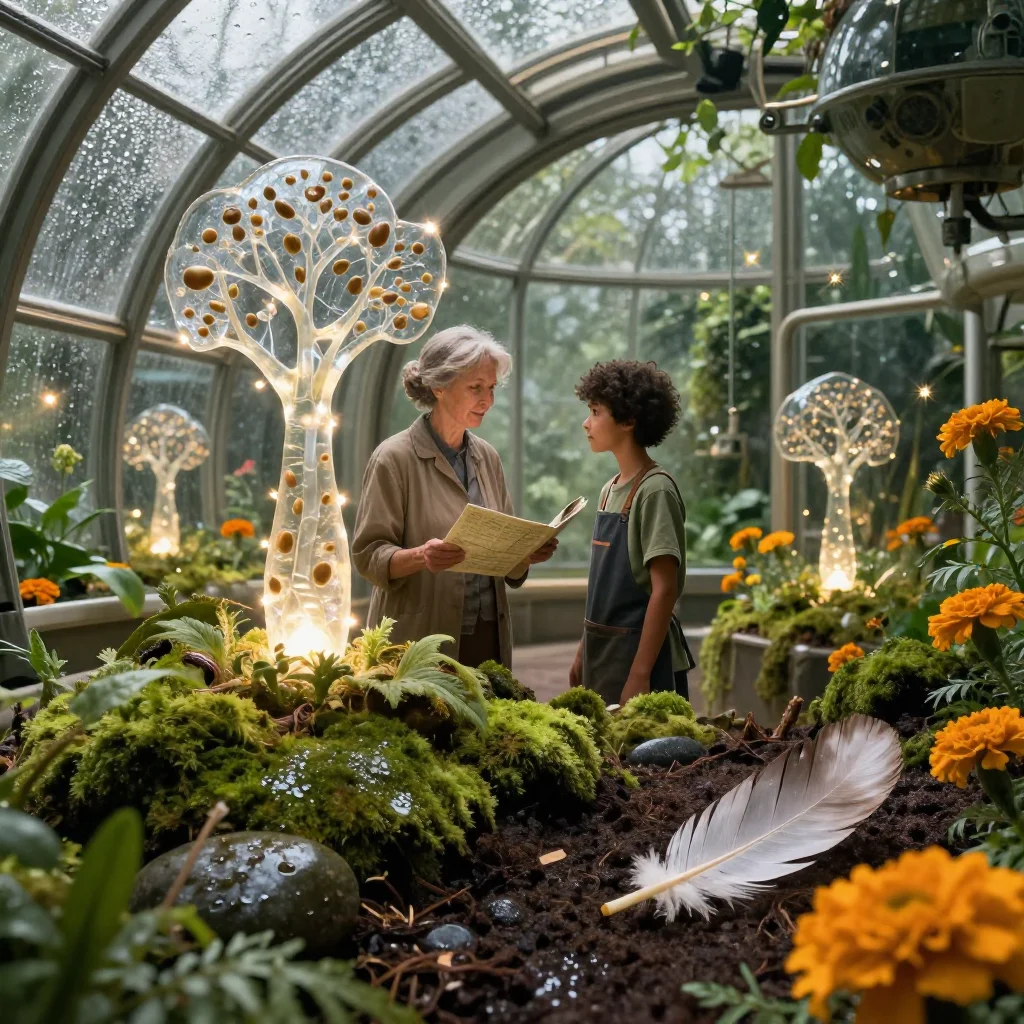
She lived aboard Meridian Crown, an orbital greenhouse built around the seed called Arden: a fist-sized kernel recovered from a dead forest on a moon no longer mapped. Arden remembered every root it had held. In its glass chambers, extinct trees grew as scent and pressure. Wet stone breathed beneath the moss-green walkways. At dusk, the leaves released tiny flashes of marigold.
“You could make a place for them,” said Ilya Sen, the greenhouse’s keeper, one morning while he repaired a cracked irrigation collar.
“Them?”
“The things that lose their places.”
He did not look at her. He never did when he was being kind.
Mara watched a fern uncurl beside his wrist. “Places are not graves.”
“No,” he said. “But they have a way of haunting the living.”
The Market of Expensive Things
The market occupied the greenhouse’s lower ring, where sunlight was weaker and condensation gathered on every surface. It dealt in vanished locations. A balcony from a city swallowed by fire. A schoolroom in a country renamed twice. A garden gate whose owner had forgotten the house attached to it.
Most passages were sold in fragments: a smell, a patch of floor, the sound of rain against a roof. Buyers touched the fragments and received a brief direction. The market called this remembering, though everyone knew it was only appetite dressed as grief.
Near the end of the shift, a woman in a green coat set a white feather on the counter.
“That one is true,” she said.
Mara did not touch it. The feather belonged to a bird that had not existed for two hundred years, a white ibis recorded only in a dead naturalist’s notebook. Because the record was exact, the feather could carry its owner’s path. It was worth more than a month’s work.
“The seller wants passage,” the woman continued. “She says her house is gone. She wants to know whether it can still be found.”
“Then the seller should pay the ordinary price.”
“She did. The feather came back changed.”
Mara examined it. The quill was soft, the barbs still releasing a faint mineral smell. A moth wing was printed in the dust beneath it, pale as a thumbnail.
Her hands went cold. She had seen that wing in an atlas decades ago: a vanished species drawn beside a coastline that had since folded into the sea.
“Where is the seller now?”
“She has entered the passage.”
Mara drew the door before she could stop herself. The map was unfinished, its blank area shaped like a wound. She added a window, a table, and a single chair. Then she added a second chair.
The ink glowed. The market went quiet.
A Place That Could Rest
On the other side, the vanished house stood in darkness.
Not ruin-dark. Rest-dark. The walls were whole. A bowl held three pears. Rain ticked against a roof that had not existed for a century. At the table sat the feather’s seller, a young man with marigold eyes and hands stained blue from repairing signal relays.
“You came,” he said.
“Where is the woman who sold the feather?”
“I am the woman who sold the feather.”
He opened his palm. A moth wing lay there, trembling despite the stillness of the air.
Mara stepped back. “That is not possible.”
“The market sells true things. I sold a feather from my own world. The wing is the price I paid.”
She saw the truth of it then. He had crossed into a place that had forgotten him, and in exchange the market had given him an object from a species that no longer existed. Every truthful thing demanded an equal loss.
“You wanted a place for lost things,” he said. “I can give you one.”
“What do you want?”
“You.”
The answer was simple, expensive, and utterly sincere. Mara felt it in the old ache beneath her ribs.
“I am not a lost thing.”
“You are the person who keeps drawing exits.”
Outside, through the door, the market bell rang once. The walls of the house began to fade. The vanished place could not remain without a memory strong enough to hold it, and the man’s memory had already been spent.
Mara took the moth wing. He took her hand.
“If we go back,” she said, “the market will try to keep the house.”
“Then we make a larger door.”
What the Door Could Hold
They returned to Meridian Crown beneath the white feather and the green glow of Arden.
Mara drew on the floor, on the walls, on the backs of her own hands. She made a garden for objects without owners: a cracked bell, a child’s shoe, the name of a star, a road ending in snow. For each one, the seed supplied a root of memory, and Ilya built a small chamber around it.
The market objected. Its agents sealed the lower ring, called her a thief of prices, and offered to buy the refuge outright. One offered a map of every place still scheduled to disappear. Another offered a body that would never age.
Mara refused. The man named Ilya took the white feather from the counter and told them the feather had always belonged to the house they had built. It had been a promise: a place where loss could rest without being priced.
By midnight, the market was no longer a market. The agents stood among the newly planted chambers, touching doors that led nowhere because the places behind them had no owner left to want them. Their expensive truths had revealed their emptiness.
Arden split its shell and released a leaf shaped like an open palm.
Mara put the moth wing beneath it. Ilya placed the feather beside the wing. The two vanished things rested on living moss, surrounded by wet stone and one bright marigold bloom.
“A place can be lost,” he said, “without losing its meaning.”
She looked at the door she had drawn for them: not an exit, not a return, but a room with two chairs and a window facing a forest that memory had preserved.
“Then we keep it,” Mara said.
They entered together. Behind them, the door remained—not because the world had been repaired, but because two people had refused to call restoration impossible.





