 Netwrck
Fairy-Tale Fiction.
The Door Tree
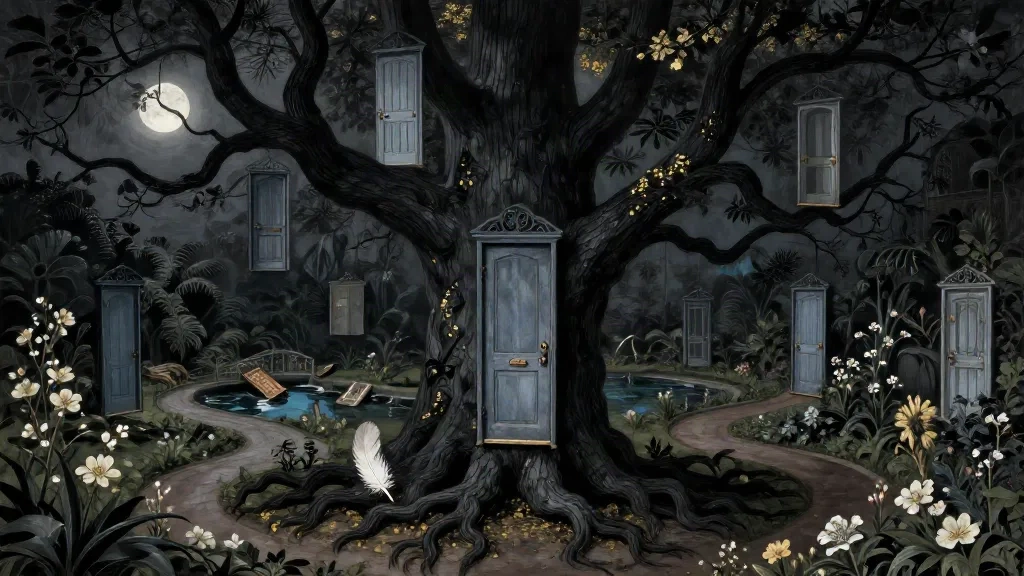
At the center of the botanical garden stood a tree whose trunk was black lacquer polished by rain, and from its branches grew doors.
They were not carved into the wood. They arrived whole, with brass hinges, frosted panes, and thresholds thick with moss. Some opened onto kitchens, some onto cliffs, and one low door opened only after rain into a room full of winter.
Every morning, Elian Venn climbed the spiral path to the tree. He was a retired cartographer with ink-darkened fingers and a memory for vanished roads. The town had erased its old districts, drowned its forests, and renamed its rivers, but he had drawn them all before the changes came.
His hands could draw doors only on maps of places that no longer existed. The gift had been useless until that morning, when a white feather lodged itself between the tree’s roots and a torn moth wing appeared on top of it.
The feather was cold as moonlight. The wing glittered with gold dust.
Elian crouched beside them. Beneath the leaf mold, he uncovered a map: the garden, the tree, the market, and one blank shape where a place should have been.
The Market of True Things
The market occupied the eastern beds, between rows of flowers that bloomed only when someone told the truth.
At one stall, a woman sold memories of childhood. At another, children traded tomorrow’s weather for yesterday’s applause. The expensive things were always true: first love, last words, the exact name of a buried city, a mother’s final thought.
The merchant wore a black coat powdered with gold. He displayed a moth wing beneath a glass bell and a white feather beside a brass scale.
“You cannot buy a place for lost things with money,” he said. “Only with truths.”
Elian pointed to the map. “This place is gone.”
“Then it has room.”
The merchant named his price: the truth of why Elian had stopped drawing maps. The cartographer looked away.
He had left his last map unfinished because it showed the road back to his daughter, who had vanished during the survey of a mine that officially had never existed. He had told everyone the road was imaginary. The lie had become a locked room, and behind it waited the memory of her hand in his.
“Draw the blank shape,” the merchant said, “and I will make it real.”
Elian’s pencil trembled. The market’s truthful bells rang in the branches. Behind the tree, a door opened onto a field of pale flowers, each petal shaped like a lost key.
The Price of Arrival
At sunset, Elian drew.
He made a coast where no coast had been, a hill where no hill had stood, and a small harbor beneath a black moon. He gave it rooms with no names, gardens with no rulers, and a shoreline where discarded names could lie without washing away.
As the lines dried, the tree groaned. One branch lowered a door made of blue-gray wood. Cold moonlight spilled through its panes, carrying the scent of dust, salt, and apples.
From the harbor came a procession: a drowned atlas, a jar of unspoken apologies, a shoe belonging to no visible foot, a bell that remembered a vanished tower, and a moth wing drifting like a small, exhausted flag.
Elian stepped aside. Each lost thing passed through, and each received a place to rest.
Then a young girl emerged from the final room, carrying a white feather.
Her face was older than his memory, but her hand was unchanged.
“You said the road was imaginary,” she said.
Elian offered her the finished map. “I was wrong.”
The merchant stepped forward. “The price.”
Elian understood then. The truth had not purchased the place. It had purchased its door.
A Place to Remain
He gave the merchant the map.
Not the map of the new harbor, but the last unfinished map of the mine, with its impossible road drawn in careful blue ink. The merchant accepted it and opened his coat.
Inside was darkness.
“No one can rest by being found,” he said. “They need somewhere the truth cannot enter.”
Elian placed the white feather and the moth wing at the threshold. The feather became a doorjamb; the wing scattered into gold dust. The black door-tree bent until its lowest branch touched the new harbor.
At once, the garden’s flowers closed.
The daughter lifted the map. “Will you come with me?”
Elian looked at the room of her childhood, the shore of the mine, the years he had mistaken silence for safety.
“No,” he said. “But I will draw your road whenever you need it.”
He opened a blank page beneath the cold moonlight. At the top he wrote a new place, not a place that had been lost, but one that had not yet been abandoned.
The door-tree opened. Beyond it waited the harbor, crowded with quiet things and a single clear table.
Elian sat. He began to draw a home.





