 Netwrck
Mythic Fiction.
The Tree That Held the Hallways
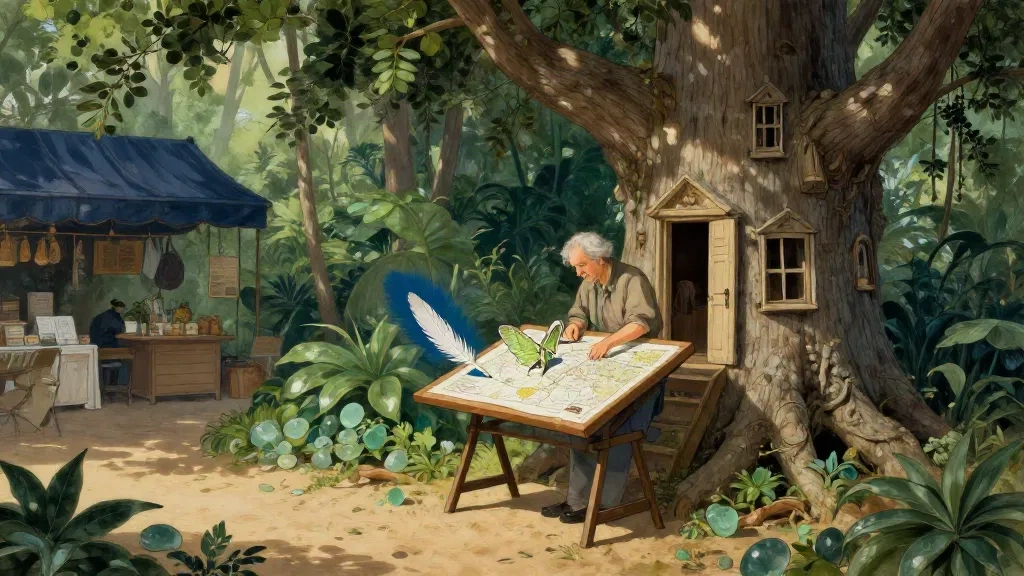
At the center of the glasshouse grew a tree with doors in its bark.
They appeared in winter as thin blue seams, opened in summer into small golden mouths, and vanished whenever the gardeners tried to name their destinations. Some opened onto beaches buried beneath black sand. Others revealed rooms where snow fell upward. One, Mara Venn knew, opened onto the village where she had been a girl, though the village had drowned before she learned to write.
Mara was a retired cartographer. Her hands still moved with the old certainty, drawing coastlines and roads from memory. Since the tree had begun growing doors, she had spent her days making maps of places that no longer existed. A vanished orchard. A railway station swallowed by a lake. The last house on a street erased by a new road. She entered the doorways and returned with measurements, remembering what could no longer be seen.
Her desire was simple: to make a place where lost things could rest.
Not ghosts. Not relics. Lost things: the smell of bread from a demolished bakery, the tune a mother sang before the war, the exact color of a vanished door. Mara believed the tree could keep them if she drew the boundaries correctly.
The Market Beneath the Cobalt Awning
On the eastern side of the garden, beneath a cobalt awning stitched with silver thread, a market opened only during the hour before dusk.
Stalls displayed ordinary treasures: amber marbles, sealed letters, buttons polished by vanished hands. A woman sold a key that opened the door to her childhood bedroom. A boy offered a feather so white it seemed to bleach the air around it. He said it had fallen from a bird that existed for only one morning.
Mara disliked the market because nothing there was cheap.
The merchant at the final stall was a tall man with sand-colored gloves. His table held a single empty cloth.
“Everything expensive is true,” he said. “That is the rule.”
He placed a moth wing on the cloth. It was the size of a leaf, seaglass green, patterned with pale eyes.
“The wing of the first moth drawn from a map,” he said. “It remembers a forest that never existed.”
“How much?”
“The truth of a place you have omitted.”
Mara touched the wing. The garden vanished behind it. She saw a red house at the edge of an autumn field, a road she had deliberately erased from every map because no traveler had returned from it. Inside the house, someone was waiting.
The merchant raised the price.
“Give me the door your mother closed.”
Mara withdrew her hand. The vision disappeared.
A Map Without a Return
She began working at sunset, before the doors opened. She drew a sanctuary in the clearing beneath the tree: a low stone shelter, a shallow basin, one bench facing west. She placed within it the names of places she knew only from other people’s grief.
The map resisted her. Lines blurred where she had intended clarity. A moth wing landed on the paper, flattening itself against the coast of a vanished lake. A white feather drifted down and pointed toward the tree.
When Mara looked up, a new door had opened in the trunk.
Beyond it was not a lost place. It was the garden itself, seen from above, with every path leading back to the same empty center.
“You are drawing a room without an exit,” said the merchant behind her. He had followed without appearing on any road. “That is how false histories begin.”
Mara understood then what the market had been selling. Not truth, but the privilege of deciding which truth others must carry. The expensive things were always true because someone else had paid for their weight.
She drew a door in the sanctuary map. Not to any place she remembered, but to a threshold that had never existed.
The Room That Refused to Close
The tree opened.
Inside was a white room filled with unfinished weather. Rain hung above the floor. Snow drifted beneath the ceiling. A blue shadow moved along the walls, carrying the moth wing and the white feather in its hands.
Mara stepped inside.
The lost things came forward: a child’s abandoned name, a battlefield’s last bell, the green hill behind a house she had burned down. Each asked to be kept. Each asked to be remembered instead.
She could not save them by preserving them exactly. The past had already altered them. She could only give them shelter without turning them into copies.
So she drew the sanctuary larger than the tree, larger than the garden, with doors opening onto all directions. She made room for absence itself.
At dawn, the market had vanished. The tree stood bare, its bark smooth except for one small cobalt seam.
Mara placed the moth wing beneath it. The white feather rested beside it, untouched by wind.
Then she opened her map. Across the blank center, a final door appeared, leading nowhere she could name. Mara smiled. For the first time in years, she had drawn a place that did not ask to be found.





