 Netwrck
Magical Realism.
The Door That Would Not Open
Mara Venn arrived at the Meridian Garden with a brass case, a notebook, and a map so old its folds had become translucent. She had been paid to interpret the dreams of sleeping machines: weather engines dreaming of drought, seed sorters dreaming of birds, the great clock at the garden’s northern wall dreaming the same minute over and over. Her employer, a quiet man named Pell, believed machinery dreamed because it was tired.
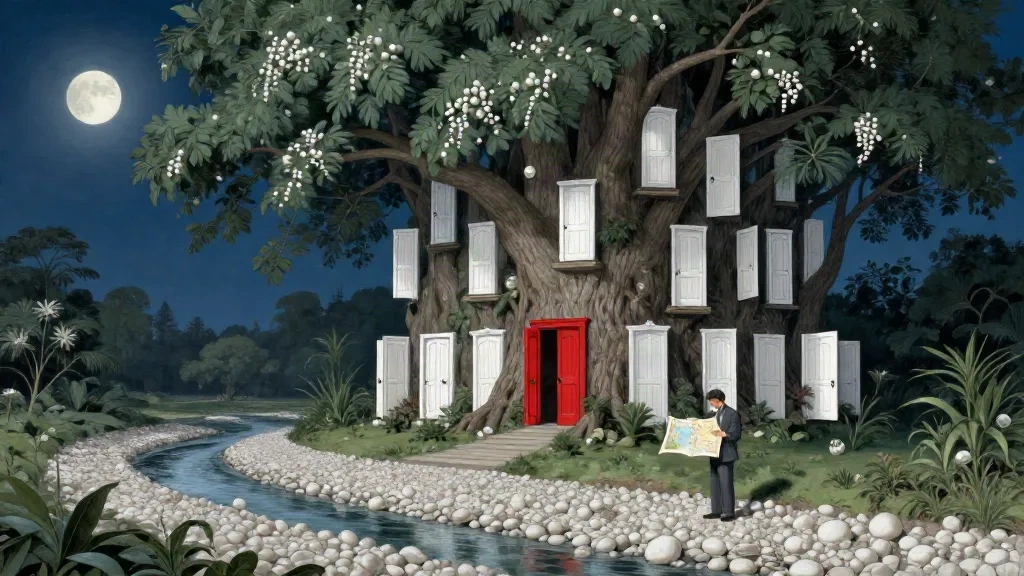
Beyond the glasshouses, an enormous tree grew doors instead of branches. They emerged pale as bone from the trunk, each with a different number of hinges. Most led to potting sheds, rain rooms, or locked cabinets. One was unmarked and opened onto a dry riverbed filled with smooth white stones.
Mara’s task was simple. Her desire was not.
She had inherited the map from her father, and its pale blue rivers stopped at the garden walls. She wanted to finish it before winter. She wanted lines that showed where the hidden water went, where seeds slept before becoming trees, where her family had lived before the river changed course. Above all, she wanted a map better than the one she had received: truthful, legible, free of the blank spaces everyone else had used for inconvenient truths.
What the Machines Remembered
On her third night, Mara translated a tiny irrigation pump. It dreamed in fragments: silver roots, blue stone, a red door, three voices at a dry crossing. The last fragment was a voice she knew.
It belonged to her sister, Iona, who had not spoken to Mara in eleven years.
They had grown up beside the old Venn channel, now a dry riverbed running through the eastern gardens. Their father had promised to divide the family orchard between them. Iona remembered him saying the eastern half was hers. Mara remembered him saying the western half was hers. Their mother remembered nothing about land at all; she said the promise had been made at the crossing, before the flood, and that words spoken there belonged to the river.
When the flood came, the orchard vanished beneath mud. Their father died with the map in his hands. Iona moved north. Mara came here.
Mara marked the pump’s dream in her notebook, then crossed out the name of the crossing. The machines did not make that distinction. Machines remembered pressure, rhythm, the temperature of a hand on a valve. They did not divide memory into ownership.
Three Versions of the Orchard
The unmarked door appeared in the tree that week, low to the ground and fitted with no handle. Mara opened it with a trowel. Beyond it waited the dry riverbed, its stones arranged in lines as deliberate as handwriting.
Pell followed her into the garden. In his hands he carried three maps. One was the original, inherited by Mara. One had been sent by Iona. The third was drawn by their mother during her final year, when her memory had begun to come apart like paper.
Each map showed a different orchard.
On the original, both sisters owned everything. On Iona’s map, the eastern half glowed red. On their mother’s map, no orchard existed at all. In its place was a single door, painted red beneath a midnight-blue sky.
“Which one do you believe?” Pell asked.
“That depends on whether I’m mapping land or memory.”
“Then map both. But remember that a map is an argument.”
That night, the sleeping machines began dreaming together. Their voices passed through the underground pipes and gathered beneath Mara’s room: the splash of floodwater, the crack of a branch, Iona shouting from the wrong side of the channel. The red door appeared in every dream.
Mara understood then that the garden had been planted with a family’s mistake. Every promise became a seed. Every disputed memory became a root. The tree did not decide who was right. It grew the version that kept the wound open.
A Better Map
At dawn, Mara took a red brush from the toolroom and painted the door at the crossing. It stood on the new map alone, a bright hinge in the white riverbed. She drew no orchard, no boundary, no arrow pointing toward ownership.
Pell found her packing her case. “You could stay,” he said. “The machines need translating.”
“They do,” Mara agreed. “But they do not need me to choose which family member is right.”
She sent Iona the map before she left. The letter contained no apology. It contained only the red door, the unfinished channel, and a note in precise black ink: Here is where we promised. Here is what remains.
On the train, Mara watched the garden disappear behind pearl-colored smoke. When the unmarked door appeared in the carriage wall, she did not open it. Some doors were not meant for escape. Some were meant to show you the shape of the road you had chosen.
Years later, she translated a machine dreaming of rain. It showed a dry riverbed, a red door, and two maps laid over one another. The water rose at last, carrying both routes toward the same unnamed sea.





