 Netwrck
Mystery.
The Courtyard of Small Graves
Inez Bell was paid to keep the mountain tidy, not to ask why the old observatory had three hundred windows and no door. Every Tuesday she climbed from the municipal nursery with a wheelbarrow of thorn cuttings, ash-grey herbs, and stories gathered from families who had forgotten where they came from.
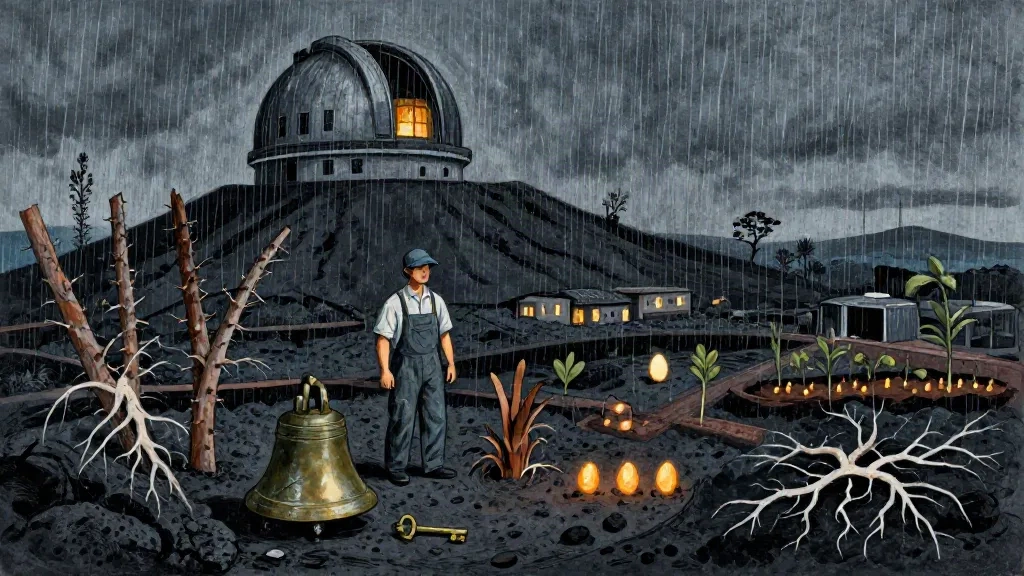
Her work was simple. In neglected courtyards, she planted a story beside a plant that needed it. A grandmother’s memory went under rosemary. A drowned fisherman’s laugh rooted in winter thyme. In the courtyard behind the shuttered tram depot, she planted the story of a woman named Elian who had vanished during the eruption of 1891, leaving behind one cracked bell and no explanation.
That was the story Inez intended to turn into a shelter. Her own sister, Mara, had slept in doorways since their mother’s death. If a story could keep a body from freezing, Inez thought, it could keep a person from becoming invisible. She cleared the courtyard’s volcanic gravel, dug a narrow trench, and placed the bell at its center.
Under the bell lay a brass key, green with age but warm to the touch.
That night the mountain dreamed. A low vibration rose through the courtyard, and one amber window appeared high on the observatory’s eastern face.
The Machine Against Belief
The next morning, Inez found a door beneath the bell.
It had no handle. A brass plate bore an inscription: THE GARDEN OF UNBELIEVED THINGS. When she said the words aloud, the key turned by itself.
Inside was a machine built from copper pipes, black glass, and seed-shaped chambers. Its display read: 531 SHELTERS REQUIRED. NO WITNESS PERMITTED.
A ledger on the wall explained the rest. The machine turned forgotten stories into physical shelter, but it could not function amid belief. One sincere thought that a story was true, one witness who expected the impossible, and the walls collapsed.
Inez understood then why nobody had used it. A shelter built from doubt required an entire community to agree not to believe in it. Elian’s story was already known. The bell had been rung once, perhaps by someone who had searched for her. It could not carry the burden of shelter now.
So Inez made a new story from the facts no one had checked. She planted a tale of a courier who climbed the mountain carrying a lantern, vanished into the volcano, and returned every winter with a seed from the other side. She buried the story beneath the bell and told no one.
The machine began to turn.
What the Mountain Refused
By the third night, the courtyard had become a shelter without walls. Travelers slept beneath an umbrella of rain-silver air. A woman with a fever found a dry bench. Two children drew maps of rooms that were not yet there.
But the machine showed cracks in its copper ribs. Each person who woke inside the shelter began doubting it. One said the floor was only packed ash. Another called the roof a trick of the storm. In the morning, the shelter had folded into a heap of wet gravel.
Inez read the ledger’s final line: A FAMILY STORY MAY NOT BE GIVEN TO STRANGERS UNLESS IT HAS BEEN RELEASED.
She understood the cost. To free Elian’s story, she had to surrender the last certainty that her sister was worth searching for. Mara had loved the vanished woman, or perhaps the story had been passed down until love was indistinguishable from inheritance. Inez had planted it because it was the only family history she still had.
At dusk she carried the cracked bell to the railway platform. She rang it once, then broke it against the rail. The sound traveled down the valley, thin and unmistakable.
“Elian was not a courier,” Inez told the arriving passengers. “She was afraid. She climbed here to disappear from a debt, and the mountain kept the debt instead of the woman.”
No one believed her. That was the beginning.
The Amber Window
By midnight, strangers were repeating the story to strangers. Some added that Elian had planted white flowers on the crater rim. Some said she lived in the observatory, tending a garden beneath the sleeping mountain. The machine listened to every denial and every invention. It fed on the space between what they knew and what they feared.
At dawn, the courtyard rose again.
The shelter had no locked doors, only deep eaves, dry sand, and a low stone bench warm beneath the rain. Mara arrived last, carrying a lantern and refusing to look at Inez.
“I heard the bell,” she said.
“It was cracked.”
“Most true things are.”
The machine sank beneath the earth, leaving only the brass key in the soil. By day, the observatory showed a single amber window. Travelers claimed they saw a gardener moving behind the glass, planting stories in the dark.
Inez left the key where it lay. A shelter that needed belief would belong to no one. This one asked only for doubt, welcome, and a place to set down one’s burden.
That was enough.





